








 CoinDesk
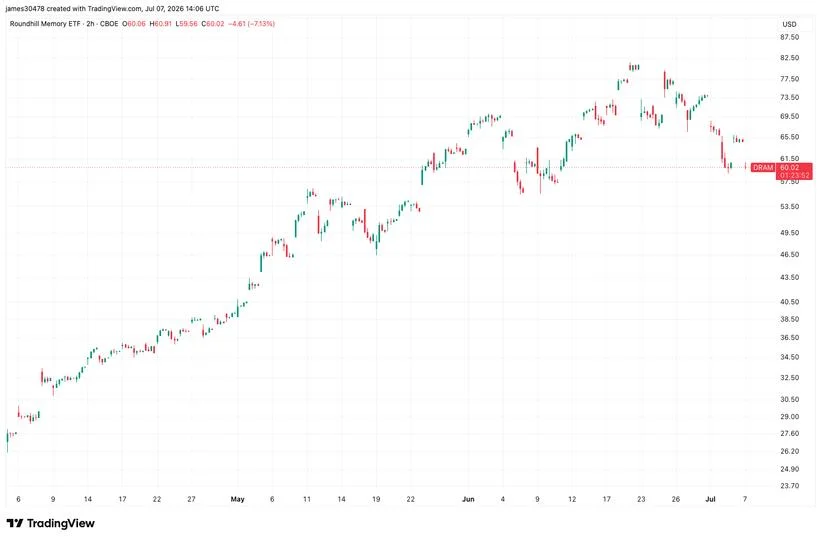



Semiconductor and memory stocks slid sharply this week as Samsung Electronics posted record second-quarter profit yet watched shares fall nearly 7%, and SK Hynix drifted further from its all-time high ahead of its U.S. listing. Micron and Sandisk came under heavy pressure in sympathy, and the selloff is being read as a reality check on an AI infrastructure trade that has driven the market for over a year.
Why it matters
The gap between earnings and price action is the tell. Samsung delivered its strongest quarterly result on record and still could not lift the stock, while SK Hynix trades 25% below its peak just days before a landmark U.S. listing. Both signal that expectations for AI-linked chipmakers have run ahead of what hyperscaler spending can deliver, especially as Chinese entrants like Zhipu AI build custom silicon for cheaper open-source models. The narrative is shifting from "more GPUs, more memory" to "more efficient models, less infrastructure".
Market impact
For crypto, the rotation math is direct. Bitcoin and digital assets have been a funding source for the AI trade over the past year, and a fading AI bid removes the marginal buyer of chip and memory names. Stablecoin market cap falling to $312B in June, its largest monthly drop since TerraUSD, sits alongside the chip weakness, while tokenized equity volumes surged 145% to a record $3.86B in the same period. If AI enthusiasm continues to cool, the capital that needs a home could rotate back into digital assets, where valuations have already reset and capital expenditure assumptions are far less frothy.

Frequently asked questions
-
Why are AI chip stocks falling despite record earnings from Samsung?
Samsung posted record second-quarter profit yet shares fell nearly 7%, a gap that signals expectations for AI-linked chipmakers have outrun what hyperscaler spending can deliver. Investors are increasingly pricing in a slower next phase of AI infrastructure investment.
-
How does the AI trade slowdown affect crypto markets?
Bitcoin and digital assets have been a funding source for the AI trade over the past year. If AI enthusiasm continues to fade, capital that needs a home could rotate back into digital assets where valuations have already reset.
-
What is Zhipu AI's role in challenging US chip dominance?
Zhipu AI, one of China's leading AI startups, is exploring a custom AI chip to support demand for its open-source GLM models. The move highlights the rise of lower-cost AI ecosystems built around domestic hardware rather than cutting-edge US chips.
-
How big was the stablecoin market drop in June?
Stablecoin market cap fell to $312B in June, marking its largest monthly drop since the TerraUSD collapse. In the same period, tokenized equity volumes surged 145% to a record $3.86B.
-
What happens to crypto valuations if AI infrastructure spending slows?
A slowdown in AI infrastructure spending would remove a major marginal buyer from chip and memory names. Capital that rotates out would likely seek alternative risk assets, and crypto, already reset on valuations and spending assumptions, is a natural candidate.
 Whale Alert
 WuBlockchain
 TheBlock
 CoinTelegraph