


 CryptoSlate

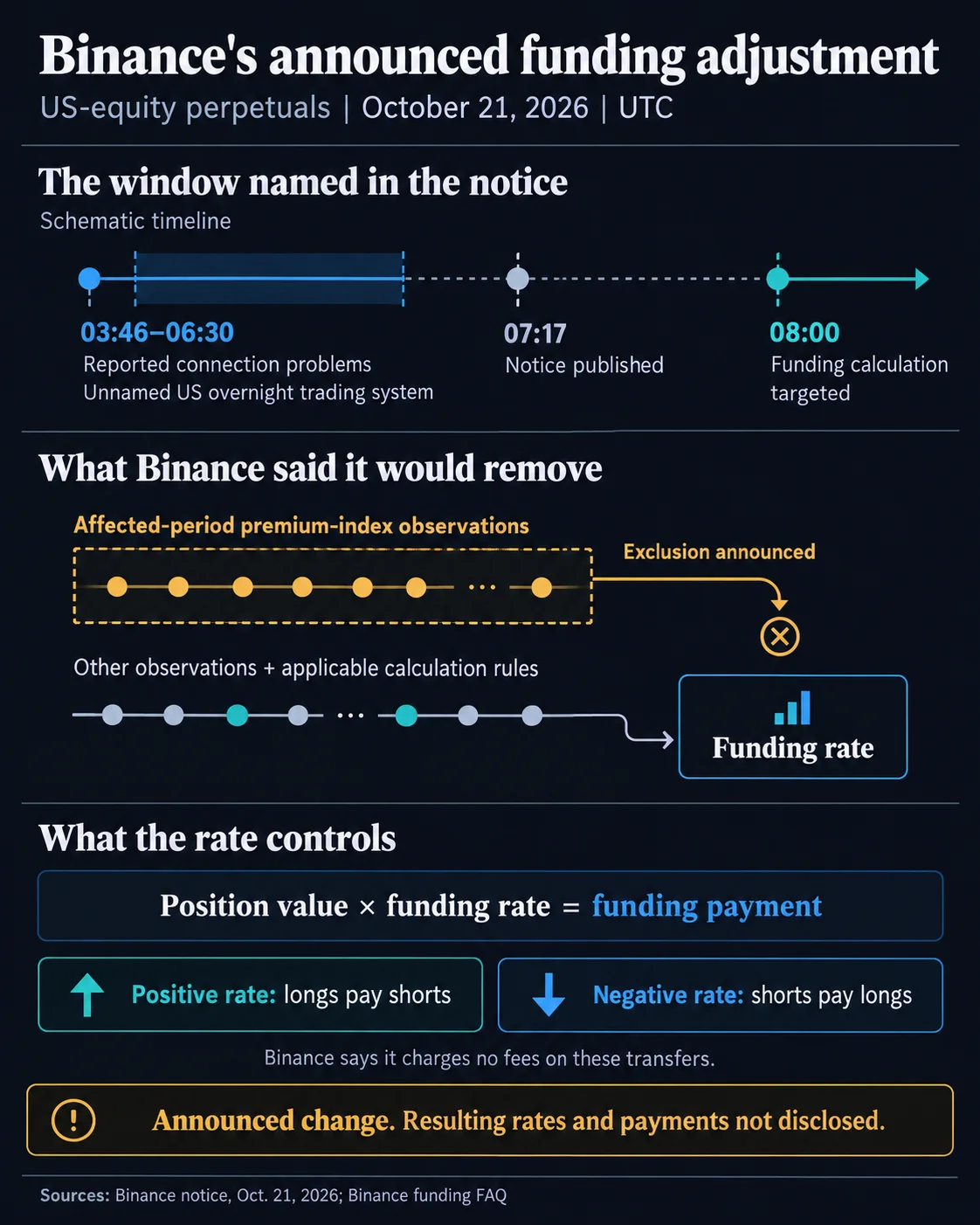
Binance announced it would exclude premium-index observations affected by an overnight connectivity problem from its October 21 funding-rate calculation for US-equity perpetual futures. The disruption ran from 03:46 to 06:30 UTC at an unnamed US overnight alternative trading system, and the adjusted 08:00 UTC calculation covered all TradFi perpetuals with US equities as their underlying assets.
Funding on Binance's perpetual futures is a periodic cash transfer between opposing position holders. When the funding rate is positive, longs pay shorts; when negative, shorts pay longs. The rate is derived in part from a premium index that compares futures order-book prices against a reference price index, averaged across the funding period. Removing the affected observations changes that input set, which in turn changes the resulting rate, but Binance stopped short of committing to cancel or compensate any resulting payment.
The exchange disclosed no final funding rates, payment totals, or customer-impact figures in its notice. The adjustment is also distinct from the mark-price and stock-token collateral mechanics that govern how positions and account assets are valued, a separate layer of the exchange's TradFi perpetuals framework.
The incident highlights the structural tension in offering around-the-clock equity derivatives: when the underlying market is closed or disrupted, exchanges must fall back on vendor reference prices and order-book-derived inputs, each carrying its own data-quality risk.
Frequently asked questions
-
What caused Binance to adjust its October 21 funding calculation?
An intermittent connectivity problem at an unnamed US overnight alternative trading system between 03:46 and 06:30 UTC disrupted premium-index data. Binance excluded those affected observations from the 08:00 UTC funding-rate calculation for all US-equity TradFi perpetuals.
-
Does the data exclusion mean affected traders will not pay or receive funding?
Not necessarily. Binance's adjustment changes the inputs used to calculate the funding rate, but the exchange made no commitment to cancel resulting payments or compensate traders for any difference.
-
How does Binance's perpetual funding mechanism actually work?
Funding is a periodic cash transfer between holders of long and short perpetual positions. When the rate is positive, longs pay shorts; when negative, shorts pay longs. The rate is derived partly from a premium index that averages futures order-book prices against a reference price over the funding period.
-
Is this adjustment related to how Binance values stock-token collateral?
No. The adjustment concerns only the premium-index inputs used to calculate periodic funding transfers between opposing traders. Collateral valuation and mark-price mechanics are separate layers of Binance's TradFi perpetuals framework and were not affected.
-
Why is overnight data quality a recurring risk for equity perpetual futures?
Around-the-clock equity derivatives must rely on vendor reference prices and order-book-derived inputs when traditional markets are closed. If those data sources are disrupted, the resulting funding calculations can reflect inaccurate market conditions, as this incident illustrated.
 WatcherGuru
 Crypto News
 WuBlockchain
 Crypto Rank News
 Whale Alert
 Lookonchain
 CoinTelegraph