








 CryptoSlate

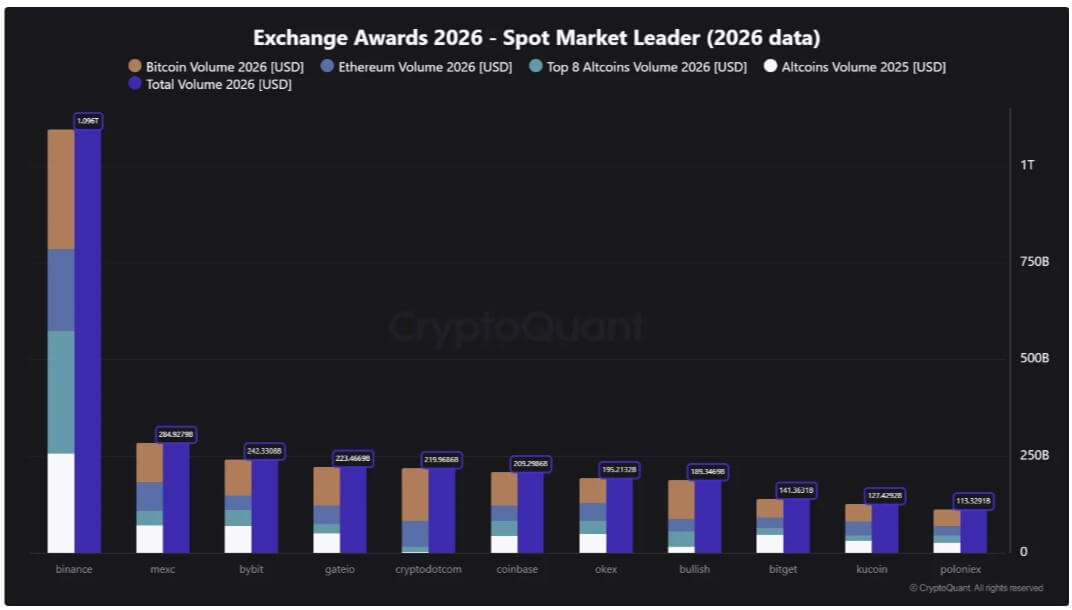
Crypto trading has stopped spreading across hundreds of platforms and is now pooling inside a handful of large exchanges that increasingly act as banks, brokers, custodians and lenders at the same time. Binance alone cleared $1.09 trillion in volume across the first 112 days of 2026, dwarfing the next-largest venues — MEXC at $284.9B, Bybit at $242.3B, Crypto.com at $219.9B, Coinbase at $209.3B and OKX at $195.2B, according to CryptoQuant data cited in a new Financial Stability Institute paper from the Bank for International Settlements. The BIS estimates the top 10 exchanges now handle roughly 90% of global centralized spot volume, with Binance sitting near 39% on its own.
Why it matters
The FSI paper labels these firms "multifunction cryptoasset intermediaries," or MCIs — platforms that combine trading, custody, staking, lending, derivatives and yield products under one roof, the way a traditional bank, broker, exchange and custodian would each sit in separate regulatory lanes. The top five MCIs collectively serve an estimated 200M–230M users, with 20M–34M using staking or earn products that turn idle balances into unsecured credit exposure to the venue itself. Celsius and FTX are cited as the proof-of-concept failures of exactly that model, only smaller than the platforms dominating liquidity today.
Market impact
The concentration is also a market-structure problem, not just a consumer-protection one. When leverage, collateral and automated liquidation engines all sit on the same venues that dominate spot liquidity, a macro shock can become a system-wide deleveraging event within minutes — the BIS points to the October 2025 flash crash, which triggered roughly $19B in forced liquidations across 1.6M traders, as a live demonstration. The paper's prescription is bank-style prudential rules — capital and liquidity buffers, stress testing, customer-asset segregation, and resolution planning — applied to MCIs, with a mix of entity-based and activity-based oversight. As TradFi linkages deepen through spot ETFs, institutional custody, stablecoin reserves and brokerage rails, the FSI warns that a disruption at a major venue would not stay inside crypto.



Frequently asked questions
-
What did the BIS actually say about crypto exchanges?
A new Financial Stability Institute paper from the Bank for International Settlements warned that large crypto platforms have evolved into "multifunction cryptoasset intermediaries" — venues combining trading, custody, lending, derivatives, staking and yield products under one roof, without the prudential rules that…
-
How concentrated is crypto trading right now?
According to CryptoQuant data cited in the BIS paper, Binance cleared $1.09T in volume in the first 112 days of 2026. The top 10 centralized exchanges handle roughly 90% of global spot volume, with Binance alone near 39%. The next tier — MEXC, Bybit, Crypto.com, Coinbase and OKX — trails by a wide margin.
-
Why is yield-earning on exchanges a risk?
BIS researchers say that when customers deposit assets into staking or earn products, they can end up holding an unsecured claim on the platform rather than ownership of specific assets. If the venue fails, customers rank alongside other creditors — with no deposit insurance or central bank backstop behind them.
-
What historical failures does the BIS reference?
The paper cites Celsius Network, whose yield model collapsed when withdrawals hit in 2022, and FTX, where customer assets became entangled with affiliated trading activity. Both are presented as structural previews of the risk pattern now visible at today's larger venues.
-
What is the BIS recommending regulators do?
The paper calls for bank-style prudential rules applied to large crypto intermediaries: capital and liquidity buffers, stress testing, customer-asset segregation and formal resolution planning. It also recommends a mix of entity-based oversight of the platform as a whole and activity-based rules for specific services…
 Whale Alert
 Altcoin Daily
 WuBlockchain
 CoinDesk
 Crypto News