


 CryptoSlate
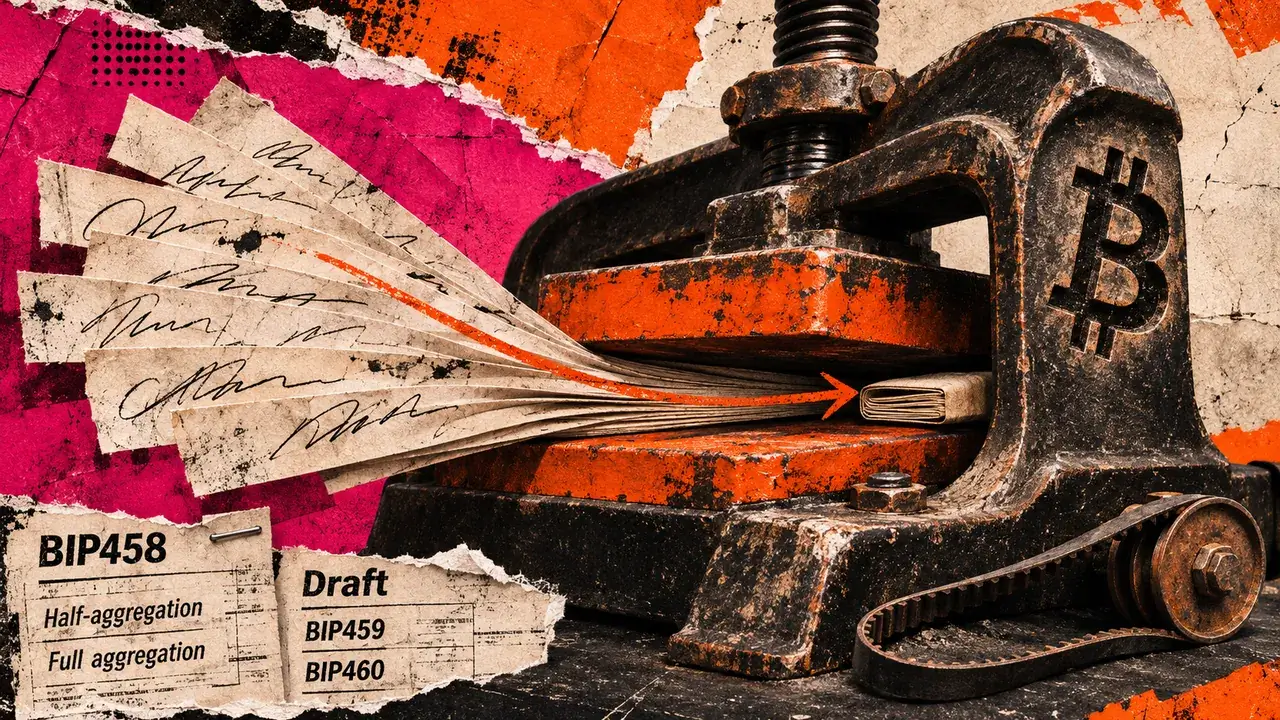

Bitcoin developers merged three draft proposals on November 2–4 that would combine transaction input signatures to reduce the space they occupy. In modeled transactions, full aggregation cuts fees by 14.2% for a joint payment and 27.3% for a consolidation. The proposals are not yet activated.
Why it matters
BIP458, BIP459 and BIP460 describe mechanisms for combining signatures from eligible inputs. Half-aggregation combines independently produced signatures without a joint signing session. Full aggregation requires coordinated signing but produces one 64-byte signature for each aggregation group.
For 10 signatures, the payload falls from 640 bytes to 352 bytes with half-aggregation or 64 bytes with full aggregation, before encoding overhead. The reduction in the fee for a whole transaction is smaller because other transaction data remains.
Wallets would need to support a new output type: existing Taproot outputs would not automatically gain aggregation. Script-path spends cannot join aggregation groups, and eligible inputs can opt out. Full aggregation also requires a two-round signing protocol, with careful handling of secret nonces because reuse can expose signing keys.
Market impact
In the modeled 10-input, 10-output joint payment, half-aggregation reduces the fee by about 7.1%, while full aggregation cuts it by 14.2%. For a 100-input consolidation into one output, the respective savings are about 13.6% and 27.3%.
Those examples assume all inputs are in one eligible group and use specified transaction settings. BIP460 leaves activation parameters unspecified, and its proposed witness version needs coordination with other proposals. The potential savings therefore depend on implementation and wallet support.

Frequently asked questions
-
How much could the proposals reduce fees for a joint Bitcoin payment?
In a modeled payment with 10 inputs and 10 outputs, half-aggregation reduces the fee by about 7.1% and full aggregation by 14.2%.
-
Why are modeled consolidation savings larger?
The consolidation example combines 100 inputs into one output. Full aggregation cuts its modeled fee by approximately 27.3%, while half-aggregation cuts it by 13.6%.
-
What is the difference between half-aggregation and full aggregation?
Half-aggregation combines independently produced signatures without a joint signing session. Full aggregation requires coordinated signing and produces one 64-byte signature per group.
-
Will existing Taproot outputs automatically get lower fees?
No. Wallets would need to support a new output type, and existing Taproot outputs would not automatically gain aggregation.
-
What must happen before Bitcoin users can benefit?
The proposals need implementation and wallet support. BIP460 leaves activation parameters unspecified, and its proposed witness version needs coordination with other proposals.
 TheBlock
 Crypto News
 WatcherGuru
 CoinTelegraph
 Crypto Rank News
 WuBlockchain
 CoinDesk
 Benjamin Cowen