








 CoinDesk
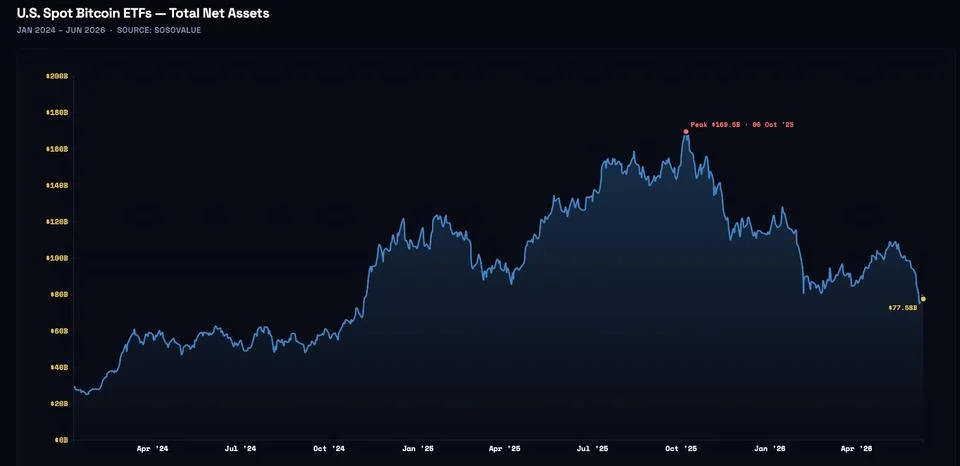



Net assets across the eleven U.S.-listed spot Bitcoin ETFs stood at $77.58 billion on June 9 — the same level seen just days after Donald Trump's November 2024 election victory. The round trip is stark: total assets crossed $90 billion within a week of that win and went on to hit a record $169.54 billion in October 2025, only to give all of it back even as the SEC dropped major enforcement actions, the U.S. established a strategic Bitcoin reserve, and the Digital Asset Market Clarity Act advanced through Congress.
Why it matters
The regulatory backdrop has never been more favorable for crypto, yet capital has left anyway. Cumulative net inflows since inception peaked at $62.77 billion in October 2025 and have since dropped by nearly $9 billion to $53.77 billion — the lowest reading since August 2024. Analysts at Binance Research told CoinDesk the outflows reflect short-term pressure as inflation pushes the Fed hawkish, "while on-chain supply tightening remains intact." Former 21Shares co-founder Ophelia Snyder added that competing narratives — AI, SpaceX, other high-profile growth stories — are draining attention and capital from crypto, with geopolitics, the Strait of Hormuz, U.S. jobs data, and broader macro uncertainty compounding the jitters.
Market impact
The ETFs have registered a net outflow of over $5 billion in just four weeks. Lekker Capital CIO Quinn Thompson separately flagged Bitcoin's growing divergence from tech stocks as AI spending surges, citing DAT issues, Strategy's STRC preferred shares, and quantum computing concerns. The structural setup — friendliest U.S. regulatory regime on record, yet ETF assets back to a 19-month floor — makes the next macro print (CPI, jobs, any Fed-speak) the dominant near-term driver of flows.

Frequently asked questions
-
Why are spot Bitcoin ETF assets back to post-election levels?
Net assets across the eleven U.S. spot Bitcoin ETFs stood at $77.58 billion on June 9 — the same level seen just after Trump's November 2024 election win, despite a record high of $169.54 billion in October 2025.
-
How much have spot Bitcoin ETFs lost recently?
The eleven U.S.-listed spot Bitcoin ETFs registered a net outflow of over $5 billion in just four weeks, with cumulative net inflows since inception falling by nearly $9 billion to $53.77 billion.
-
What are analysts blaming for the Bitcoin ETF outflows?
Binance Research cited short-term pressure from inflation pushing the Fed hawkish. Former 21Shares co-founder Ophelia Snyder said competing narratives like AI and SpaceX are draining capital and attention from crypto.
-
Has the U.S. regulatory environment actually improved for Bitcoin?
Yes — the SEC has dropped several high-profile enforcement actions, the U.S. established a strategic Bitcoin reserve, and the Digital Asset Market Clarity Act is advancing in Congress to clarify SEC and CFTC jurisdiction.
-
What is the lowest cumulative inflow figure for spot Bitcoin ETFs since?
Cumulative net inflows since inception now stand at $53.77 billion, the lowest reading since August 2024, down from a peak of $62.77 billion hit in October 2025 alongside Bitcoin's all-time high.
 WuBlockchain
 CoinTelegraph
 CryptoSlate
 Lookonchain
 WatcherGuru