








 CryptoSlate



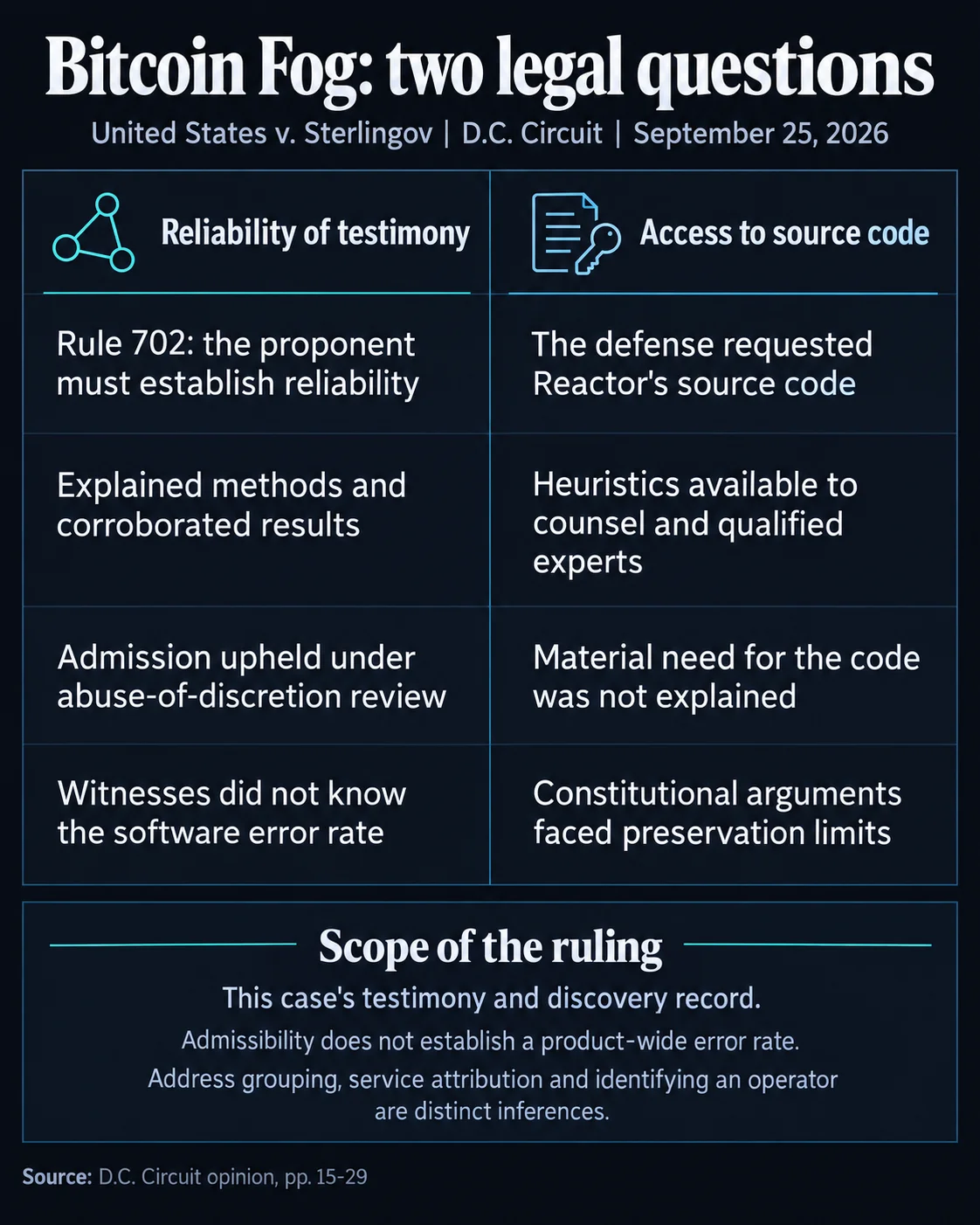
The D.C. Circuit upheld Roman Sterlingov’s convictions and 150-month sentence for operating Bitcoin Fog, a bitcoin-mixing service, on September 25. The appeals court allowed expert testimony using Chainalysis Reactor, which witnesses said clustered and attributed more than 900,000 Bitcoin addresses to the service. Sterlingov’s bid for Reactor’s source code failed because he did not establish its material connection to his defense and because of how the objections were preserved.
The court considered whether the tracing testimony met Federal Rule of Evidence 702, including whether its methods were reliable and reliably applied. The witnesses acknowledged Reactor had not been peer-reviewed and that they did not know its error rate. The court pointed to other reliability markers, including the witnesses’ experience, explanations of the methods, comparisons with information obtained through legal processes, and corroborating evidence.
Two checks in the opinion have narrower meanings than a product-wide accuracy claim. Reactor matched four of five known Bitcoin Fog addresses used in undercover transactions; the court accepted the trial court’s explanation that the software was conservative and underinclusive in this case. A separate-case check found correct clustering and attribution for 99.9% of a group of addresses, but the opinion did not provide a complete public sampling design. That figure is not a product-wide error rate.
Why it matters
The decision draws a line between access to a tool’s source code and access to the methods behind its conclusions. Sterlingov’s counsel and qualified experts could inspect Reactor’s heuristics and assumptions under a protective order, while his personal access was restricted. The appeals court noted that the trial judge had asked why the code was material and had been willing to provide it if a need was justified.
The court also distinguished the attribution of addresses to a service from proof of who owns funds held by those addresses. Separate evidence in the case included IP-overlap analysis, financial records, and Sterlingov’s earlier activity concerning mixers and darknet promotion. The ruling addresses the admissibility of expert testimony on this record; it does not make every address-clustering inference equivalent to proof of personal ownership.
Market impact
For blockchain analytics firms and investigators, the opinion supports the use of explained, corroborated proprietary tracing in court, without establishing a universal accuracy benchmark for Reactor.

Frequently asked questions
-
Why did the appeals court reject Sterlingov’s request for Reactor’s source code?
The court said Sterlingov had not explained the code’s material connection to his defense. His counsel and qualified experts could inspect Reactor’s heuristics and assumptions under a protective order.
-
What did Reactor’s check of five Bitcoin Fog addresses show?
Reactor’s Bitcoin Fog cluster contained four of the five known addresses used in undercover transactions. The court accepted the explanation that the software was conservative and underinclusive in this case.
-
Does the 99.9% result establish Reactor’s overall error rate?
No. The 99.9% figure concerned a group of addresses checked in a separate case, and the opinion did not provide a complete public sampling design.
-
What reliability concerns about Reactor did witnesses acknowledge?
Witnesses acknowledged that Reactor had not been peer-reviewed and that they did not know its error rate. The court cited other indicators, including explained methods, expert experience, and corroboration.
-
Does attributing addresses to Bitcoin Fog prove who owned the funds?
No. The opinion distinguishes identifying addresses associated with a service from proving who owned funds held there or who operated the service. The prosecution also presented other evidence in Sterlingov’s case.
 CoinDesk
 Crypto News
 TheBlock
 WatcherGuru
 Lookonchain
 Altcoin Daily