








 CoinDesk

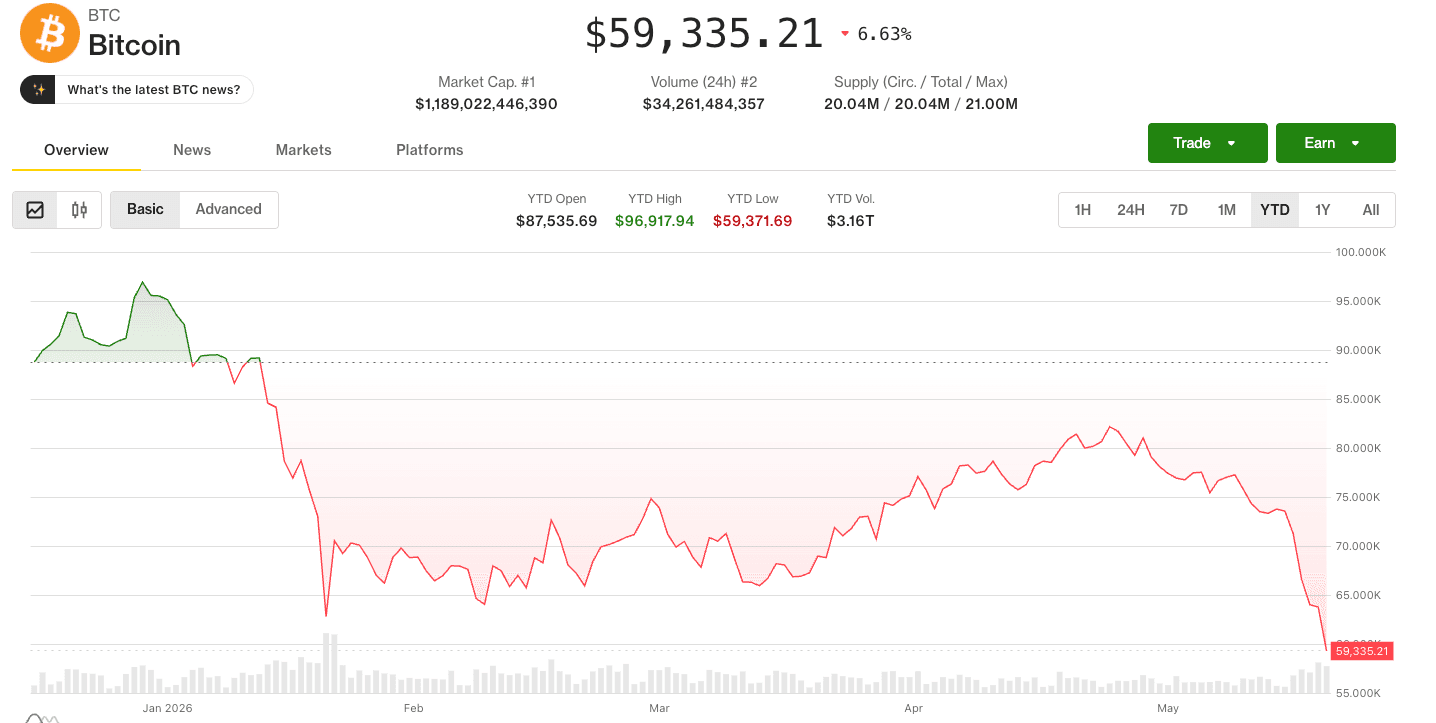


Bitcoin dropped below $60,000 this week, shedding roughly 17% of its value and wiping out about $200 billion in market capitalization in seven days — the worst weekly performance since July 2024. The slide left the largest digital asset down about 27% over the past month and more than 50% below its Oct. 6 all-time high, according to CoinDesk data.
Why it matters
Hardcore bitcoin purists, from Mati Greenspan to Strategy (MSTR) Chairman Michael Saylor, frame the drawdown as a capital rotation rather than a structural break. "Bitcoin is not facing a bitcoin problem. It's facing a liquidity problem," Greenspan told CoinDesk, arguing that AI has become the dominant destination for speculative capital. Saylor put numbers on the shift on X: "Capital markets are funding the AI buildout at historic scale: ~$400B over six months," adding that the ~$4B in spot bitcoin ETF outflows since May 14 represent a rotation, "not a bitcoin impairment."
Greenspan points to the Anthropic IPO targeting a roughly $1 trillion valuation, plus the anticipated OpenAI, Anthropic and SpaceX listings that could collectively raise more than $200B, as evidence of where the marginal dollar is going. Bitcoin core developer Jameson Lopp echoed the diagnosis on X: "I suspect the root cause is the bear market, combined with TradFi markets experiencing an AI boom."
Market impact
The cross-currents are real. U.S. spot bitcoin ETFs logged $3.45 billion in outflows across 11 consecutive sessions, AI equities remain among the market's strongest performers, and Strategy's late-May sale of 32 BTC — its first in four years, used to fund STRC dividend payments — rattled sentiment even though Greenspan called it "not even a rounding error" against the company's 843,000-BTC balance sheet.
Greenspan warned the trade may not reverse cleanly. "If AI sentiment cracks, bitcoin could get hit twice: first from liquidity leaving crypto, and then again from a broader risk-off move across markets." Strike CEO Jack Mallers sidestepped the macro debate and told followers to buy the dip.

Frequently asked questions
-
How much has bitcoin lost in the recent crash?
Bitcoin shed roughly 17% in a week, wiping out about $200 billion in market capitalization, according to CoinDesk data. The asset is now below $60,000, down ~27% on the month and more than 50% from its Oct. 6 all-time high.
-
Why are bitcoin purists not panicking about the drop?
Maximalists including Mati Greenspan, Michael Saylor and Jameson Lopp argue the selloff reflects speculative capital rotating into AI infrastructure, not a structural loss of faith. Saylor pegged AI capex at roughly $400 billion over six months against ~$4 billion in spot BTC ETF outflows.
-
How much have spot bitcoin ETFs shed during the slump?
U.S. spot bitcoin ETFs logged $3.45 billion in net outflows across 11 consecutive sessions, the longest such streak on record, pressuring BTC while AI equities held among the market's strongest performers.
-
Did Strategy's small BTC sale damage market confidence?
Strategy sold 32 BTC for $2.5 million in late May — its first sale in four years — to fund STRC dividend payments. Greenspan called the move "not even a rounding error" against an 843,000-BTC balance sheet, but AdLunam's Jason Fernandes said the psychological shock added to broader pressure.
-
Could a reversal in AI sentiment help bitcoin?
Greenspan warned the unwind may not cleanly benefit crypto. If AI sentiment cracks, bitcoin could get hit twice: first from liquidity already leaving crypto, then again from a broader risk-off move across markets. The next leg likely depends on whether AI capex appetite holds or rolls over.
 Crypto News
 WatcherGuru
 Benjamin Cowen
 Glassnode
 CryptoSlate
 TheBlock
 CoinTelegraph