


 CryptoSlate



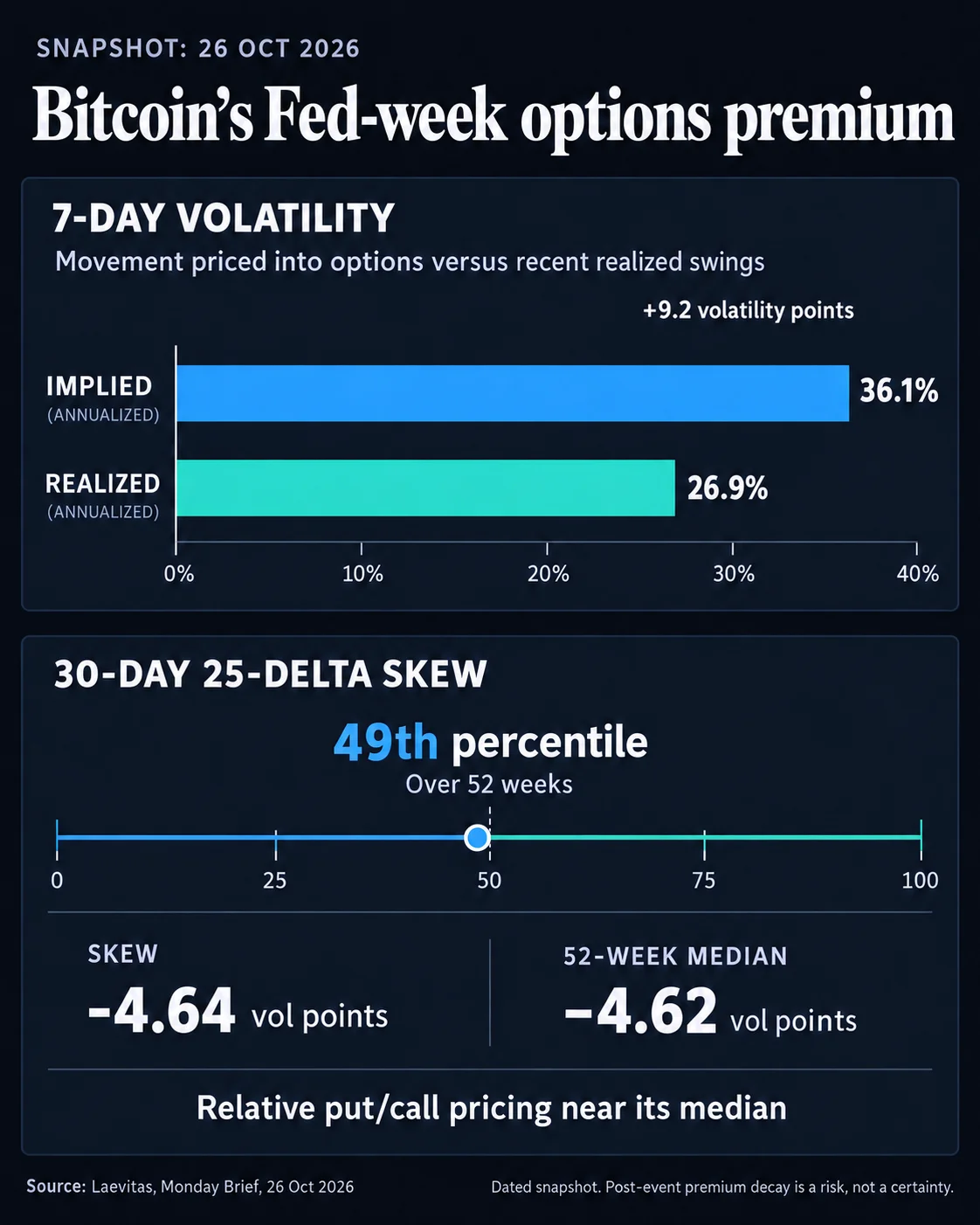
Laevitas’s Oct. 26 snapshot put Bitcoin’s seven-day implied volatility at 36.1%, against 26.9% realized volatility, a 9.2-point gap. A separate at-the-money reading was 36.5%, up from 32% a week earlier and close to the 30-day level of 37%.
Why it matters
Implied volatility reflects movement priced into options, while realized volatility measures past price swings. The gap shows that traders are pricing more short-term uncertainty than Bitcoin has recently delivered. It does not mean the Fed alone accounts for the premium: the week also includes European Central Bank and Bank of Japan decisions, economic releases, earnings and Friday’s Deribit monthly expiry.
Bitcoin’s 30-day 25-delta skew was minus 4.64 volatility points, nearly matching its minus 4.62 median and sitting at the 49th percentile over 52 weeks. Under Laevitas’s convention, the negative reading indicates a premium for puts over comparable calls, but the measure remains close to its usual level.
Market impact
For buyers holding options through the announcements, time decay and a decline in implied volatility can reduce an option’s value if Bitcoin does not move enough to offset those effects. A favorable price move can counter them. If the decisions bring little movement and uncertainty recedes, some of the event premium may fade; surprises or further uncertainty could sustain it.

Frequently asked questions
-
How large was the gap between Bitcoin’s implied and realized volatility?
Laevitas compared seven-day implied volatility of 36.1% with realized volatility of 26.9%, a gap of 9.2 volatility points.
-
Why might Bitcoin options lose value after the central-bank decisions?
If markets stay calm and implied volatility falls, options buyers can lose value. Time passing also erodes an option’s remaining time value.
-
What events beyond the Fed were included in the busy calendar?
The calendar included European Central Bank and Bank of Japan decisions, economic releases, earnings and Friday’s Deribit monthly expiry.
-
What did Bitcoin’s 30-day options skew indicate?
The 30-day 25-delta skew was minus 4.64 volatility points, close to its minus 4.62 median and at the 49th percentile over 52 weeks.
-
Can a Bitcoin price move offset volatility and time decay?
Yes. A favorable Bitcoin price move can offset the effects of lower implied volatility and time passing on a purchased option.
 TheBlock
 WatcherGuru
 CoinTelegraph
 Whale Alert
 Crypto Capital Venture
 Crypto News