








 CoinDesk
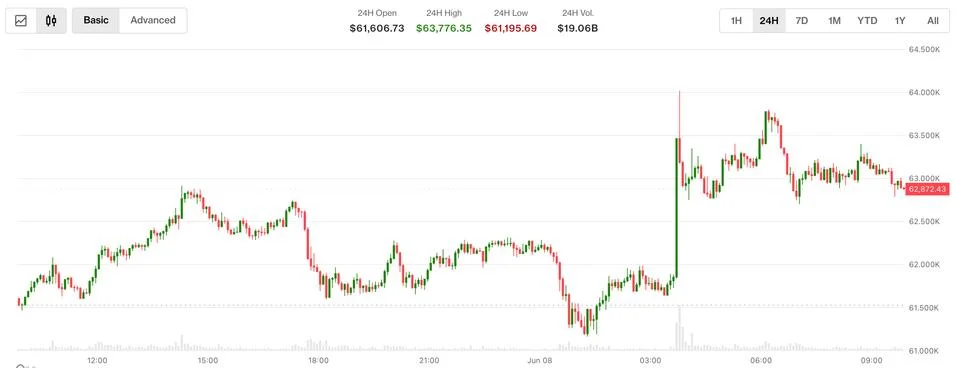



Bitcoin fell to roughly $62,900 by 4:00 UTC on Monday, pulling back from an overnight high of $63,776 as renewed airstrikes between Iran and Israel broke the fragile ceasefire that had calmed energy markets. WTI crude jumped more than 3% to $93.50, and Asian equity indexes sold off hard: South Korea's KOSPI dropped over 6.8%, triggering a temporary trade halt, while Japan's Nikkei fell more than 3%.
U.S. President Donald Trump told Axios he would call Israeli Prime Minister Benjamin Netanyahu to urge restraint, saying "Israel had its strike and Iran had its strike. We don't need another one." Still, the risk-off reaction was already priced across asset classes, with the spike in oil adding to an upward move in U.S. Treasury yields that began after Friday's blowout monthly jobs report.
Why it matters
Bitcoin is behaving like a high-beta risk asset this cycle, and the current selloff is macro-driven rather than crypto-specific. Rising oil hardens the inflation impulse, which in turn pressures Treasury yields higher and pulls capital toward dollar-equivalents — the textbook setup that drains liquidity from speculative assets. The geopolitical layer (Iran-Israel), the regional equity rout (KOSPI circuit breaker, Nikkei -3%), and the rates layer are all pointing the same direction at once.
Spot bitcoin ETF flows have compounded the move: U.S.-listed funds logged roughly $1.72 billion in net outflows last week, the largest weekly redemption in over a year and a sharp reversal from the dip-buying pattern seen in February. Strategy's BTC sale and the rotation out of the AI-stock complex are additional weights that already pulled BTC down about 14% last week, briefly under $60,000.
Market impact
Volatility is likely to stay elevated through the week. Key catalysts include U.S. inflation data, which will set the near-term path for real yields, plus a heavy IPO calendar (SpaceX, Anthropic) that competes for risk-asset liquidity. Traders will be watching whether the $60,000-$62,000 range holds as a structural floor — a break would likely accelerate ETF outflows and draw in forced selling.

Frequently asked questions
-
Why did Bitcoin drop to $63,000?
Bitcoin pulled back from an overnight high of $63,776 as Iran and Israel traded airstrikes, lifting WTI crude above $93.50 and hammering Asian equities. The move is macro-driven, not crypto-specific — rising oil, rising U.S. Treasury yields, and ~$1.72B in spot ETF outflows last week all pointed the same direction.
-
How are the Iran-Israel tensions affecting crypto markets?
The renewed airstrikes broke the fragile ceasefire that had calmed energy markets. Risk-off sentiment pushed BTC down alongside Asian equities, while WTI crude jumped more than 3%. Trump told Axios he would urge Netanyahu toward restraint, but the broader geopolitical risk premium remains in oil and yields.
-
What happened with spot Bitcoin ETF flows last week?
U.S.-listed spot bitcoin ETFs saw roughly $1.72 billion in net outflows last week, the largest weekly redemption in over a year. The selling marks a sharp reversal from February, when institutional buyers consistently stepped in to buy the dip near $60,000.
-
Why are Asian stock markets crashing today?
South Korea's KOSPI fell over 6.8%, triggering a temporary trade halt on circuit breakers, while Japan's Nikkei dropped more than 3%. The selloff reflects risk-off positioning across the region as oil spiked and the dollar strengthened on rising U.S. Treasury yields.
-
What is the outlook for Bitcoin this week?
Volatility is likely to stay elevated. Key catalysts include U.S. inflation data, which will set the path for real yields, plus a heavy IPO calendar including SpaceX and Anthropic that competes for risk-asset liquidity. Traders are watching whether $60,000-$62,000 holds as a structural floor.
 WatcherGuru
 CoinTelegraph
 CryptoSlate
 Crypto Capital Venture
 WuBlockchain