








 CoinDesk
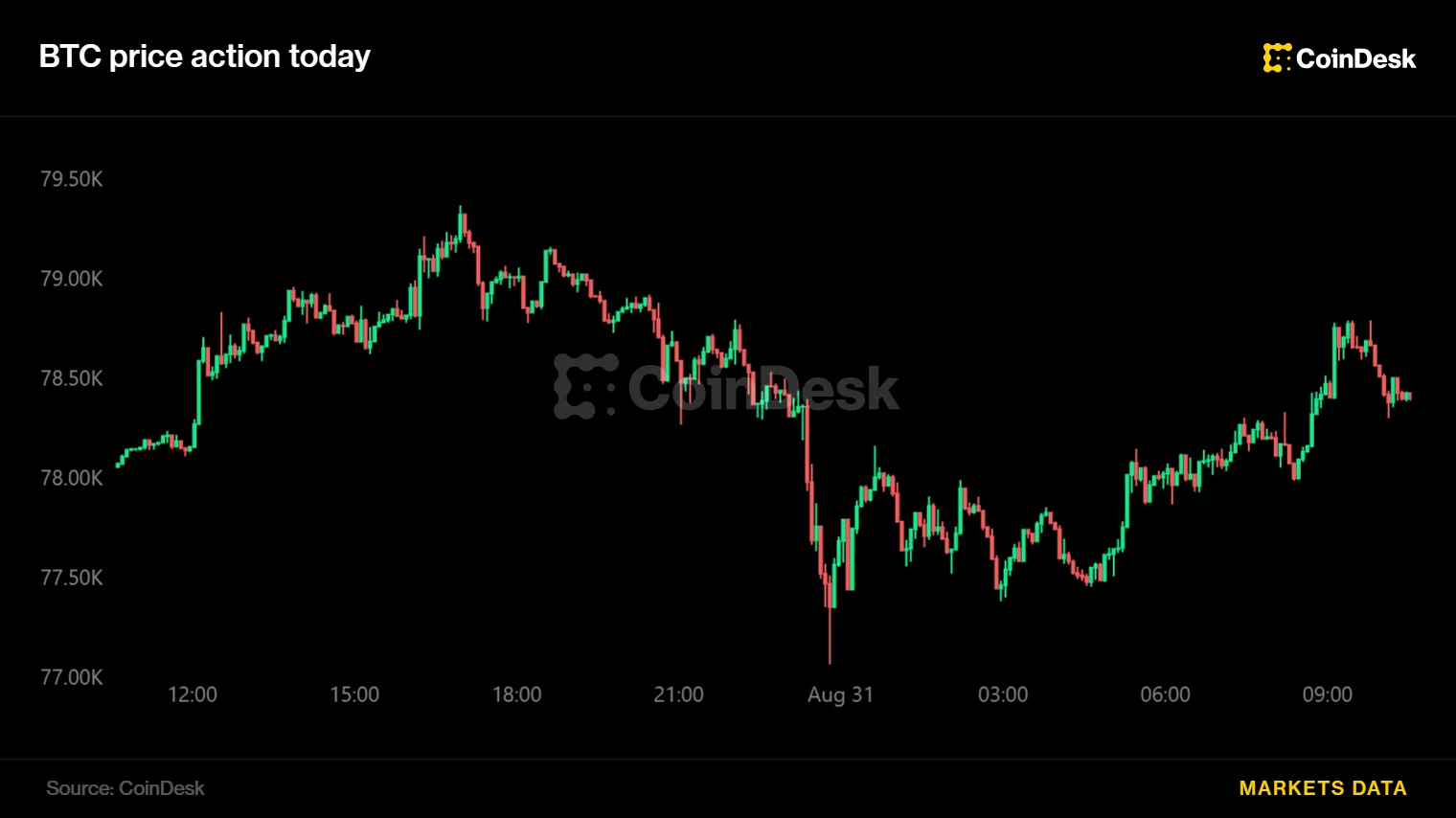


Bitcoin held near $78,000 on Monday, shrugging the first U.S. strikes against Iran in weeks that pushed Brent crude above $90 a barrel and pressured global stocks. The cryptocurrency is up more than 24% in August, on track for its best monthly performance since November 2024 and its best August since 2017. The decoupling from a classic risk-off event is the signal, not the print: 24-hour taker volume more than doubled to $183 billion while open interest stayed near $136 billion, a textbook signature of churn rather than fresh directional positioning.
Why it matters
The traditional macro playbook reads geopolitical escalation as risk-off: oil jumps, equities sell, bitcoin follows. Monday broke that chain. Iran strikes and a Brent print above $90 produced a flat BTC session and a CoinDesk 20 (CD20) reading of -0.75%, while Japan's Nikkei closed -0.14% and U.S. futures pointed lower. Bitcoin absorbing the headline without selling suggests the bid behind this rally is structural rather than reflexive, supported by positioning that did not unwind when the geopolitical shock hit.
Market impact
Derivatives data reinforce the read. Total liquidations topped $431 million over 24 hours, with ether absorbing $130 million and bitcoin $100 million. BTC's 30-day implied volatility index, BVIV, retreated below 40% after spiking toward 50% through Aug. 21, a pattern markets price when participants expect renewed calm rather than a follow-through leg lower. Deribit's most-traded bitcoin puts clustered at the $70,000, $73,000 and $74,000 strikes, hedging activity consistent with caution but not panic.
Two names stood out from the majors. Uniswap (UNI) gained 6.9% as on-chain data showed more than $1.5 billion of tokenized stock trades routed through Uniswap on Robinhood Chain; futures open interest rose 12% with funding rates near 2%, a bullish setup that is not yet overheated. Monero (XMR) printed a 12% 24-hour rally with open interest up 15% to 637,000 tokens, the most since February 2024, but annualized perpetual funding near 100% flags an overcrowded long and the risk of a sharp unwind if momentum stalls.




Frequently asked questions
-
Why didn't bitcoin drop when the U.S. struck Iran?
The 24% August gain appears to be backed by structural bid rather than reflexive positioning. 24-hour volume doubled to $183 billion while open interest held flat near $136 billion, indicating churn rather than fresh longs getting shaken out by the headline.
-
How is August 2025 performing for bitcoin?
Bitcoin is up more than 24% in August, on track for its strongest monthly performance since November 2024 and its best August since 2017.
-
What happened to oil and stocks during the Iran strikes?
Brent crude jumped above $90 per barrel after U.S. forces struck Iranian rocket launchers. Global equities sold off, with Japan's Nikkei closing -0.14% and U.S. futures pointing lower, while bitcoin held flat near $78,000.
-
Which altcoins moved during the session?
Uniswap (UNI) gained 6.9% on Robinhood Chain tokenized stock volume above $1.5 billion, and Monero (XMR) rallied 12% but with annualized funding near 100% flagging an overcrowded long. PROM dropped 18% on profit-taking.
-
What does the BTC volatility index say?
BTC's 30-day implied volatility (BVIV) dropped below 40% after spiking toward 50% through Aug. 21, suggesting markets expect renewed calm and continued bullish price action rather than a follow-through selloff.
 TheBlock
 Crypto Capital Venture
 Benjamin Cowen
 WatcherGuru
 CoinTelegraph
 Crypto News
 Crypto Rank News