








 CoinDesk
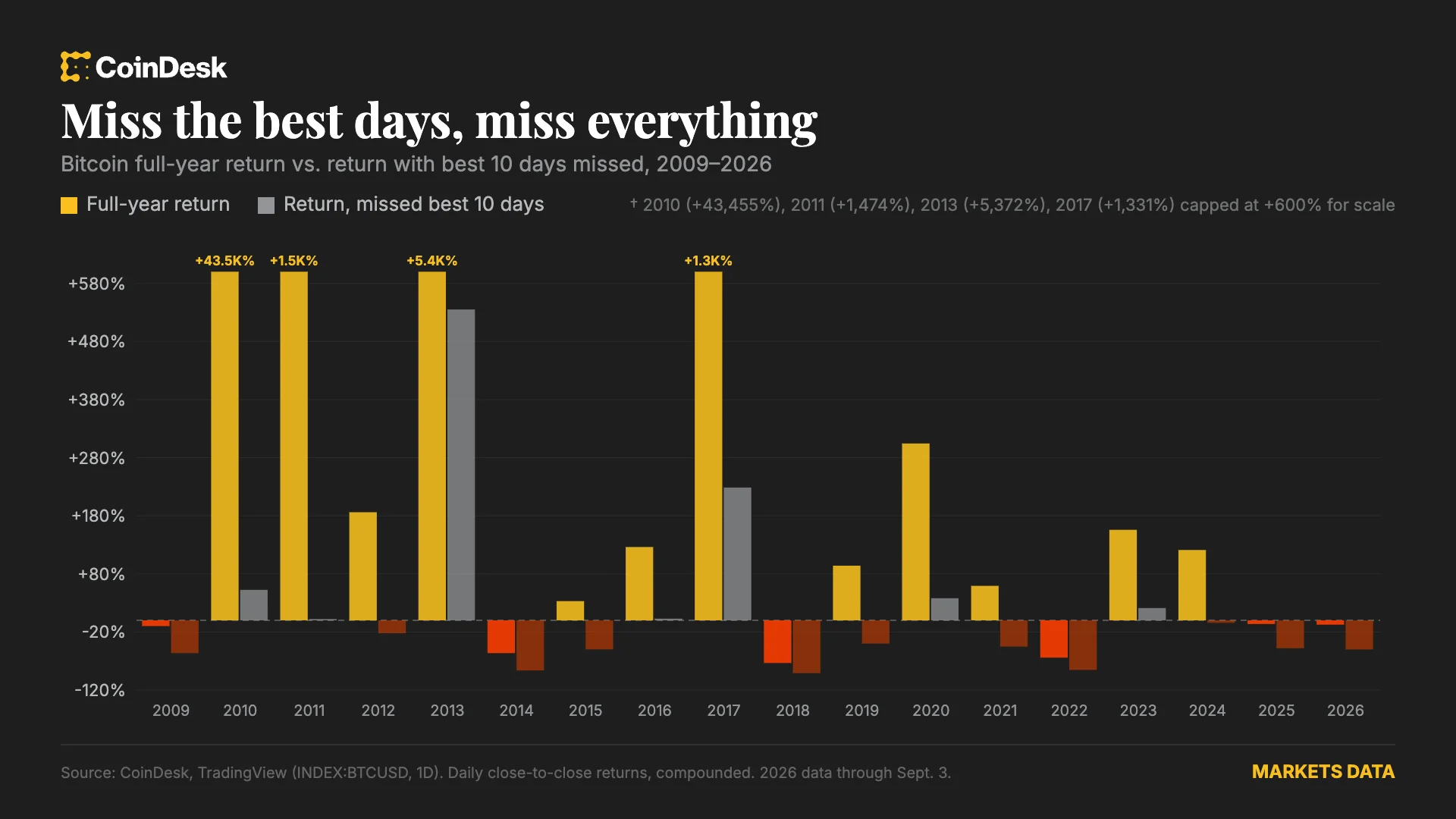


Bitcoin's annual returns ride on a tiny fraction of its trading days. Analysis of bitcoin price history from 2010 through 2026 shows that removing the ten best sessions of a year turns a winning year into a losing one in 11 of the last 18 years. The pattern makes precise market timing brutally hard: a trader has to enter a rally almost on the day it begins, because missing the first week or two often means missing nearly the entire move.
Why it matters
Andre Dragosch, head of research at Bitwise Europe, summed it up in a CoinDesk interview. "Bitcoin is actually a relatively boring asset," he said, adding that "the majority of performance is usually made in a handful of days, while most of the time it moves sideways and consolidates." His conclusion follows naturally: time in the market beats timing the market.
The asymmetry has softened, though not disappeared. Bitcoin's best single day in 2010 returned 294%. In 2011, it was 53%. Over the past four years, the best single day each year has landed between 9% and 12%. The cost of missing those days has dropped with it. Missing the five or ten best sessions cost a 2010 holder about 98% of what they would otherwise have earned. In 2023 through 2026, the penalty sits closer to a third.
Adam Haeems, head of asset management at Tesseract Group, pointed to February 2026 as the cleanest illustration. Bitcoin fell about 14% on Feb. 5, then jumped roughly 12% the next day. Anyone stopped out on Thursday had a day to get back in, and he treats drawdown avoidance as anything but a free option.
Market impact
For institutions, the pattern reshapes how positions are sized and executed. Haeems reframes timing as "a risk we manage, not an edge we chase," and the work shifts to building allocations clients can actually hold through drawdowns. The odds of ending up underwater drop below 1% after a three-year holding period, per Dragosch.
For larger players, liquidity is the second-order problem. Paul Howard, senior director at Wincent's OTC desk, noted the same clustering on the execution side. When bitcoin ran from roughly $63,000 to $80,000 in August, liquidity thinned and fragmented right when it mattered.

Frequently asked questions
-
Why does market timing fail for Bitcoin?
Bitcoin's annual returns concentrate in a tiny fraction of trading days, and missing those sessions often flips a winning year into a losing one. Bitwise Europe's Andre Dragosch called precise timing "close to impossible."
-
How concentrated are Bitcoin's best trading days?
Removing the ten best days of a year turned a winning year into a losing one in 11 of the last 18 years. 2019 returned 94% with its top ten but finished down 40% without them; 2011's 1,474% return shrank to 2.2%.
-
Has Bitcoin's volatility actually declined?
Best single-day returns fell from 294% in 2010 to 53% in 2011, and have landed between 9% and 12% in each of the past four years. Missing the top sessions cost a 2010 holder roughly 98% of returns; in 2023-2026, the penalty sits closer to a third.
-
How does this pattern affect institutional execution?
Liquidity thins and fragments exactly when it matters most. Wincent OTC's Paul Howard pointed to the August run from roughly $63,000 to $80,000 as a recent example, and argues institutions need OTC routing plus post-trade transaction cost analysis.
-
Does holding Bitcoin longer really reduce the risk of a loss?
According to Dragosch, the odds of being underwater on a Bitcoin position drop below 1% after a three-year holding period. The longer the time horizon, the more the boring, sideways days work in the holder's favor.
 Whale Alert
 Crypto News
 Lookonchain
 WuBlockchain
 CryptoSlate
 TheBlock