








 CoinDesk
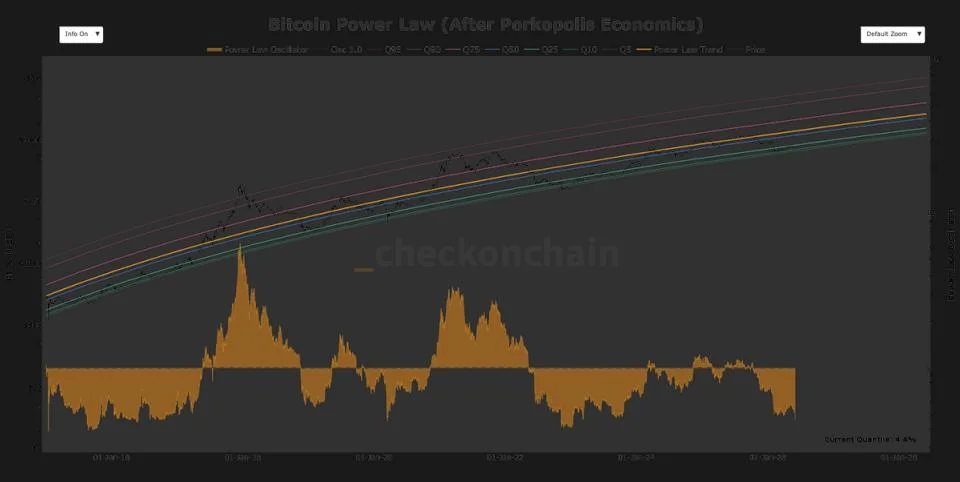


Bitcoin slipped below $66,000 on Wednesday and pushed the Power Law Oscillator to 4.4% — a level at which the asset has been more expensive than today for roughly 95.6% of its trading history, according to checkonchain data. The reading places BTC against the lower boundary of the Power Law corridor, a logarithmic valuation model popularized by physicist Giovanni Santostasi and refined by Porkopolis Economics that has contained bitcoin's price action for more than a decade.
Why it matters
The Power Law model plots BTC's price against time on a log scale and argues that growth decelerates naturally as the network matures — a structural pattern, not a halving-cycle artifact. Previous visits to comparable oscillator readings coincided with extreme market stress: the March 2020 pandemic crash and the November 2022 FTX collapse both pushed bitcoin toward the lower edge of the corridor before significant recoveries followed.
Market impact
The model offers no guarantee the floor holds again, but long-term investors are reading the 4.4% oscillator print as one of the deepest historical discounts to trend. A bounce from this level wouldn't require a regime change — it would only require BTC to retrace toward the corridor's midline, which historically tracks the long-term trend path rather than cycle peaks.

Frequently asked questions
-
What is the Power Law Oscillator and what does a 4.4% reading mean?
The Power Law Oscillator measures bitcoin's price against a long-term logarithmic trend model. A reading of 4.4% means BTC has traded above that level roughly 95.6% of the time in its history, signaling one of the deepest discounts to trend on record.
-
Who developed the Power Law model for bitcoin?
The model was popularized by physicist Giovanni Santostasi and refined by analyst Porkopolis Economics. It plots BTC's price against time on a logarithmic scale and has tracked bitcoin's trajectory for more than a decade.
-
How does the Power Law differ from bitcoin halving-cycle models?
Halving-cycle models focus on the four-year supply-cut rhythm. The Power Law argues bitcoin follows a long-term mathematical trend where growth decelerates as the network matures, independent of halving schedules.
-
When did bitcoin last trade at similar Power Law discount levels?
Comparable oscillator readings appeared during the March 2020 pandemic-driven crash and the November 2022 FTX collapse. Both episodes pushed BTC toward the corridor's lower edge before significant recoveries followed.
-
Does a deep Power Law discount guarantee a price rebound?
No. The model offers no guarantee the floor will hold. Long-term investors treat the 4.4% reading as a historically cheap zone relative to trend, but a recovery would require price to retrace toward the corridor's midline, not just any single catalyst.
 Lookonchain
 CZ Binance
 Crypto News
 WuBlockchain
 CoinTelegraph
 CryptoSlate
 WatcherGuru