








 CoinDesk
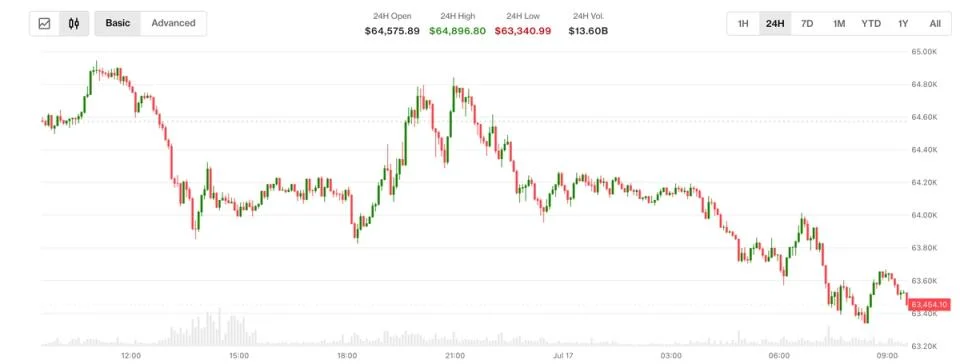



Bitcoin slid to $63,600 after fresh U.S. airstrikes on Iranian infrastructure and a renewed escalation in U.S.-China rhetoric rattled global risk sentiment, extending Thursday's 1.4% drop from $65,000. BTC now trades just below its widely watched 50-day simple moving average, a level traders view as the near-term momentum gauge.
Iran's semi-official Fars news agency reported that U.S. strikes hit five bridges in the southern Hormozgan province along with a missile hit on the Chabahar maritime control tower. Despite the escalation, WTI crude held steady near $79 a barrel, suggesting oil markets have so far shrugged off the supply-shock premium.
In parallel, President Donald Trump announced the declassification of intelligence reports alleging China obtained 220 million U.S. voter records, calling it a major threat to democracy. Beijing's embassy flatly denied the claims, and the rhetoric lands weeks before Trump's planned September meeting with Xi Jinping.
Why it matters
Two geopolitical flashpoints hit risk markets in the same session: a kinetic U.S.-Iran escalation and a verbal U.S.-China flare-up timed ahead of a diplomatic window. Asia bore the immediate brunt, with Japan's Nikkei dropping nearly 3% to a one-month low, Australia's ASX 200 slipping 0.5%, and Nasdaq futures falling 0.8% after the tech-heavy index lost 1.6% on Thursday.
The Aussie dollar, a commodity-sensitive G10 proxy for China exposure, weakened against the U.S. dollar on fears of renewed friction. InvestingLive's Eamonn Sheridan warned that Trump's accusations "introduce a new source of friction risk into a relationship that had been steadying," complicating the diplomatic runway into September regardless of the underlying facts.
Market impact
Bitcoin's drop below the 50-day SMA is the technical line in the sand. A sustained breach often triggers systematic de-risking from funds benchmarked to trend signals, and AUD's parallel weakness suggests the contagion is broad-based rather than crypto-specific. If the U.S.-China dispute intensifies ahead of the Trump-Xi meeting, expect further pressure on BTC and correlated risk assets until the diplomatic calendar clarifies the path.

Frequently asked questions
-
Why did Bitcoin fall below $64,000?
Bitcoin slipped to $63,600 after fresh U.S. airstrikes on Iran and a renewed U.S.-China escalation under President Trump weighed on global risk sentiment, extending Thursday's 1.4% slide from $65,000.
-
What U.S. targets were hit in Iran?
Iran's Fars news agency reported U.S. strikes hit five bridges in the southern Hormozgan province and a missile hit the Chabahar maritime control tower, though WTI crude held near $79 a barrel.
-
What did Trump say about China and the U.S. election?
Trump announced the declassification of intelligence alleging China obtained 220 million U.S. voter records, calling it a major threat to democracy. China's embassy flatly denied the allegations.
-
How did Asian markets react to the escalation?
Japan's Nikkei dropped nearly 3% to a one-month low, Australia's ASX 200 slipped 0.5%, Nasdaq futures fell 0.8%, and the Aussie dollar weakened as a G10 proxy for China exposure.
-
Why does the 50-day moving average matter for Bitcoin?
BTC now trades just below its 50-day simple moving average, a level traders view as the near-term momentum gauge. A sustained breach often triggers systematic de-risking from trend-following funds.
 WuBlockchain
 CryptoSlate
 Crypto News
 Crypto Rank News
 CoinTelegraph
 Crypto Capital Venture
 TheBlock