








 CoinDesk
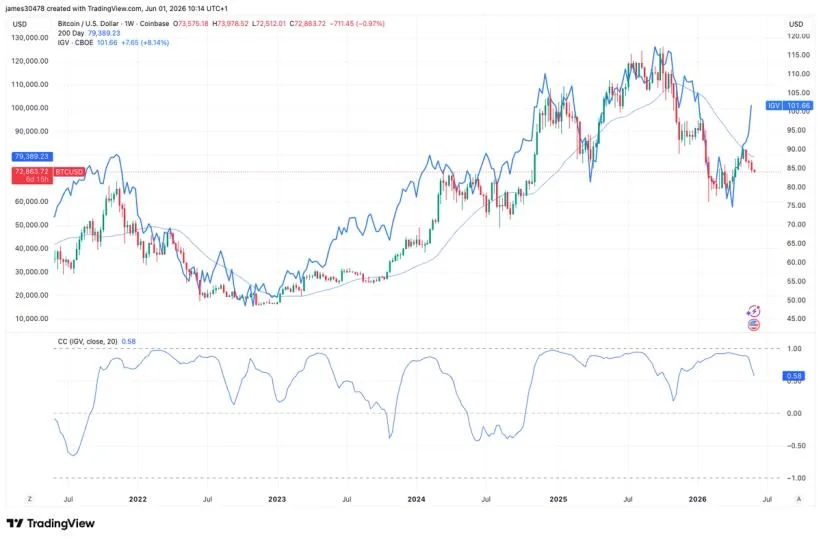


Bitcoin's 20-day rolling correlation with the iShares Expanded Tech-Software Sector ETF (IGV) has fallen to 0.58, a level not seen since October 2023 and summer 2024 — both moments that preceded major bitcoin rallies. The divergence has been sharp: since May 14, IGV has gained roughly 12% while bitcoin has fallen about 10%, one of the largest disconnects between the two assets in recent years.
IGV has rallied 36% since April 10 and reclaimed its 200-day moving average, staging an impressive recovery from the AI-disruption-driven "SaaS apocalypse" selloff that hit names like Oracle, Microsoft, and Palantir. Bitcoin, by contrast, is trading near $73,000 — nearly 10% below its 200-day moving average of $79,388 — and has not shared in software's rebound.
Why it matters
The correlation breakdown is structurally significant because IGV served as one of the closest equity proxies for bitcoin during the 2023-2024 cycle, with the two assets moving in near-lockstep. Their simultaneous drawdowns from October 2025 highs — bitcoin roughly 50%, IGV around 37% — were driven by different narratives (crypto-specific deleveraging versus AI-disruption fears in software), but the recovery is now splitting paths.
The historical pattern is consistent: the last two notable periods of low BTC-IGV correlation (October 2023 at ~$25K BTC, and summer 2024) were followed by bitcoin significantly outperforming in the months that followed, rallying to $70K and then toward $100K respectively. Each instance lasted only briefly before the assets re-coupled, typically with bitcoin doing the catching up.
Market impact
The setup leaves two possible resolutions: bitcoin catches up to software's recovery, or IGV's 36% rally proves a fakeout. The latter looks less likely given IGV's reclaim of the 200-day moving average — a key long-term trend signal — and its continued pre-market strength near 104 on Monday. Derivatives data show mildly bullish BTC positioning and steady open interest following spot bitcoin ETFs' record 10 straight days of net outflows totaling $2.97 billion, suggesting institutional risk appetite is stabilizing even as the correlation signal builds.

Frequently asked questions
-
What is the current correlation between Bitcoin and software stocks?
Bitcoin's 20-day rolling correlation with the iShares Expanded Tech-Software Sector ETF (IGV) has fallen to 0.58, a level not seen since October 2023 and summer 2024.
-
Why are Bitcoin and software stocks diverging?
Since May 14, IGV has gained roughly 12% while bitcoin has fallen about 10%. IGV recovered from AI-disruption fears hitting software names, while bitcoin has lagged below its 200-day moving average of $79,388.
-
What happened the last time Bitcoin-IGV correlation was this low?
In October 2023, with BTC near $25K, the correlation dropped before a rally to $70K over six months. In summer 2024, a similar setup preceded a surge toward $100K after Trump's election victory.
-
Has IGV reclaimed key technical levels?
Yes. IGV has rallied 36% since April 10 and reclaimed its 200-day moving average, closing Friday near 98 and trading around 104 in pre-market Monday.
-
What does derivatives data say about Bitcoin positioning?
Derivatives data show mildly bullish positioning and steady open interest, suggesting institutional risk appetite is stabilizing after spot bitcoin ETFs recorded 10 straight days of net outflows totaling $2.97 billion.
 CryptoSlate
 WatcherGuru
 Whale Alert
 Crypto News
 CoinTelegraph