








 CoinDesk

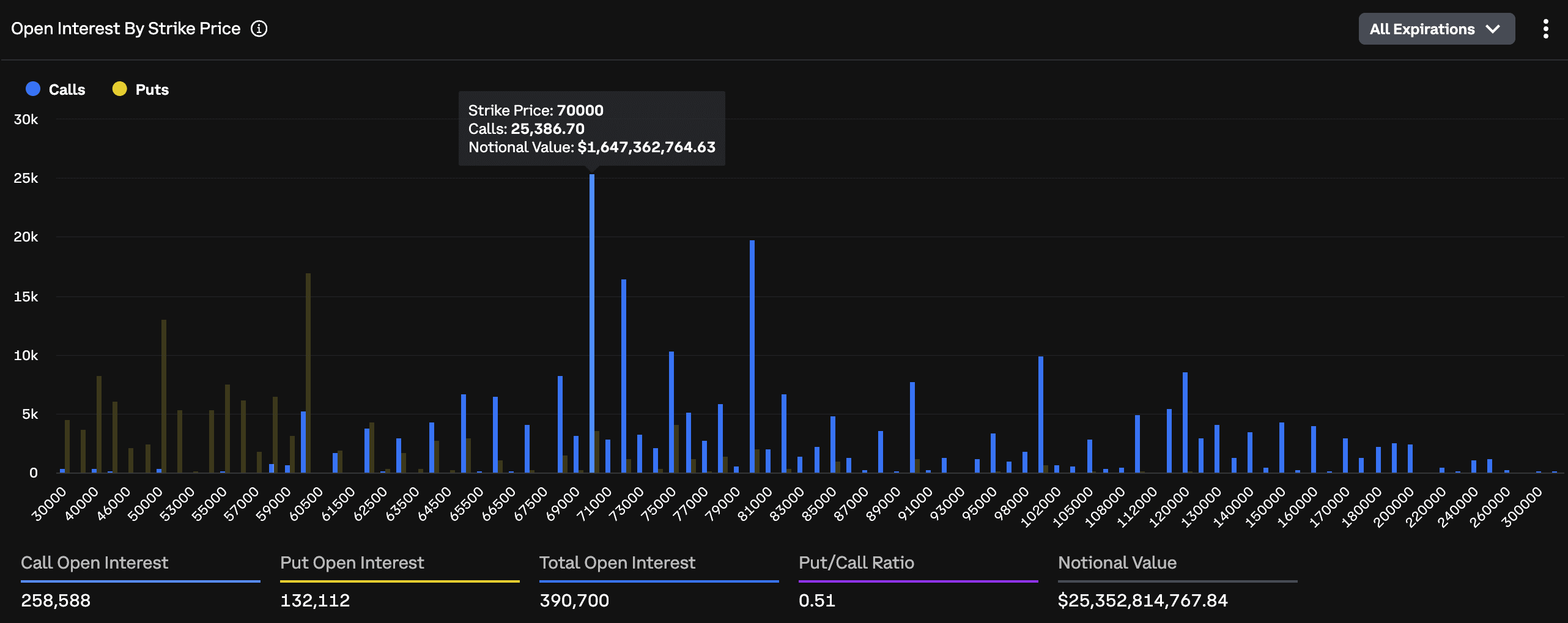


The most heavily traded Bitcoin call option has slipped from $80,000 to $70,000, with the new top strike carrying $1.63 billion in notional open interest, according to data sourced from Metrics. For six months the $80,000 call had held that position, and analysts had used the $60,000-$80,000 band as the working range for BTC. The $60,000 put remains the dominant downside bet, suggesting traders are now framing a $60,000-$70,000 corridor rather than the wider band that defined the market through the first half of the year.
Why it matters
Call-strike rotation is a quiet but telling signal of where market makers and active traders expect the next move to peak. A lower top-strike means upside expectations have reset, even as downside protection stays anchored. Imran Lakha, founder of Options Insights, noted that dealers hold a "net long gamma exposure" above $70,000: market makers become natural sellers into any push above that level, which acts as a structural ceiling on how quickly BTC can run once it approaches the strike. Lakha contrasted this with ether, which he said is far less exposed to dealer gamma and can therefore move more freely.
Market impact
Bitcoin was trading near $64,100, down roughly 1% since midnight UTC, alongside similar losses across ETH, XRP and SOL and a 0.5% slip on Nasdaq 100 futures. The structural read is the ceiling has shifted lower to $70,000 while the floor at $60,000 holds, compressing the tradable range into a band that dealer hedging is set to amplify at the upper edge. Alex Kuptsikevich, chief market analyst at FxPro, framed the setup as a patience trade: "buying in a quiet market at less than half of peak levels looks like a perfectly reasonable tactic for the coming days or weeks," while flagging the risk that a financial-market shock could break the corridor in either direction.




Frequently asked questions
-
What does it mean that BTC's top call strike slid from $80K to $70K?
The $70,000 call is now the most heavily held bullish options position, carrying $1.63B in notional open interest and replacing the $80,000 call that held that spot for six months.
-
Why is the $60,000-$70,000 band significant for bitcoin right now?
The $60,000 put remains the most popular downside hedge, so traders are anchoring a tighter $60K-$70K trading range rather than the wider $60K-$80K corridor that defined the first half of the year.
-
How does dealer gamma act as a ceiling above $70,000?
Per Options Insights' Imran Lakha, dealers are net long gamma above $70,000 and need to sell into strength to stay market-neutral, which caps how fast BTC can rally once it approaches that strike.
-
Is ether less exposed to this dealer-gamma dynamic?
Yes. Lakha noted ETH is far less exposed to dealer gamma dynamics than BTC, which is why ETH tends to move more freely when it breaks out.
-
What price levels was bitcoin trading at when the report was published?
BTC was last near $64,100, down roughly 1% since midnight UTC, alongside similar losses across ETH, XRP and SOL and a 0.5% dip on Nasdaq 100 futures.
 Crypto Rank News
 WatcherGuru
 Whale Alert
 Crypto News
 WuBlockchain
 Lookonchain
 TheBlock
 CryptoSlate