








 CoinDesk

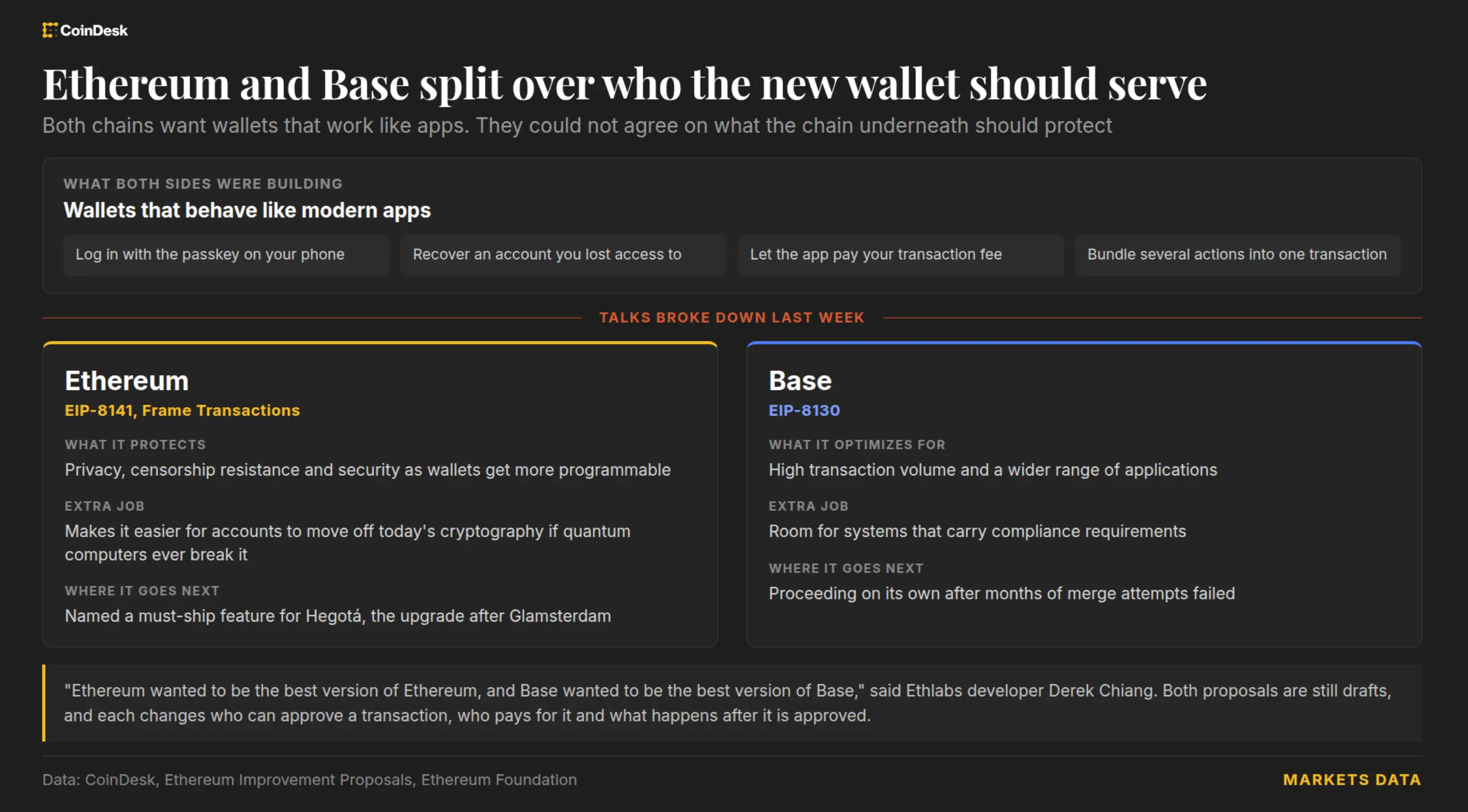


Ethereum and Coinbase-backed Base have abandoned months of talks on a shared standard for next-generation crypto wallets, with Ethereum pushing EIP-8141, known as Frame Transactions, and Base advancing its competing EIP-8130. The failure to merge the designs means wallets and apps that span both networks may need to support two different ways of constructing and approving the same transaction.
Both proposals aim to make wallets behave more like modern apps: passkey logins, alternative account recovery, apps paying gas fees, bundled transactions, and no need to hold ETH just to cover fees. But Ethereum's version emphasizes privacy, censorship resistance, security and a path off today's cryptography if quantum computers eventually break it, while Base favors flexibility for high-volume applications and compliance requirements.
Why it matters
"Ethereum wanted to be the best version of Ethereum, and Base wanted to be the best version of Base," Derek Chiang, an Ethlabs developer involved in the work, posted on X. He said the cooperation broke down last week after months of trying to merge the two designs, because forcing a common standard meant one side would give up features it considered core.
Ethereum-based networks were supposed to inherit one common set of wallet rules even as they diverged elsewhere. That assumption is now off the table, and the split is a signal about how L2s increasingly optimize for their own priorities over ecosystem uniformity.
Market impact
The Ethereum Foundation this month listed EIP-8141 among the execution-layer features expected to ship with Hegotá, the upgrade after Glamsterdam later this year. It remains a draft and is not running on mainnet. Base is testing EIP-8130 on its Vibenet devnet, with deployments planned for the Cobalt upgrade in September. Developers building cross-network wallets now face duplicated engineering work and possible UX divergence between the two ecosystems.

Frequently asked questions
-
What is Ethereum's EIP-8141 Frame Transactions proposal?
It's a draft standard that changes how transactions are approved and paid for, enabling passkey logins, app-paid gas fees, bundled actions, and optional ETH holdings. It emphasizes privacy, censorship resistance, and quantum-safe account migration.
-
How does Base's EIP-8130 differ from EIP-8141?
EIP-8130 favors flexibility for high-volume applications and systems with compliance requirements, while Ethereum's EIP-8141 prioritizes privacy, censorship resistance, and security for programmable wallets.
-
Why did Ethereum and Base fail to agree on a common wallet standard?
After months of talks, developers concluded a compromise would force one side to drop features it considered core. Developer Derek Chiang said each chain's priorities outweighed ecosystem interoperability.
-
When will the new wallet standards ship?
Ethereum's EIP-8141 is targeted at the Hegotá upgrade, which follows Glamsterdam later this year, and is still in development. Base's EIP-8130 is on the Vibenet devnet and planned for the Cobalt upgrade in September.
-
What does the split mean for cross-network wallets?
Wallets and apps that operate on both Ethereum and Base may need to support two different ways of constructing and approving the same transaction, increasing engineering work and potential UX divergence.
 CryptoSlate
 Crypto News
 TheBlock
 CoinTelegraph
 Glassnode
 WuBlockchain