


 CryptoSlate



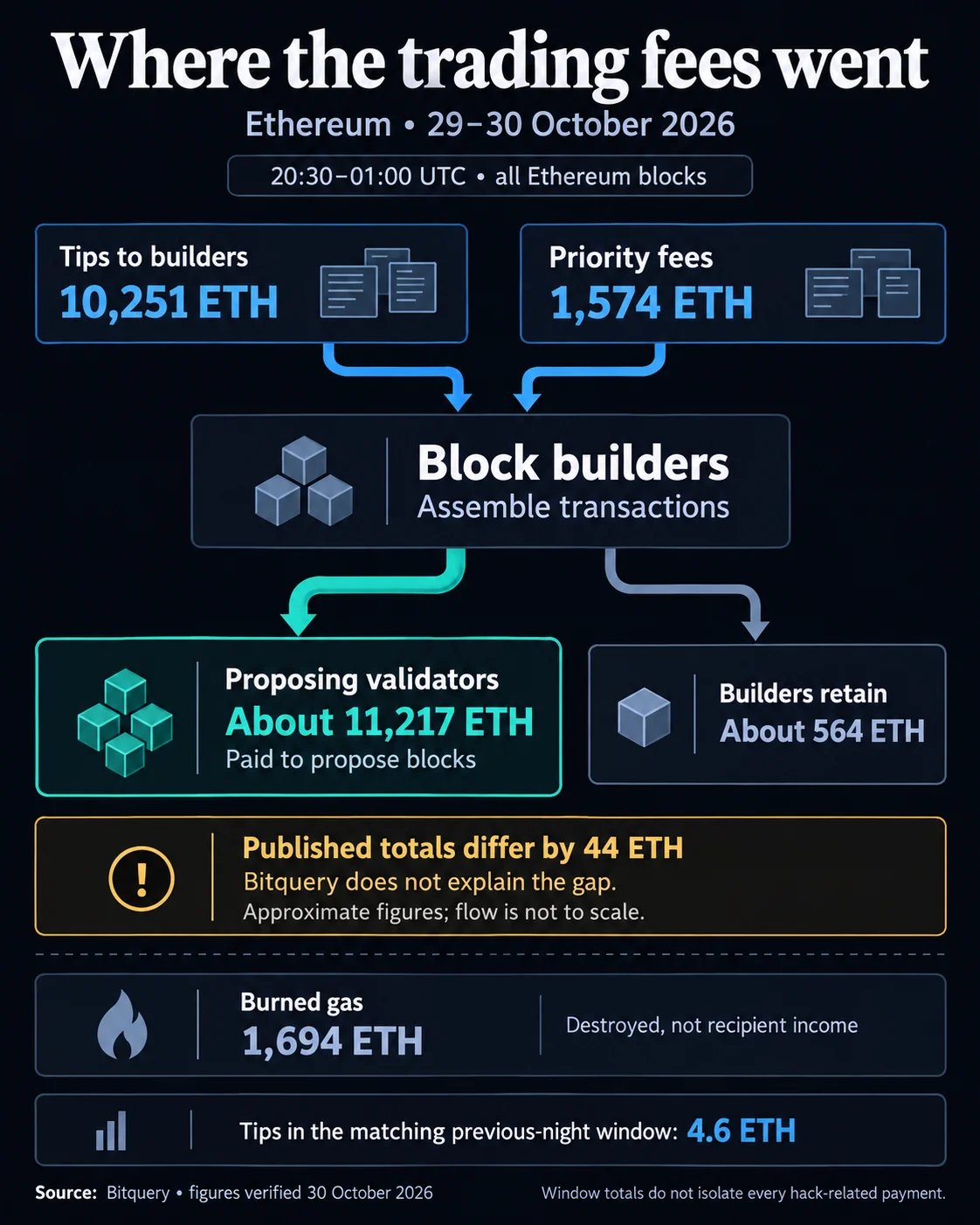
Ethereum validators received about $29.5 million during a trading frenzy triggered by the $6.3 billion Binance hack, while the attackers lost approximately $119 million in rushed trades. Trading firms and automated bots retained roughly $60 million in profits after costs, according to Bitquery’s investigation.
Why it matters
The attackers swapped stolen stablecoins and other assets for ETH and TRX as they tried to move funds before stablecoin issuers could freeze them. On Ethereum, they paid about $71.5 million above prevailing market prices for ETH, pushing the WETH/USDT pool on Uniswap as much as 38% above the broader market.
That price gap drew arbitrage traders into Ethereum’s maximal extractable value market. Bots bid for priority blockspace through specialized builders, who then compete for validators to propose their blocks. The resulting payments can flow to validators and, through staking services such as Lido, to participating stakers.
Market impact
Ethereum block builders received 10,251 ETH in tips between 20:30 UTC on Oct. 29 and 01:00 UTC on Oct. 30, versus 4.6 ETH during the equivalent period the previous night. Validators received about 11,217 ETH during the four-and-a-half-hour window, while builders retained roughly 564 ETH after payments, largely through Titan’s relay.
The competition also produced losses: 10,235 Ethereum transactions failed, compared with about 3,500 the previous night. One MEV bot captured $2.87 million in trading discounts but paid $2.95 million in fees, ending about $110,000 down. On Tron, traders made another $12.4 million before fees from price discrepancies after the attackers exchanged about 234 million USDT for TRX.





Frequently asked questions
-
How did the attackers’ trades create profits for Ethereum traders?
Large, hurried swaps pushed prices away from broader market levels, creating arbitrage opportunities. Traders paid for priority blockspace to act on those price gaps.
-
Why did Ethereum block-builder tips surge during the trading frenzy?
Bots competed for priority access to limited blockspace so they could capture arbitrage opportunities. Builders received 10,251 ETH in tips during the period, compared with 4.6 ETH in the equivalent period the previous night.
-
How much did the Binance attackers pay above market prices for ETH?
On Ethereum, the attackers paid approximately $71.5 million above prevailing market prices to acquire ETH.
-
Did every arbitrage bot profit from the price gaps?
No. One bot captured $2.87 million in trading discounts but paid $2.95 million in fees, leaving it about $110,000 down.
-
What happened to trading opportunities on Tron?
After the attackers exchanged about 234 million USDT for TRX, traders exploiting the resulting price discrepancies generated another $12.4 million before fees.
 CoinTelegraph
 Lookonchain
 WuBlockchain
 Crypto News
 CoinDesk
 TheBlock
 WatcherGuru
 Glassnode