








 WuBlockchain

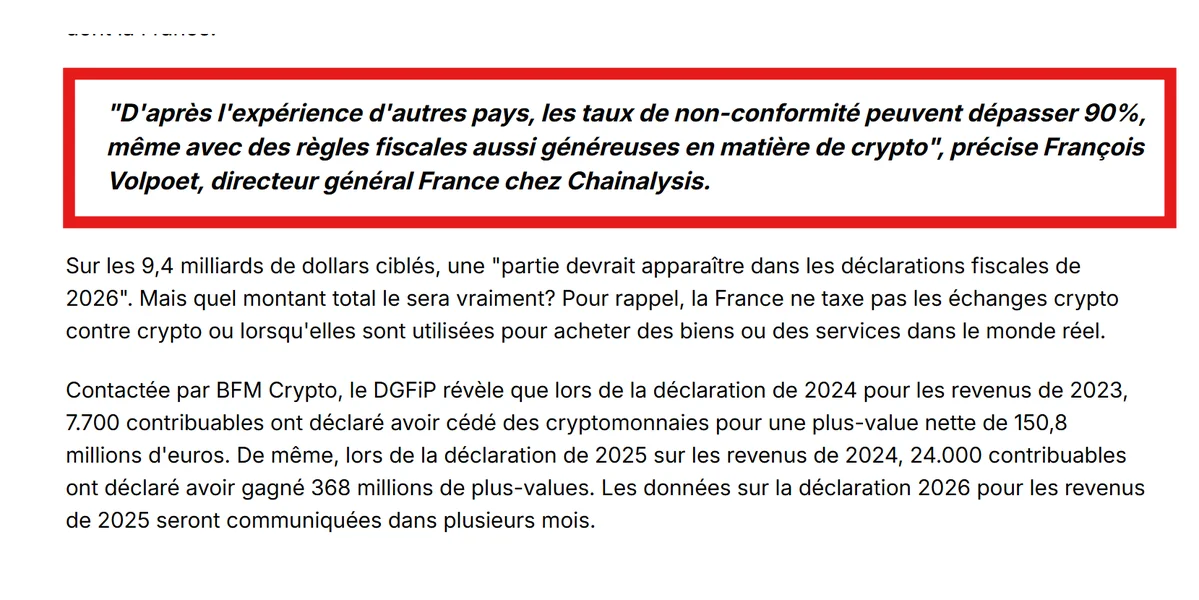
Chainalysis estimates that crypto tax non-compliance could exceed 90% in some countries, a gap France is preparing to close as it receives far more detailed transaction data starting in 2027 under the EU's DAC8 framework and the OECD's Crypto-Asset Reporting Framework (CARF).
In France specifically, Chainalysis put potentially taxable crypto activity at about $9.4 billion in 2025, broken down into roughly $1.7 billion in income, $2.5 billion in capital gains, and $5.2 billion in crypto payments. Against that, only about 24,000 French taxpayers reported €368 million in crypto capital gains for tax year 2024, a fraction of the estimated flow.
Why it matters
DAC8, the EU's eighth directive on administrative cooperation, obliges crypto-asset service providers operating in the bloc to report user transaction data to tax authorities starting in 2026, with first exchanges of that data arriving in 2027. CARF is the OECD's parallel global standard, and France is among the early adopters. Together they replace the current patchwork of self-reporting with automatic cross-border reporting, the same mechanism that already catches offshore brokerage income.
Market impact
For French holders who have not been reporting, the clock now has a date. Past amnesty-style programs in other jurisdictions have shown that once reporting kicks in, compliance rates climb sharply in the first two filing cycles. Exchanges serving French clients can also expect heightened KYC pressure, as reporting starts at the venue level rather than depending on user self-declaration.
Frequently asked questions
-
What is DAC8 and when does it start applying?
DAC8 is the EU's eighth directive on administrative cooperation. It obliges crypto-asset service providers operating in the bloc to report user transaction data to tax authorities starting in 2026, with first cross-border exchanges of that data arriving in 2027.
-
What is the OECD's CARF?
CARF, the Crypto-Asset Reporting Framework, is the OECD's parallel global standard for automatic exchange of crypto tax information. It complements DAC8 in the EU and is being adopted by other jurisdictions including France.
-
How big is France's crypto tax gap according to Chainalysis?
Chainalysis estimates potentially taxable French crypto activity at about $9.4 billion in 2025, including $1.7B in income, $2.5B in capital gains and $5.2B in crypto payments. Only about 24,000 taxpayers reported €368 million in capital gains for tax year 2024.
-
Why is non-compliance above 90% in some countries?
Crypto has historically relied on user self-reporting with limited venue-level reporting, unlike traditional brokerage income. Chainalysis argues this self-reporting model misses the vast majority of taxable flows, especially in countries without automatic data exchange.
-
What changes for French crypto holders from 2027?
From 2027 onward, French tax authorities will receive detailed user transaction data directly from EU-licensed crypto venues under DAC8. Holders who have not been reporting face a sharply higher chance of detection, and past amnesties suggest compliance rates jump sharply in the first two filing cycles.
 TheBlock
 WatcherGuru
 CoinDesk
 CryptoSlate
 CoinTelegraph
 Altcoin Daily