








 WatcherGuru

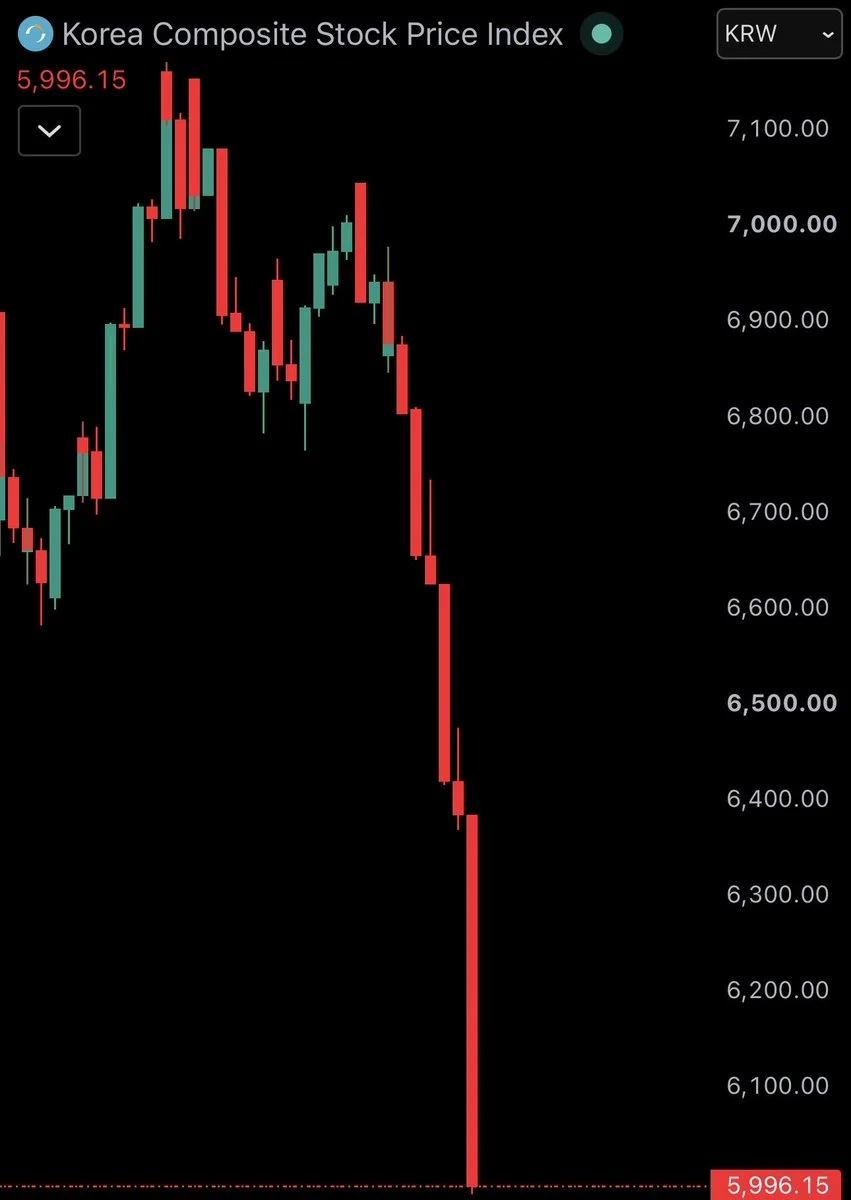
South Korea's KOSPI crashed 6% in a sharp risk-off session, one of the benchmark index's steepest single-day declines in recent memory.
The KOSPI is widely read as a real-time barometer of global risk appetite given the heavy weight of export-driven tech and memory-chip names on the index. A move of this size out of Asia typically bleeds into European and US sessions as traders de-risk ahead of the Western open.
Why it matters
A 6% single-day drop in a major developed-market index is not noise. It signals that leveraged positioning is being unwound and that institutions are cutting exposure rather than buying the dip, at least for now.
Market impact
Risk assets across the board, including crypto, tend to track this kind of macro shock closely in the immediate aftermath. The next test is whether South Korean policymakers or the Bank of Korea step in with verbal or actual intervention, and whether US equity futures follow the KOSPI lower at the open.
Frequently asked questions
-
How much did South Korea's KOSPI fall?
The KOSPI crashed 6% in a single session, one of its steepest daily declines in recent years.
-
Why is the KOSPI considered a risk-appetite barometer?
The index is dominated by export-driven technology and memory-chip companies, so its swings are closely read as a real-time gauge of global risk appetite.
-
What does the KOSPI crash mean for crypto markets?
Risk assets including crypto tend to track sharp macro shocks from major equity markets in the immediate aftermath, as traders cut leverage across the board.
-
Could the South Korean government intervene after the KOSPI drop?
Policymakers and the Bank of Korea have historically responded to severe equity selloffs with verbal reassurance or stabilization measures, and markets will watch for such a step.
-
What should traders watch after the KOSPI crash?
The key signals are whether US and European equity futures follow the KOSPI lower and whether any official intervention from Seoul emerges.
 CoinTelegraph
 TheBlock
 Benjamin Cowen
 WuBlockchain
 CoinDesk