








 CoinDesk

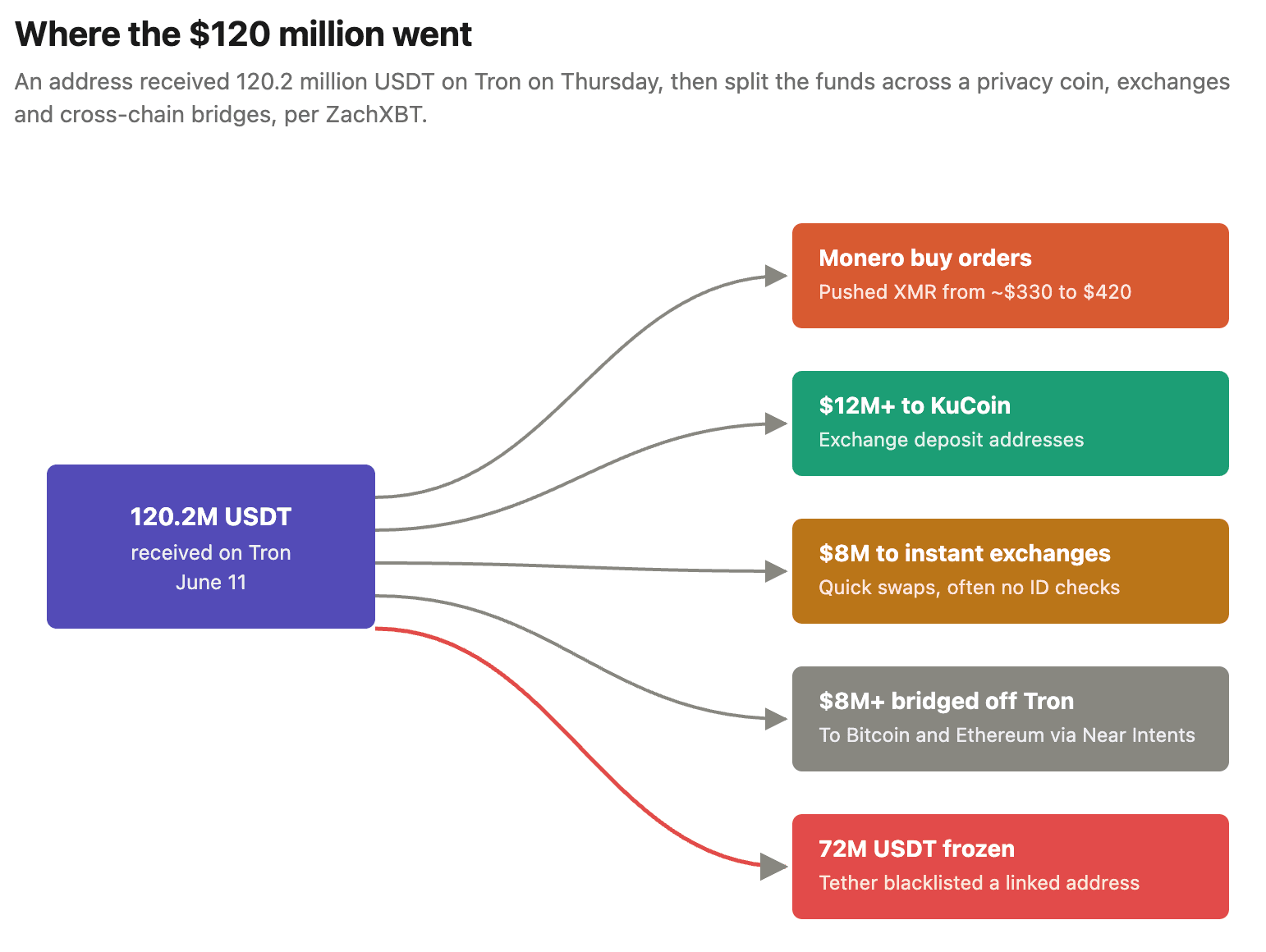


An unknown entity routed roughly $120 million in USDT through a complex swap chain this week, buying enough Monero (XMR) to push the privacy coin from about $330 to an intraday high near $438 before settling around $382, up roughly 8% on the day. Onchain investigator ZachXBT traced the flow on Telegram, identifying 120.2 million USDT that landed on a Tron address on Thursday before being split across exchanges, instant swap services, the Bitcoin and Ethereum networks, and Monero itself. Tether later froze $72 million of the USDT tied to the activity after the trail reached the same conclusion the swaps suggested: laundering.
Why it matters
XMR's liquidity is thin enough that a single motivated buyer can swing the price over 30% in hours, and that fragility is exactly what makes it attractive for cleaning large sums. The pattern — fast conversion into a privacy coin, instant swaps, cross-chain hops via tools like Near Intents — is the textbook laundering chain ZachXBT has been documenting across multiple high-profile investigations. Tether's mid-flight freeze of $72M is the more consequential beat: it shows the stablecoin issuer willing and able to blacklist addresses in real time when the onchain evidence is clear, reinforcing USDT's case to regulators that it is not a fully uncontrolled rail.
Market impact
XMR's 8% day is the loudest line, but the real read is in what the trace revealed about routing: more than $12 million flowed to KuCoin deposit addresses, around $8 million through instant swap services that often skip KYC, and another $8 million bridged off Tron onto BTC and ETH via Near Intents. For exchanges named in the trace, the pressure is to show enhanced monitoring on these deposit clusters. For Monero, the spike is a familiar pattern — illicit flows drive the visible volatility, which keeps the asset under regulatory scrutiny and limits any sustained listing access on US venues.


Frequently asked questions
-
Why did Monero's price spike to $438?
An unknown entity routed roughly $120M in USDT through a swap chain and bought enough XMR to move the market. Monero's thin liquidity means a single large buyer can swing the price sharply, pushing XMR from about $330 to an intraday high near $438.
-
How much USDT did Tether freeze?
Tether blacklisted an address holding 72 million USDT tied to the activity after onchain investigator ZachXBT traced the laundering pattern. Once frozen, those tokens can no longer be moved or cashed out.
-
What role did ZachXBT play in tracing the funds?
ZachXBT identified 120.2M USDT landing on a Tron address on Thursday and traced the split across exchanges, instant swap services, the Bitcoin and Ethereum networks, and Monero. The trace documented more than $12M to KuCoin deposit addresses and ~$8M bridged off Tron via Near Intents.
-
Why is Monero used for laundering?
XMR is a privacy coin designed to obscure who sends and receives funds, making it difficult to trace. Combined with its thin liquidity, large buy orders can both clean the funds and move the market visibly, which is why it features in repeated laundering investigations.
-
What does the freeze signal for the stablecoin sector?
Tether's mid-flight freeze of $72M shows the issuer willing and able to blacklist addresses in real time when the onchain evidence is clear. It reinforces the case to regulators that USDT is not an uncontrolled rail, while putting pressure on exchanges named in the trace to demonstrate enhanced monitoring.
 CryptoSlate
 Altcoin Daily
 Crypto News
 WatcherGuru
 Glassnode
 TheBlock
 CoinTelegraph