








 CoinDesk
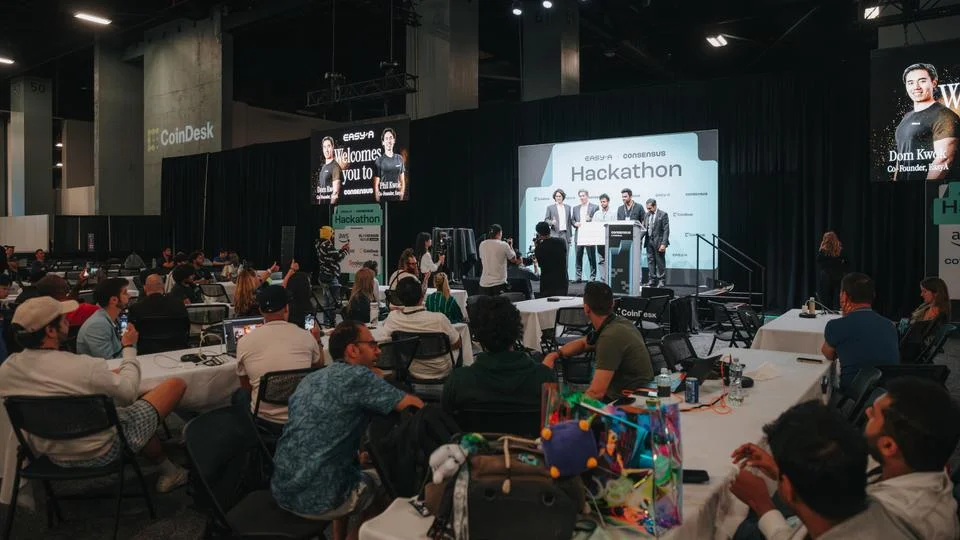
Nearly 1,000 developers packed the EasyA Hackathon at Consensus Miami 2026, with AI agents emerging as the dominant theme across every sponsor track. Builders from crypto ecosystems Base and Solana sat shoulder-to-shoulder with engineers from Microsoft and Google, shipping products that stretched from autonomous drone coordination to consumer prediction markets. Prize pools topped $200K plus $75,000 in Solana phones, and every winning project had an agentic AI layer at its core.
The headline winners underscore how far the agentic thesis has moved past chatbot demos. FlyPraxis took the $50,000 Kickstart prize for a real-time drone intelligence platform pitched as "Palantir in real time" for military operators. HIIE won second by building an agent-driven pipeline that turns text prompts into buildable hardware, compressing months of prototyping into a single workflow. The Coinbase / AWS track went to Dairy Price API x402, a pay-per-call commodity pricing service where AI agents settle USDC on Base through the x402 framework — no API keys, no human in the loop.
Why it matters
EasyA co-founders Dom and Philip Kwok are no longer pitching the event as a coding competition. "We want billion-dollar companies coming out of EasyA," Dom told CoinDesk, pointing to a previous Harvard team that founded Permission AI, now reportedly valued near $10 billion, and to alumni who have run through Y Combinator, raised from top-tier VCs, and processed hundreds of millions in transactions. The shift from infrastructure tooling to AI-native consumer apps and autonomous agents — what the Kwoks call the "Year of the Application Layer" — mirrors a broader venture pivot across crypto, where capital is increasingly chasing agent infrastructure, not base-layer rails.
The sponsor challenges telegraphed the same read. Coinbase built its entire track around x402, the emerging framework for AI-agent payments and machine-to-machine settlement on Base. Solana and Solana Mobile pushed teams toward mobile-first agent experiences integrated with the Seeker phone and x402. Even the consumer-facing winners — Snakr's AI food-intelligence scanner, Rhythym's routine-support app for executive dysfunction — were architected around agents doing autonomous work, not static interfaces.
Market impact
The win list is a clean snapshot of where crypto-AI capital is clustering. Payments and agent identity (Dairy Price API x402, AgentPay, Chainlens) ran on Base. Mobile-native agent apps ran on Solana.


Frequently asked questions
-
What was the EasyA Consensus Miami 2026 hackathon?
It was a hackathon hosted by EasyA inside Consensus Miami 2026, drawing nearly 1,000 developers from crypto ecosystems like Base and Solana alongside engineers from Microsoft and Google, with AI agents as the dominant theme across all sponsor tracks.
-
Who won the EasyA Miami hackathon and what did they build?
FlyPraxis won the $50,000 Kickstart track for a real-time drone intelligence platform. The Coinbase / AWS track went to Dairy Price API x402 for a pay-per-call commodity pricing service settled in USDC on Base. Parabola topped the Solana Mobile track with a mobile-native prediction market.
-
What is x402 and why is Coinbase backing it?
x402 is an emerging framework for AI-agent payments and machine-to-machine interactions on Base. Coinbase built its entire hackathon challenge around it because it lets autonomous agents settle USDC transactions without traditional API keys or human approval.
-
How big were the EasyA Miami hackathon prizes?
Prize pools exceeded $200,000 in cash plus $75,000 worth of Solana phones. The Kickstart track paid $50,000, the Coinbase / AWS track $45,000, and the Solana Mobile track $30,000 plus Seeker hardware.
-
What is EasyA's pitch for billion-dollar companies out of its hackathons?
Co-founders Dom and Philip Kwok claim past EasyA participants have founded a company now valued near $10 billion (Permission AI), entered Y Combinator, raised from top-tier VCs, and processed hundreds of millions in transactions — positioning the event as a venture-scale launchpad rather than a coding competition.
 CoinTelegraph
 WatcherGuru
 Crypto News
 CryptoSlate
 Lookonchain