








 CoinDesk

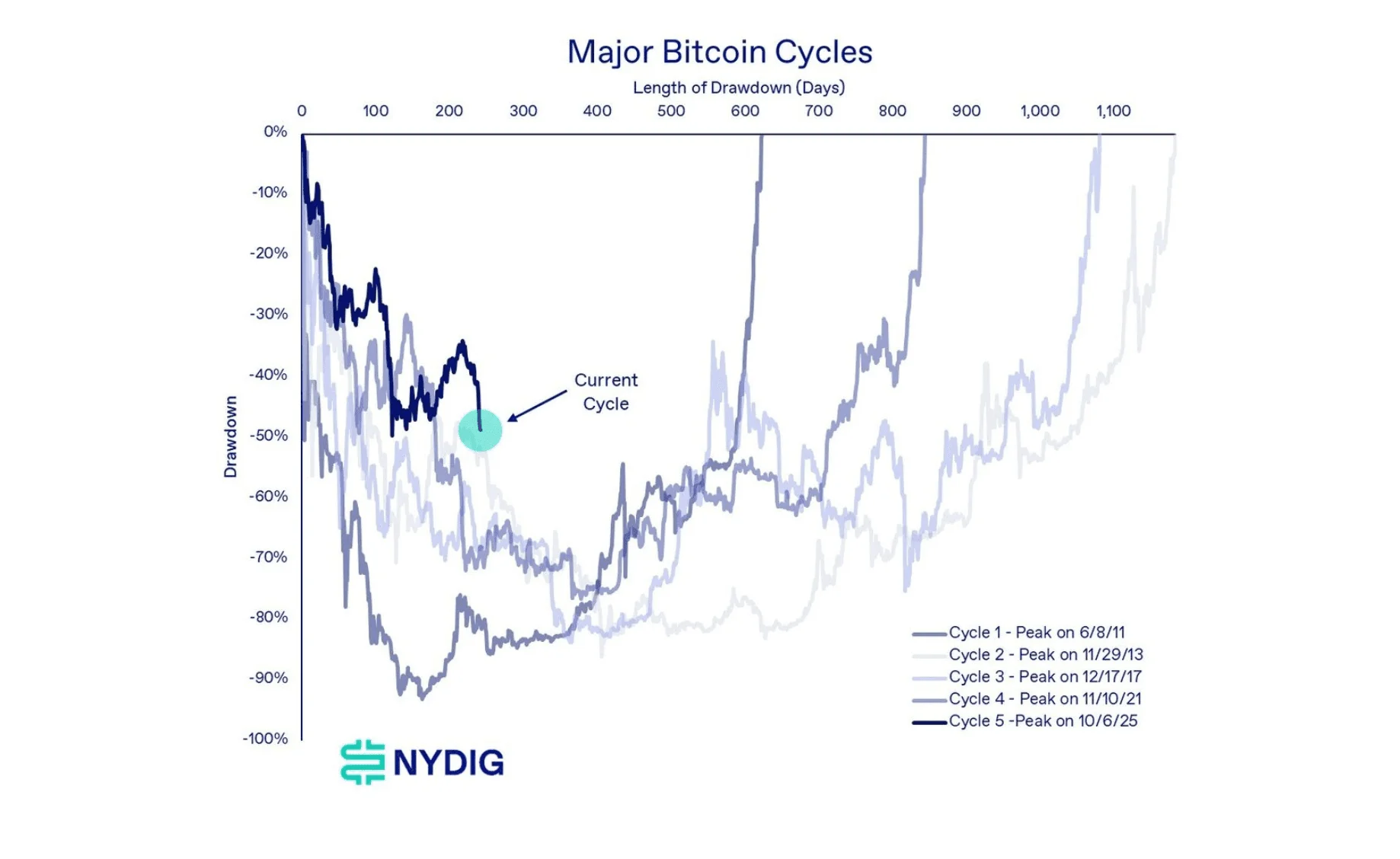


Bitcoin's recent slide has no single trigger, according to NYDIG head of research Greg Cipolaro, who argues several overlapping headwinds have converged on the market at once. He frames the weakness as the product of AI-driven capital rotation, a looming mega-IPO cycle that has institutions raising cash, resurfacing quantum-computing risk, U.S. sanctions on Iranian-linked crypto addresses, and the psychological weight of Strategy selling 32 BTC — roughly $2.5 million worth of bitcoin — for the first time.
Why it matters
Cipolaro's central point is that bitcoin and crypto increasingly compete with AI for the same marginal dollar. The investor overlap between the two sectors is larger than commonly assumed, he wrote, and as AI-linked equities continue to outperform, capital has rotated out of crypto. Layered on top, the expected debut of mega-cap tech issuers — SpaceX, OpenAI and Anthropic are widely cited as next in line — tends to force institutions to trim existing positions ahead of allocations, adding a second-order drag on demand.
Industry-specific worries compounded the macro shift. Treasury Secretary Scott Bessent's disclosure that U.S. authorities seized roughly $1 billion of Iranian-linked crypto assets raised fresh questions about government reach into digital-asset markets. Researchers publishing new work showing the computational cost of attacking widely used cryptographic schemes may be falling faster than expected brought quantum risk back into the conversation. And Strategy's 32 BTC sale, immaterial in supply terms, rattled a thesis that had rested on the company as a one-way buyer.
Market impact
Cipolaro's onchain read is mixed. Bitcoin's MVRV ratio has fallen to 1.2 — close to the level at which market value converges with investors' aggregate cost basis — and the share of supply held in profit has slipped below 50%, both historically associated with major bottoms. Yet the drawdown itself is shallow by prior standards: roughly 53% from the October peak near $126,000, against the 75–90% peaks-to-troughs of earlier cycles.

Frequently asked questions
-
Why is bitcoin falling if there's no single bad news headline?
NYDIG's Greg Cipolaro argues several headwinds have overlapped: capital rotating to AI equities, institutions trimming ahead of a large tech-IPO cycle, the U.S. seizure of roughly $1B in Iranian-linked crypto, new quantum-risk research, and Strategy's first BTC sale. None is sufficient alone, but together they explain…
-
How does AI affect bitcoin's price?
Cipolaro writes that bitcoin and AI attract the same kind of investor — those seeking exposure to emerging technology and outsized returns. As AI-linked stocks continue to outperform, capital has rotated out of crypto, making AI momentum a direct competitor for marginal dollars.
-
Why would tech IPOs weigh on bitcoin?
Mega-cap listings from SpaceX, OpenAI and Anthropic are widely expected in the coming quarters. Cipolaro notes that institutions typically raise cash and trim existing positions ahead of large new allocations, creating a structural headwind for crypto demand even before the IPOs actually price.
-
What did NYDIG say about Strategy selling bitcoin?
Strategy sold 32 BTC worth roughly $2.5 million — supply-immaterial, Cipolaro wrote, but psychologically significant. Strategy has spent years acting as one of bitcoin's most consistent buyers, and any suggestion it could become a source of supply forces investors to rethink that pillar of the bull case.
-
Has bitcoin bottomed yet?
Cipolaro's onchain read is mixed. MVRV has fallen to 1.2 and the share of supply held in profit is below 50%, both historically near major bottoms. But the 53% drawdown from the ~$126,000 October peak is much shallower than the 75–90% drops in prior cycles, leaving open whether institutional demand has structurally…
 Crypto News
 Glassnode
 WatcherGuru
 WuBlockchain