


 CryptoSlate
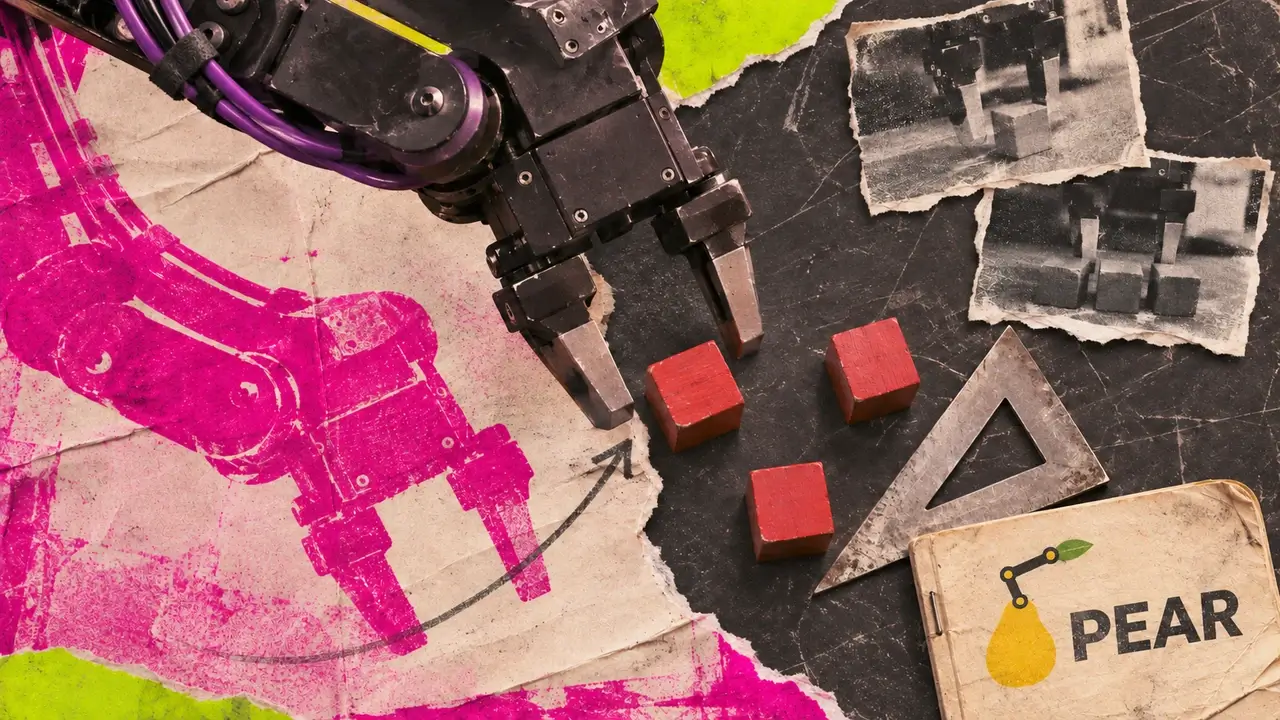

PEAR researchers reported that a model completed 18 of 30 physical robot trials after learning pickup and block alignment entirely in simulation, while the base model recorded no successes. The system post-trained Qwen3.8-27B, a 27-billion-parameter open-weight reasoning model, using reinforcement learning without demonstrations. Its physical evaluation used a dual-arm YAM robot that was not used in training, alongside a simulation-only checkpoint that completed seven of the 30 trials.
Why it matters
The cross-hardware result is the core signal. The final model practiced the two evaluated task types in simulation, then transferred them to physical hardware it had not encountered during training. It succeeded in 12 pickup attempts and six alignment attempts, showing that synthetic practice can teach more than movements tied to one machine.
PEAR controls robots by reading camera images and machine state, reasoning in text, and specifying changes to the gripper pose. Inverse kinematics converts those instructions into joint movements before a controller executes them. Performance depends on prompts that define coordinate frames, gripper orientation, cameras, and completion conditions, while each physical attempt had a 25-round budget.
Market impact
The work supports a practical route to robotics training: use simulation to generate repeatable experience, then test whether learned policies survive changes in physical hardware. That matters as developers seek to reduce the cost and time required to collect real-world training data for general-purpose robot systems.
Reasoning latency remains the main deployment constraint. PEAR's separate demonstration reached 747 tokens per second on a GB300 using lower-precision NVFP4 weights and the DFlash2 accelerator, implying about 4.3 seconds to generate an average high-effort reasoning round. The physical evaluations used BF16 weights because quantization reduced accuracy, so the speed test and success rate apply to different configurations.
The findings are author-reported and still await independent replication.
Frequently asked questions
-
How did PEAR's simulation-trained model perform in physical robot trials?
It completed 18 of 30 physical trials, including 12 pickups and six alignment attempts. The base model had no successes, while a simulation-only checkpoint completed seven.
-
Was the YAM robot used during PEAR's training?
No. The physical tests used a dual-arm YAM robot that none of the compared models trained on, making the result a test of cross-hardware transfer.
-
Which AI model was post-trained for the PEAR robotics system?
The researchers post-trained Qwen3.8-27B, an open-weight reasoning model with 27 billion parameters, using reinforcement learning without demonstrations.
-
Why was the 747 tokens per second result not used in physical trials?
The speed demonstration used lower-precision NVFP4 weights and DFlash2 on a GB300. Physical evaluations used BF16 because quantization reduced accuracy, so the configurations differed.
-
What must happen before PEAR's simulation-transfer result is widely validated?
The author-reported findings need independent replication, broader task coverage, and shorter reasoning delays. Researchers must also show that transferred policies work reliably beyond the tested YAM robot.
 CoinTelegraph
 WatcherGuru
 Crypto News
 CoinDesk
 WuBlockchain