








 CoinDesk
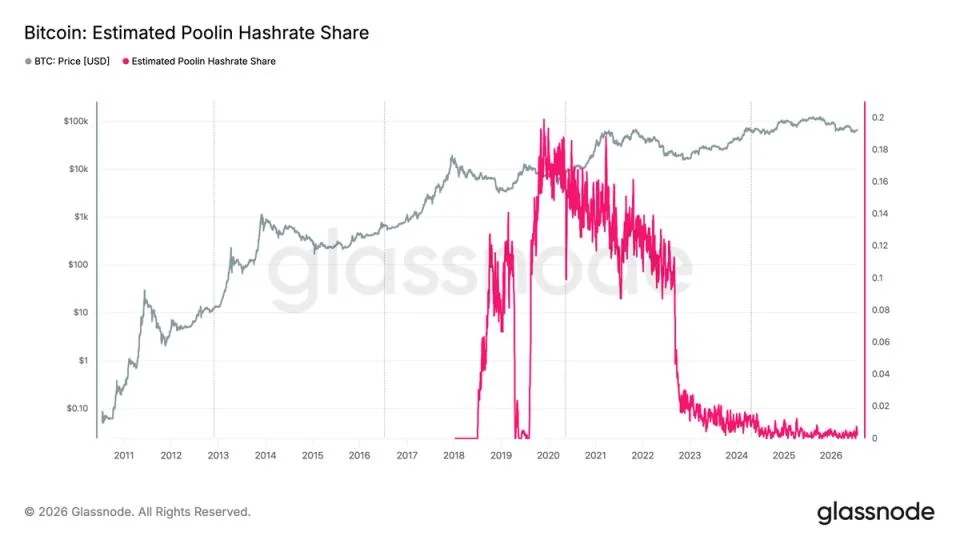



Poolin, the Singapore-based Bitcoin mining pool that once commanded roughly 18-20% of global hashrate at its 2019 peak, filed for Chapter 11 bankruptcy on July 22 alongside its U.S. affiliates Lonestar Dream and Lonestar Taproot in New Jersey. The filing discloses estimated liabilities between $100 million and $500 million, with creditors owed approximately $173 million. The company's effective hashrate share has been at zero for years, but the bankruptcy closes a multi-year unwind that began with a 2022 liquidity crisis and $163.7 million in frozen customer funds.
The only meaningful recovery in front of creditors is a $52 million bid from Thor CALAP LLC for Poolin's two West Texas mining sites, which represent the bulk of the company's remaining assets. The filing, first reported by The Energy Mag, comes more than two years after Poolin Wallet suspended withdrawals in September 2022 and issued roughly $163.7 million in IOU tokens to around 11,700 customers. Co-founder Kevin Pan acknowledged in a WeChat post at the time that the company was "facing liquidity problems."
Why it matters
Poolin's collapse is the cleanest case study of how quickly a dominant infrastructure layer can become a credit risk. In 2019 it was the single largest pool on the Bitcoin network, with more hashrate pointing at it than any other operator. By 2022 that share had collapsed, and the company was issuing IOUs to retail users after a Texas expansion that was supposed to revive the business stalled on delayed grid connection approvals. The bankruptcy crystallizes the end of that bet, with the original lender base, retail creditors, and the IOU holders all positioned behind the $52M West Texas bidder in the Chapter 11 waterfall.
Market impact
The hashrate impact is essentially zero today, since Poolin's network share has been effectively zero for years. The reading is for credit risk and the post-2022 unwind cycle. The $173M debt against a $52M asset bid implies a sizable recovery gap for unsecured creditors, and the structure of the IOU claims now faces a defined resolution path.

Frequently asked questions
-
What is Poolin's bankruptcy filing?
Poolin filed for Chapter 11 protection in New Jersey on July 22 alongside its U.S. affiliates Lonestar Dream and Lonestar Taproot, disclosing estimated liabilities between $100M and $500M and roughly $173M owed to creditors.
-
How much do creditors stand to recover?
The only meaningful asset on the table is a $52M bid from Thor CALAP LLC for two West Texas mining sites, against approximately $173M in total claims, implying a sizable recovery gap for unsecured creditors.
-
What happened to Poolin Wallet users?
Poolin Wallet suspended withdrawals in September 2022 and issued approximately $163.7M in IOU tokens to around 11,700 customers, who now hold claims in the bankruptcy proceeding.
-
How much of Bitcoin's hashrate did Poolin once control?
At its 2019 peak, Poolin commanded roughly 18-20% of global Bitcoin hashrate, making it the largest single mining pool on the network. Its share has been effectively zero for years.
-
Why did Poolin collapse?
A 2022 liquidity crisis led to withdrawal freezes and $163.7M in IOU tokens. A planned Texas expansion meant to revive the business stalled on delayed grid connection approvals, leaving the company unable to recover.
 WuBlockchain
 CryptoSlate
 Crypto News
 Lookonchain
 TheBlock