








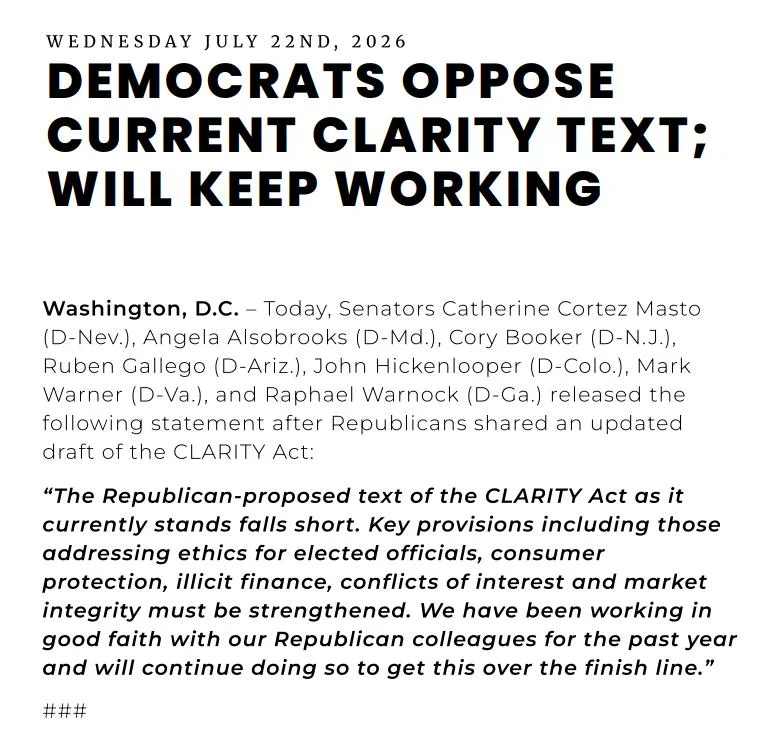
Seven pro-crypto Senate Democrats told colleagues this week that the Republican-drafted CLARITY Act still falls short on ethics, consumer protection, and illicit finance provisions. The group said it remains committed to working with Republicans to get the bill over the finish line.
Why it matters
CLARITY is the chamber's main vehicle for assigning digital asset oversight between the SEC and CFTC, a jurisdictional split the industry has been pushing for since 2023. Democratic buy-in has been the missing variable: a working group of seven has been negotiating changes for months, and their public pushback signals the remaining gaps are structural, not cosmetic. The three areas they flagged, ethics disclosures around token issuers, consumer protection standards, and anti-money-laundering guardrails for non-bank intermediaries, mirror the provisions that have stalled earlier market-structure bills.
Market impact
The bill's path through the Senate now depends on whether the working group's concerns can be resolved in markup. A clean bipartisan vote would unlock the House version and pull forward the timeline on spot altcoin ETF approvals, which the SEC has been holding until jurisdictional questions are settled. A prolonged impasse keeps the current ambiguity in place: the SEC retains de facto authority over most non-Bitcoin tokens, and issuers continue operating under enforcement rather than rule-based oversight.
Frequently asked questions
-
What is the CLARITY Act?
The CLARITY Act is the Senate's main vehicle for assigning digital asset oversight between the SEC and CFTC, a jurisdictional split the crypto industry has pushed for since 2023 to replace the current enforcement-driven regime.
-
Why are Senate Democrats pushing back on it?
A group of seven pro-crypto Democrats says the Republican-drafted version falls short on ethics disclosures around token issuers, consumer protection standards, and anti-money-laundering guardrails for non-bank intermediaries.
-
Is this a partisan block on the bill?
No. The seven Democrats publicly reaffirmed their commitment to working with Republicans to get CLARITY across the finish line, framing the pushback as good-faith negotiation rather than opposition.
-
What happens if CLARITY passes?
A clean bipartisan vote would unlock the House version and pull forward the timeline on spot altcoin ETF approvals, since the SEC has been holding those until the SEC-versus-CFTC jurisdictional question is settled.
-
What happens if it doesn't pass this session?
The current ambiguity stays in place: the SEC retains de facto authority over most non-Bitcoin tokens, and issuers continue operating under enforcement rather than rule-based oversight. The bill could slip into the next Congress.

 TheBlock
 CryptoSlate
 WatcherGuru
 CoinDesk
 WuBlockchain