








 CryptoSlate

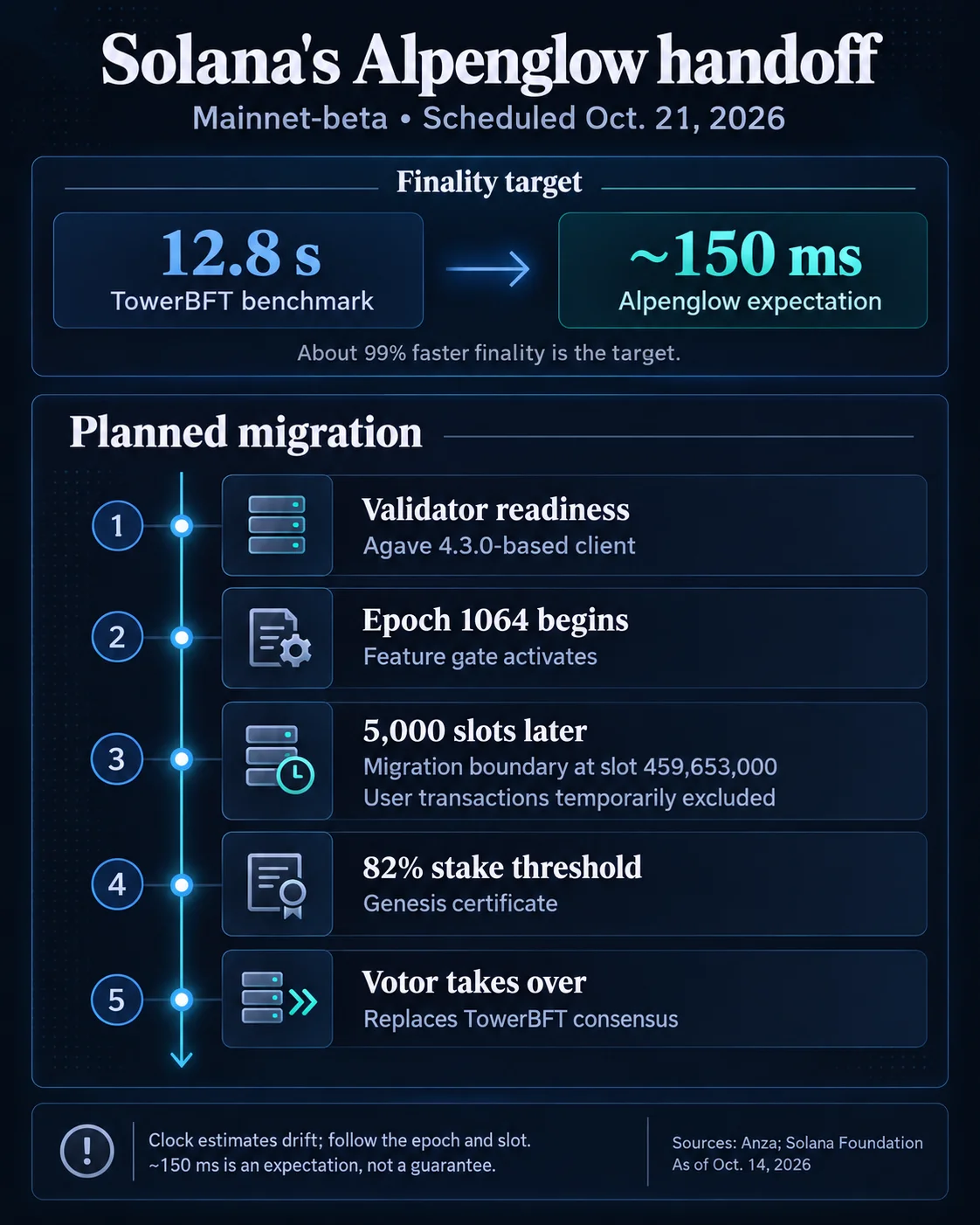

Solana plans to activate Alpenglow on mainnet on Oct. 21, replacing its TowerBFT consensus system and targeting transaction finality in about 150 milliseconds, down from roughly 12.8 seconds. Anza announced the date on Oct. 13. The target would cut finality time by nearly 99%, although actual performance will depend on network conditions, validator participation and the number of voting rounds required.
Why it matters
Alpenglow addresses the time between processing a transaction and treating it as irreversible, not the time needed to produce blocks. Its Votor system lets validators exchange votes directly and combine them into cryptographic certificates, aiming to finalize blocks after one or two voting rounds. Solana recently reduced block-production times to about 200 milliseconds, a separate change to transaction processing.
Faster finality could help payment providers treat transfers as settled sooner and let trading platforms complete operations that depend on settlement. It could also support applications involving tokenized assets and stablecoin payments. Transaction execution will remain unchanged, so existing applications are expected to keep operating without changes to their underlying programs.
Market impact
The migration will test Solana’s ability to replace consensus while the network remains live. Activation is scheduled to begin around 15:00 UTC at the start of epoch 1064. TowerBFT will continue for another 5,000 slots, or about 18 minutes, before the network attempts to switch to Votor. Validators representing at least 82% of staked SOL must sign a genesis certificate for the transition. User transactions will briefly stop entering blocks during the handover.
Validators need software based on Agave 4.3.0 and at least 0.8 SOL above their rent-exempt balance for a participation fee. Firedancer and Frankendancer clients will not be supported during the migration. Alpenglow has been deployed on testnet and devnet, but the Oct. 21 mainnet transition will be the first live test. A separate block-distribution component, Rotor, is planned for a later release.

Frequently asked questions
-
How does Alpenglow aim to reduce Solana transaction finality time?
Its Votor system lets validators exchange votes directly and combine them into cryptographic certificates. Blocks could become final after one or two voting rounds.
-
How fast is Solana targeting finality after the upgrade?
Alpenglow targets about 150 milliseconds, compared with roughly 12.8 seconds under TowerBFT. The figure is a target, not an established mainnet result.
-
What must happen for Solana's Alpenglow migration to proceed?
Validators representing at least 82% of staked SOL must sign a genesis certificate. The transition also requires validators to prepare compatible software and meet the participation-fee balance requirement.
-
Will Alpenglow require Solana applications to change their programs?
Transaction execution will remain unchanged, so existing applications are expected to keep operating without modifying their underlying programs.
-
What is the difference between Alpenglow and Rotor?
Alpenglow replaces Solana's consensus system to accelerate finality. Rotor, a separate component intended to overhaul block distribution, is planned for a later release.
 CoinTelegraph
 CoinDesk
 WuBlockchain
 WatcherGuru
 Crypto News