


 WuBlockchain

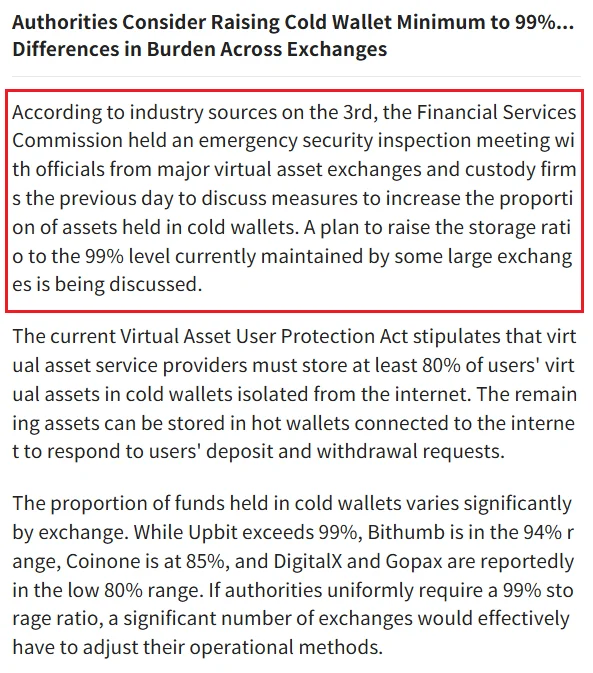
South Korea’s Financial Services Commission is considering raising the minimum share of customer assets held in cold wallets from 80% to around 99%, following the recent Binance hack. The proposal remains under discussion and has not been adopted.
Why it matters
The change would set a substantially higher storage threshold for crypto exchanges operating in South Korea. Upbit already holds more than 99% of customer assets in cold wallets, compared with roughly 94% at Bithumb and 85% at Coinone.
Market impact
Industry participants warn that a stricter requirement could delay withdrawals and increase operational burdens, particularly for smaller exchanges. The proposal’s final level and whether it becomes a rule will determine how much firms need to adjust their custody practices.
Frequently asked questions
-
What cold-wallet threshold is South Korea considering for exchanges?
The Financial Services Commission is considering raising the minimum from 80% to around 99%. The proposal has not been adopted.
-
How much of customer assets do the named exchanges keep in cold wallets?
Upbit holds more than 99%, Bithumb roughly 94%, and Coinone 85%, according to the seed.
-
What prompted South Korea to consider a higher cold-wallet requirement?
The proposal is being considered following the recent Binance hack.
-
Why do industry participants object to a stricter threshold?
They warn that it could delay withdrawals and increase operational burdens, particularly for smaller exchanges.
-
Has South Korea adopted the proposed cold-wallet rule?
No. The proposal remains under discussion and has not been adopted.
 CoinDesk
 WatcherGuru
 CryptoSlate
 CoinTelegraph