








 WatcherGuru

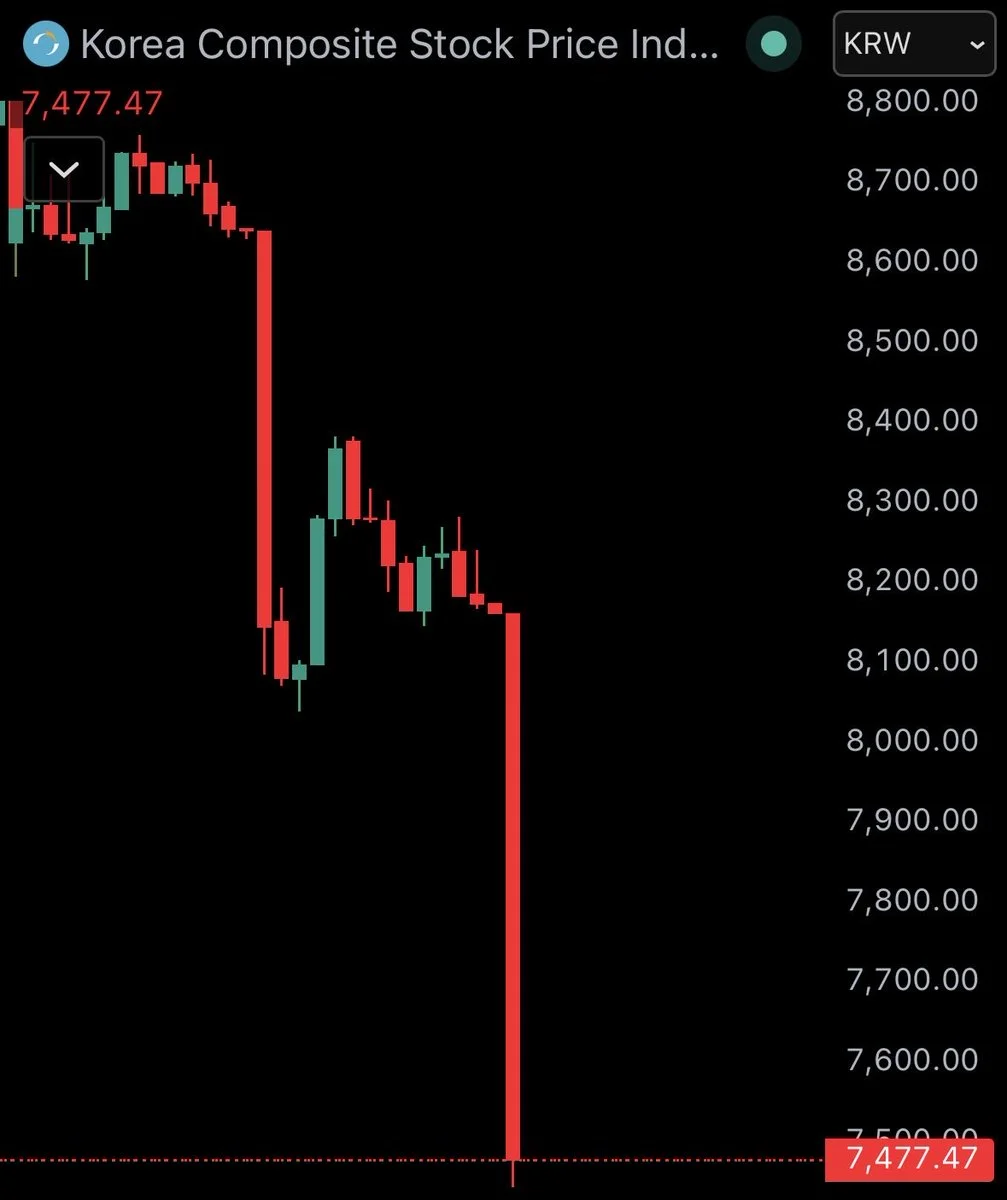
South Korea's KOSPI index plunged 8.4% on Monday, forcing exchange operators to halt trading after an automatic circuit breaker was triggered — one of the steepest single-session drops in the index's recent history.
Why it matters
Circuit breakers on major Asian equity exchanges are rare enough to be market-moving signals in their own right. A halt of this scale in South Korea — a mid-sized open economy with deep semiconductor, automotive, and consumer electronics exposure — sends an immediate risk-off signal across Asia-Pacific markets. Investors tracking crypto and broader risk assets will note that sharp dislocations in traditional equity markets have historically correlated with short-term selling pressure in BTC and ETH as institutional desks reduce gross exposure across books.
Market impact
The 8.4% drop puts the KOSPI in crash territory for the session, well beyond the 5% threshold that typically triggers the first-level circuit breaker. Traders should watch for contagion into the Korean won, regional EM currencies, and Asian crypto exchange volumes — South Korea remains one of the world's most active retail crypto markets. Any sustained equity weakness in Seoul tends to compress local risk appetite and can amplify volatility in KRW-denominated crypto pairs.
Frequently asked questions
-
What threshold triggers a circuit breaker halt on the KOSPI?
A first-level circuit breaker on the KOSPI is typically triggered when the index falls 5% or more from the previous close. An 8.4% drop well exceeds that threshold, indicating a severe single-session dislocation.
-
Why does a KOSPI crash matter for crypto markets?
South Korea is one of the world's most active retail crypto markets, and sharp equity selloffs historically compress local risk appetite and amplify volatility in KRW-denominated crypto pairs. Institutional desks may also reduce gross exposure across asset classes.
-
Which other markets could be affected by the KOSPI halt?
The Korean won and broader emerging-market currencies are the most immediate transmission channels. Regional Asia-Pacific equity indices and crypto exchange volumes in Seoul are also likely to reflect the risk-off impulse in the near term.
 WuBlockchain
 CoinTelegraph
 CryptoSlate
 TheBlock
 CoinDesk