








 CoinDesk

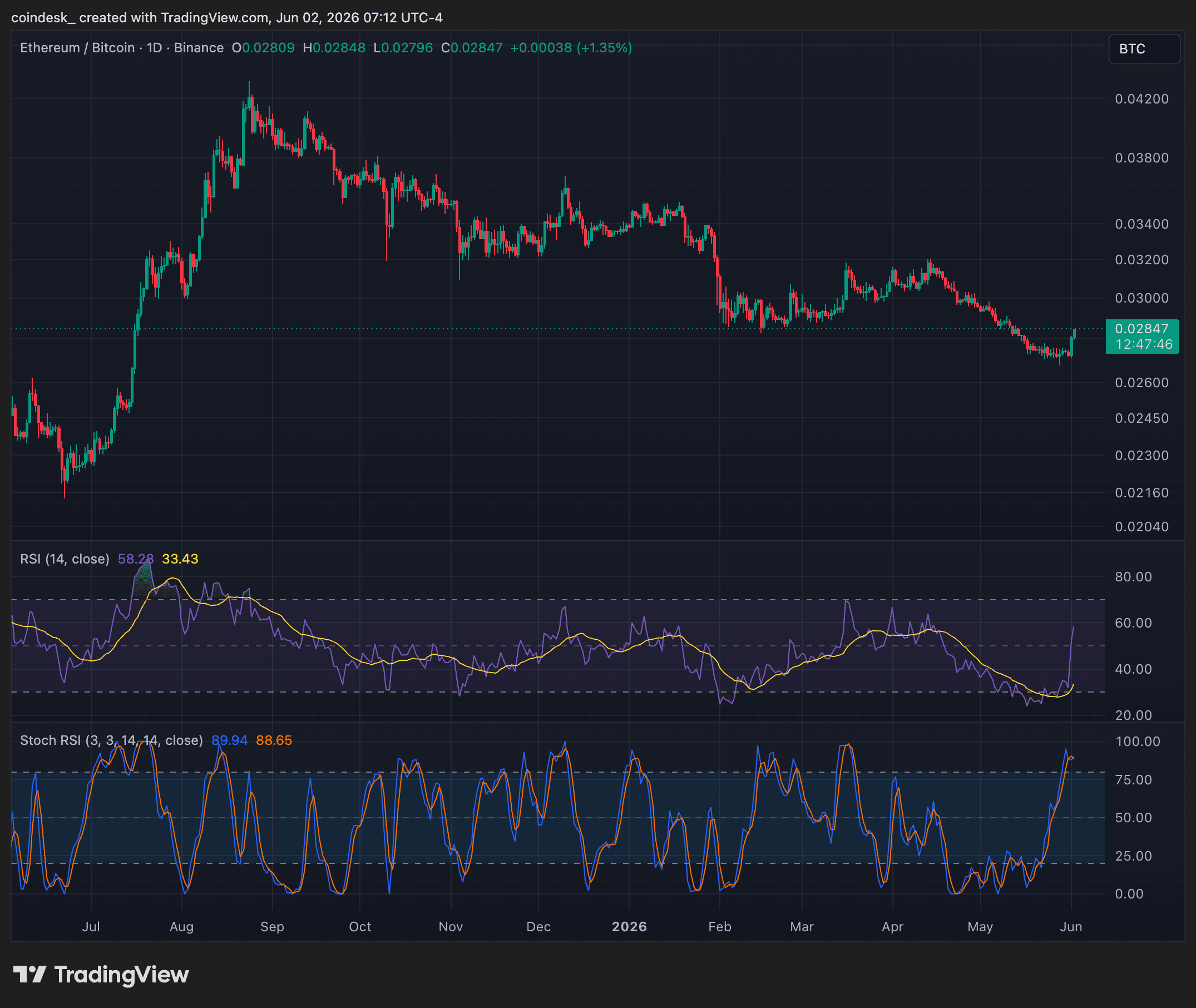

Standard Chartered head of digital asset research Geoffrey Kendrick said Strategy's first bitcoin sale since 2022 may mark the start of a sustained ether outperformance cycle, projecting the ETH-BTC ratio to climb to 0.04 by year-end from roughly 0.028 currently — a move that would translate into ether beating bitcoin by more than 40% regardless of which direction the two assets move.
The call rests on a structural divergence in how bitcoin and ether treasury companies fund their operations. Strategy (MSTR) and other BTC treasury vehicles rely almost entirely on price appreciation and capital markets activity to cover expenses, with no native yield on the underlying asset. ETH treasury firms, by contrast, can stake their holdings — currently generating around 3% annualized — and earn recurring income without ever touching principal.
Why it matters
The market read on Strategy's sale has been mostly about the headline panic it triggered, not the economics behind it. Kendrick argues the reverse: the $2.5 million in BTC that changed hands is immaterial, but it exposes a fragility in the bitcoin-treasury model that ether treasuries structurally avoid. Tom Lee's Bitmine (BMNR) — the largest ether treasury with an $11 billion ETH stash built without any debt issuance — estimates roughly $258 million in annualized staking revenue, with rewards projected to approach $300 million through its MAVAN staking platform. That is a self-funding mechanism no BTC treasury can replicate.
It is a familiar thesis from Kendrick, who has flagged ETH outperformance before — including an earlier call tied to the U.S. Clarity Act and a regulatory framework he expects to unlock the next chapter of decentralized finance. The new note extends that view with a specific catalyst: bitcoin treasuries that need to liquidate to cover obligations versus ether treasuries that don't.
Market impact
Ether has already staged a meaningful recovery from its five-year low against bitcoin hit in April 2025, bouncing more than 60% off the lows over the past year, even as ETH has depreciated 66% versus BTC since Ethereum's September 2022 transition to proof-of-stake.


Frequently asked questions
-
What did Standard Chartered's Geoffrey Kendrick say about ETH versus BTC?
Kendrick said Strategy's first bitcoin sale since 2022 may mark the start of sustained ether outperformance. He projects the ETH-BTC ratio to climb to 0.04 by year-end from ~0.028 currently, implying ether would beat bitcoin by more than 40% regardless of which direction the two assets move.
-
Why do ether treasury firms not need to sell their holdings?
Ether can be staked to earn yield — currently around 3% annualized — giving ETH treasury companies a recurring source of income without liquidating principal. Bitmine (BMNR) estimates roughly $258 million in annualized staking revenue, with rewards projected to approach $300 million through its MAVAN staking platform.
-
What was the size of Strategy's bitcoin sale and why does it matter?
Strategy sold $2.5 million in BTC — a small amount by itself. Kendrick argues the real signal is structural: it highlights that bitcoin treasury companies may need to sell holdings to cover obligations, while ether treasury firms can fund themselves from staking yield without ever touching their ETH.
-
What are Geoffrey Kendrick's longer-term ether price targets?
Kendrick has a long-term ETH price target of $4,000 by the end of 2026 and $40,000 by 2030. The ratio call to 0.04 by year-end is the near-term piece of a multi-year revaluation thesis he has been building since earlier this year.
-
How have ether and bitcoin performed against each other recently?
Ether depreciated 66% versus bitcoin from the September 2022 proof-of-stake transition through a five-year low in April 2025. Since then ETH has bounced more than 60% off the lows against BTC, and Kendrick's call is that the recovery has further to run as ETH treasury economics get repriced.
 Whale Alert
 CoinTelegraph
 Crypto News