








 CoinDesk
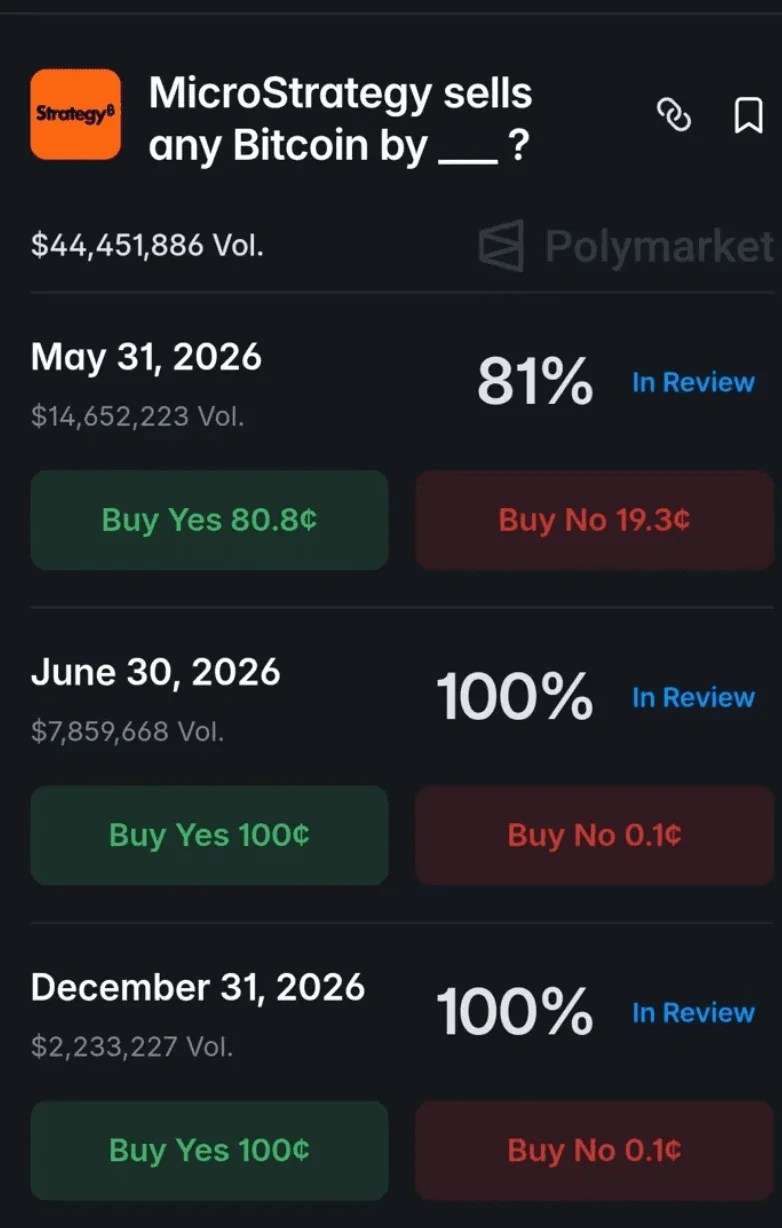


Strategy disclosed its first publicized bitcoin sale in an 8-K filed June 1 covering the period May 26 to May 31, immediately igniting a resolution dispute on Polymarket over whether the trades qualify for the May 31 deadline contract. The 'MicroStrategy sells any Bitcoin by ___?' market carries $14.65 million in volume on the May 31 contract alone, now sitting at 81% Yes and flagged "in review."
Bettors split on a timestamp question: 'Yes' holders point to onchain data and the 8-K table stating activity "as of May 31, 2026, 4:00 p.m. Eastern Time" as proof the sale predates the cutoff, while 'No' holders argue no public information existed before the June 1 filing. The June 30 and December 31 contracts have both moved to roughly 100% Yes since disclosure, reading 99.9 cents on the Yes side.
Why it matters
The fight is structurally new for crypto prediction markets. Polymarket contracts resolve on a "consensus of credible reporting" backed by MSTR filings and onchain data — but when the underlying transaction and its public disclosure fall in different reporting windows, the oracle has to pick a rule. UMA's optimistic oracle reviews ambiguous markets over a roughly two-day window before issuing a final determination. Whichever side loses on the May 31 contract absorbs the largest single payout swing of the three contests.
Heading into the filing, Polymarket had priced the odds of any Strategy bitcoin sale before year-end at 84%, up from 10% earlier in the spring. The repricing followed CEO Phong Le's Q1 earnings call, where he framed a "disciplined sale of bitcoin" as a legitimate capital management tool — language that effectively pre-conditioned the market for this exact event.
Market impact
The three contested timeframes — May 31, June 30, and December 31 — have drawn roughly $24.7 million in combined volume, making this the largest Polymarket resolution dispute tied to a single corporate action.

Frequently asked questions
-
Why is Strategy's bitcoin sale causing a dispute on Polymarket?
Polymarket's May 31 contract resolves on whether Strategy sold any bitcoin before 11:59 p.m. ET on that date. The 8-K filed June 1 reports 32 BTC sold between May 26 and May 31, splitting bettors on whether onchain timestamps or the public filing date controls the deadline.
-
How much money is at stake in the Polymarket dispute?
The contested May 31 contract carries $14.65 million in volume alone, with combined volume of roughly $24.7 million across the May 31, June 30, and December 31 contracts. The May 31 market sits at 81% Yes and is flagged 'in review.'
-
Who decides the Polymarket outcome?
UMA's optimistic oracle — the dispute-resolution system Polymarket uses for ambiguous markets — issues the final determination after a roughly two-day review. Whichever side loses on the May 31 contract absorbs the largest payout swing.
-
How did Polymarket's odds move before the Strategy sale was disclosed?
Odds of any Strategy bitcoin sale before year-end rose from 10% earlier in the spring to 84% heading into the filing. The repricing followed CEO Phong Le's Q1 earnings call, where he framed a 'disciplined sale of bitcoin' as a capital management tool.
-
What does this resolution mean for Strategy and bitcoin?
The dispute itself has limited direct price impact, but a confirmed BTC disposition forces the market to reprice the premium attached to Saylor's treasury strategy. The June 30 and December 31 contracts have already moved to roughly 100% Yes since the disclosure.
 Lookonchain
 Crypto News
 WuBlockchain
 TheBlock
 WatcherGuru
 Crypto Rank News
 CoinTelegraph