








Tether reported approximately $1.04 billion in net profit for Q1 2026, with excess reserves rising to a record $8.23 billion in its latest attestation.
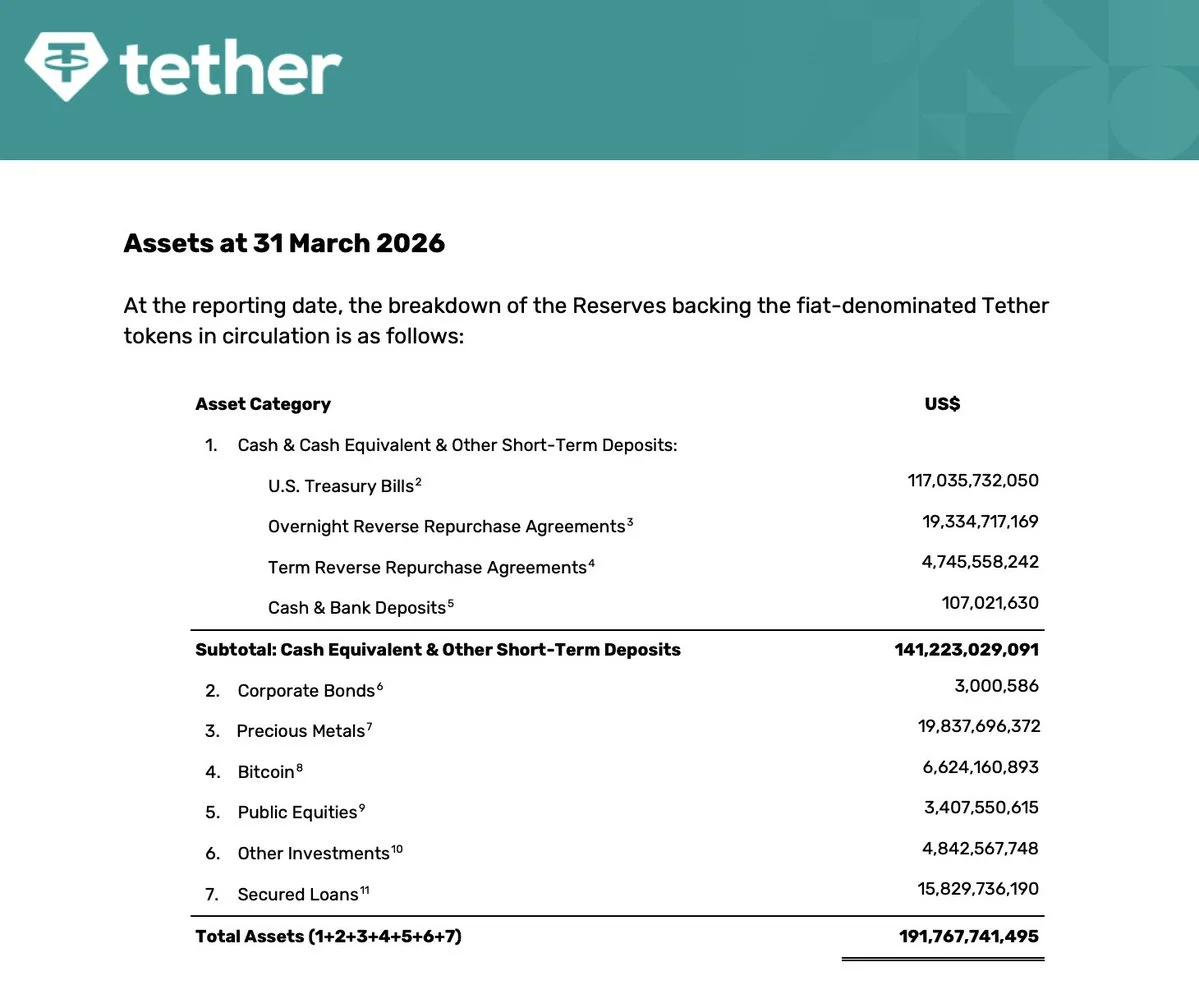
As of March 31, the company held about $191.8 billion in total assets against $183.5 billion in liabilities — liabilities that are, dollar for dollar, USDT tokens circulating in market wallets. The reserve stack remains heavily weighted toward U.S. Treasuries at roughly $141 billion, with about $20 billion in gold and $7 billion in Bitcoin filling out the rest.
Why it matters
The headline isn't the $1.04B print — Tether has run profitable quarters at this scale for years. The story is the size of the buffer. Excess reserves above $8B are the issuer's loss-absorption cushion, the line that protects $1 of USDT from a forced sell-off in the underlying Treasury book. Crossing that threshold without a redemption surge is the cleanest signal yet that Tether's float is growing faster than redemptions — i.e., the company is minting net-new USDT into demand.
It also lands at a politically charged moment. Stablecoin legislation in the U.S. is approaching a floor vote, and reserve-quality requirements are the central fault line. Tether showing up to that debate with $141B in Treasuries and an $8.23B cushion is a direct counter-argument to critics who frame the issuer as a shadow-bank risk.
Market impact
Watch $USDT supply on-chain. Net-new issuance at this scale typically shows up first in offshore demand for dollar access — Latin America, Turkey, parts of Africa — and secondarily in crypto trading pairs on offshore venues. A growing float against stable redemptions also tightens USDT's peg around $1, since the issuer has less need to lean on secondary-market arbitragers to defend the dollar peg.

Frequently asked questions
-
How much profit did Tether report in Q1 2026?
Tether reported approximately $1.04 billion in net profit for Q1 2026, per its latest attestation.
-
What are Tether's excess reserves right now?
Excess reserves reached a record $8.23 billion as of March 31, 2026 — the issuer's loss-absorption cushion backing circulating USDT.
-
How big is Tether's balance sheet?
Total assets stood at about $191.8 billion against liabilities of $183.5 billion, meaning the float of USDT tokens in circulation equaled the liability figure.
-
Where does Tether hold its reserves?
Roughly $141 billion in U.S. Treasuries, about $20 billion in gold, and about $7 billion in Bitcoin — Treasuries dominate the reserve stack.
-
Why does the reserve buffer matter for USDT?
The excess reserve buffer absorbs losses on the underlying reserve portfolio before circulating USDT holders are exposed. Crossing $8B without a redemption surge signals that new USDT issuance is outpacing redemptions — net-new demand, not churn.

 CryptoSlate
 CoinTelegraph
 TheBlock
 Crypto News
 CoinDesk