


 CryptoSlate


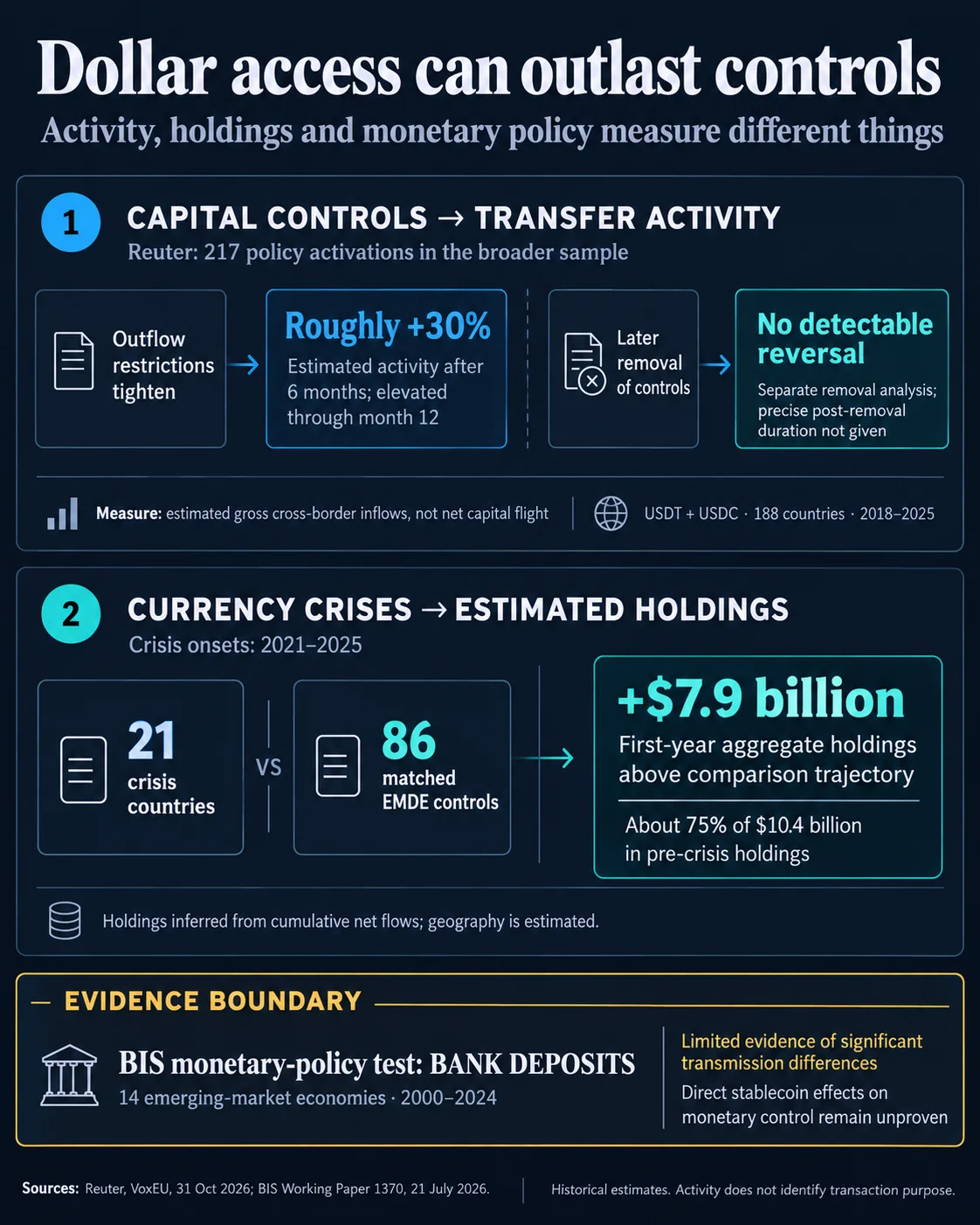

Estimated cross-border stablecoin activity rose roughly 30% within six months of tighter capital controls and remained elevated through month 12, according to IMF economist Marco Reuter's analysis of 217 activations. After controls were removed, the study found no detectable retreat in activity and rejected the hypothesis that removals fully reverse the initial increase.
Why it matters
The findings suggest dollar access through stablecoins can persist after the restrictions that may have helped drive it are lifted. Reuter's panel covers USDT and USDC activity across 188 countries from 2018 to 2025, but measures gross inflows, not net capital flight. Country attribution relies on probabilistic estimates of wallet locations.
A separate comparison found estimated holdings in 21 crisis countries rose about $7.9 billion above the trajectory in control economies during the first year. That was roughly 75% of those countries' $10.4 billion in pre-crisis holdings. The holdings estimate is distinct from the study's measure of cross-border activity.
Market impact
A BIS study also finds persistence in dollar deposits and stablecoin activity, but its tests of stablecoin-flow responses to restrictions were not statistically significant. Its methods, time periods and policy comparisons differ from Reuter's, so the results do not directly contradict one another.
For policymakers, continued monitoring after controls change may help distinguish shifts in transfers from changes in dollar holdings. Neither study establishes whether stablecoin adoption directly weakens domestic monetary control. The BIS monetary-transmission analysis examines bank deposits, not the direct causal effect of stablecoin use.


Frequently asked questions
-
How much did stablecoin activity rise after capital controls tightened?
Reuter estimates cross-border stablecoin activity rose roughly 30% within six months of tighter controls and remained elevated through month 12.
-
Did stablecoin activity fall after capital controls were removed?
The analysis found no detectable retreat after removals and rejected the hypothesis that they fully reverse the initial increase.
-
Does the study show that stablecoins caused net capital flight?
No. Reuter measures gross cross-border inflows, which do not establish net capital flight.
-
What did the separate crisis-country holdings comparison estimate?
Estimated holdings rose about $7.9 billion above the comparison-country trajectory in the first year, roughly 75% of the crisis countries' $10.4 billion in pre-crisis holdings.
-
Why do the IMF and BIS findings on restrictions differ?
The studies use different datasets, country attribution methods, time periods and policy comparisons. The BIS estimates of stablecoin-flow responses to restrictions were not statistically significant.
 WuBlockchain
 CoinDesk
 CoinTelegraph
 WatcherGuru
 TheBlock