


 WuBlockchain
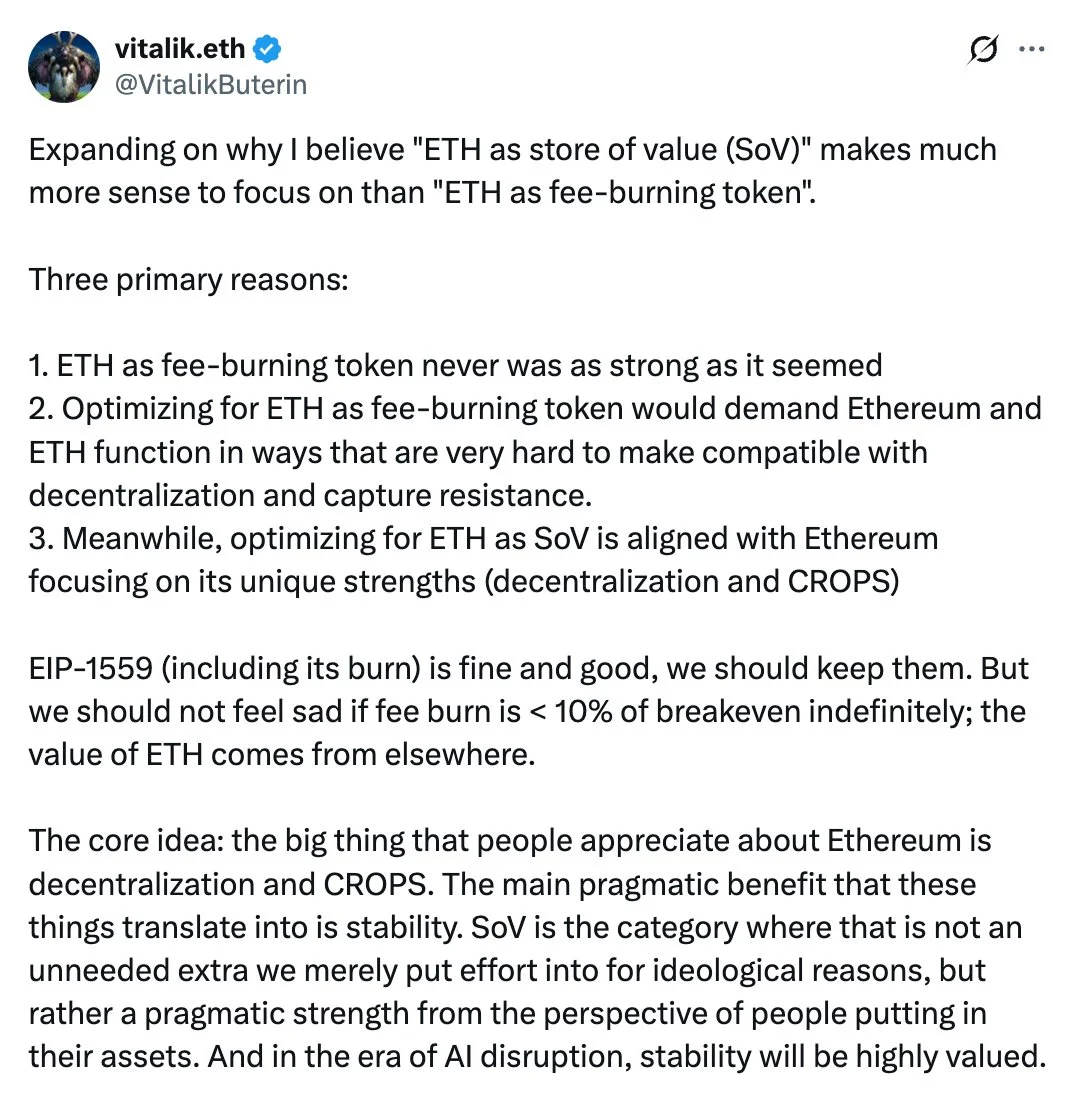

Vitalik Buterin said Ethereum should prioritize ETH's role as a store of value over its identity as a "fee-burning token," arguing that fee burn was never as strong a valuation floor as it appeared and that maximizing fees could conflict with decentralization.
He framed Ethereum's strongest attributes as decentralization and "CROPS" — censorship and capture resistance, open source, privacy and security — qualities he sees as better aligned with store-of-value positioning than with fee maximization.
Buterin added that Ethereum should not be concerned even if fee burn stays below 10% of breakeven long term, saying ETH's value can accrue from elsewhere.

Frequently asked questions
-
Why does Vitalik Buterin think fee burn is a weak valuation floor for ETH?
He argues fee burn was never as strong a valuation floor as it appeared, and that a strategy of maximizing fees could conflict with Ethereum's decentralization and capture resistance.
-
What does CROPS mean in Vitalik's Ethereum framework?
CROPS stands for censorship and capture resistance, open source, privacy and security. Buterin frames these as Ethereum's strongest attributes and better aligned with ETH as a store of value.
-
How low does Vitalik say fee burn can go before Ethereum should worry?
He said Ethereum should not be concerned even if fee burn remains below 10% of breakeven over the long term, since ETH's value can come from sources other than fee burn.
-
What role does Vitalik want ETH to play instead of a fee-burning token?
He wants ETH positioned primarily as a store of value, arguing that Ethereum's decentralization and CROPS qualities back that role more naturally than fee maximization does.
-
Does Vitalik's store-of-value argument mean Ethereum will drop EIP-1559 fee burning?
The seed carries no proposal to change fee burning. Buterin's comments are a framing argument about ETH's valuation narrative, not a stated protocol change.
 Altcoin Daily
 Lookonchain
 CryptoSlate
 CoinTelegraph
 CoinDesk
 Crypto News