








 CoinDesk

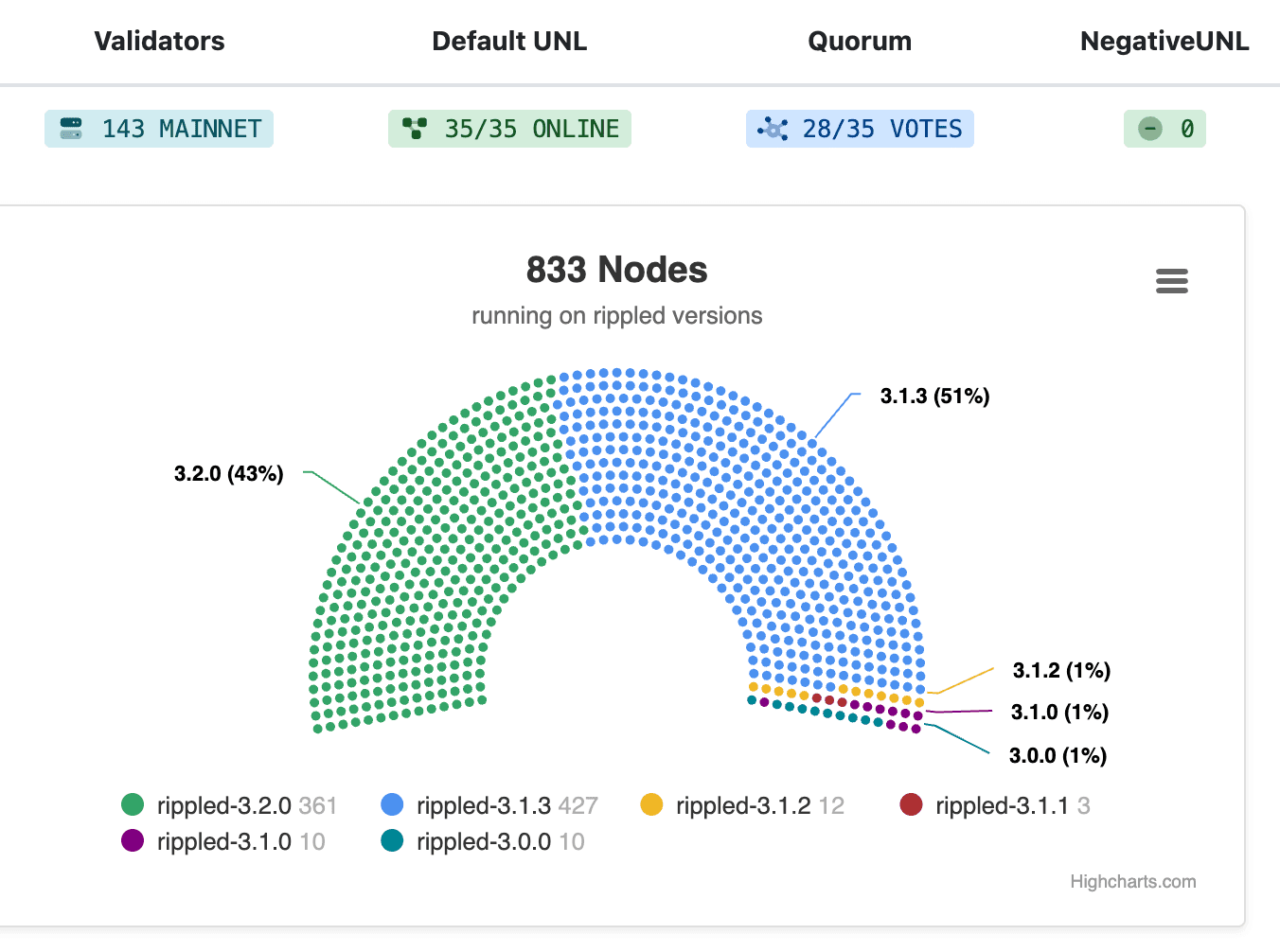


XRP Ledger's new v3.2.0 server software, designed to cut operating costs, improve stability, and make the network more attractive to institutional users, has cleared the 80% validator threshold required to activate, though broader node adoption still lags behind an older release.
Of the roughly 833 active nodes on the ledger, XRPSCAN data shows about 43% are running v3.2.0 while 51% remain on v3.1.3. The decisive number is the default Unique Node List: of 35 trusted validators, 31, or about 89%, have already upgraded, sustaining the level the network treats as sufficient over the two-week window the protocol requires.
Why it matters
Validator adoption is what gates network upgrades on the XRP Ledger, not total node count, and that line has now been crossed. The new software is the substrate for a slate of newer features the network has been actively commercializing, including single-asset vaults, permissioned decentralized exchanges, multi-purpose tokens, and a lending protocol that lets users borrow against pooled funds. Ripple, the payments company whose founders created the XRP Ledger, has voted in favor of the bundled fixCleanup3_2_0 amendment that packages the security fixes for those features.
Market impact
Upgrading a validator and voting the amendment through are two distinct steps, and the amendment is polling far lower than the software adoption, a gap that puts validators who have not upgraded at risk of an amendment-blocked state in which they are cut off from the ledger once it activates. Until fixCleanup3_2_0 clears, the security hardening for vaults, MPTs, and the lending protocol is in limbo, leaving institutional integrations that depend on those features waiting on a slow count rather than the already-finished validator migration.

Frequently asked questions
-
What is the XRP Ledger v3.2.0 upgrade designed to do?
The v3.2.0 server software is intended to cut operating costs, improve network stability, and make the XRP Ledger more attractive for institutional users, while acting as the substrate for newer features such as vaults, permissioned DEXs, multi-purpose tokens, and the lending protocol.
-
How many validators have upgraded to v3.2.0?
On the default Unique Node List of 35 trusted validators, 31, around 89%, are running v3.2.0, sustained over the two-week window the protocol requires to treat an upgrade as activated.
-
Why is overall node adoption slower than validator adoption?
Of roughly 833 active nodes, about 43% have moved to v3.2.0 while 51% remain on v3.1.3. Network upgrades on the XRP Ledger are gated by the trusted validator set, not by total node count, so the validator figure is what determines activation.
-
What is the fixCleanup3_2_0 amendment?
fixCleanup3_2_0 is a separate on-ledger amendment bundled with v3.2.0 that packages security fixes and improvements for single-asset vaults, permissioned DEXs, multi-purpose tokens, and the lending protocol, and adds internal checks to prevent deleted accounts from leaving behind stray data.
-
What happens if validators do not upgrade before the amendment activates?
Validators that have not upgraded by the time fixCleanup3_2_0 activates can be cut off from the ledger in what the network calls an amendment-blocked state, since upgrading the software and voting the amendment through are treated as two distinct steps.
 Crypto News
 CoinTelegraph
 TheBlock
 CryptoSlate
 WatcherGuru