


 CoinDesk
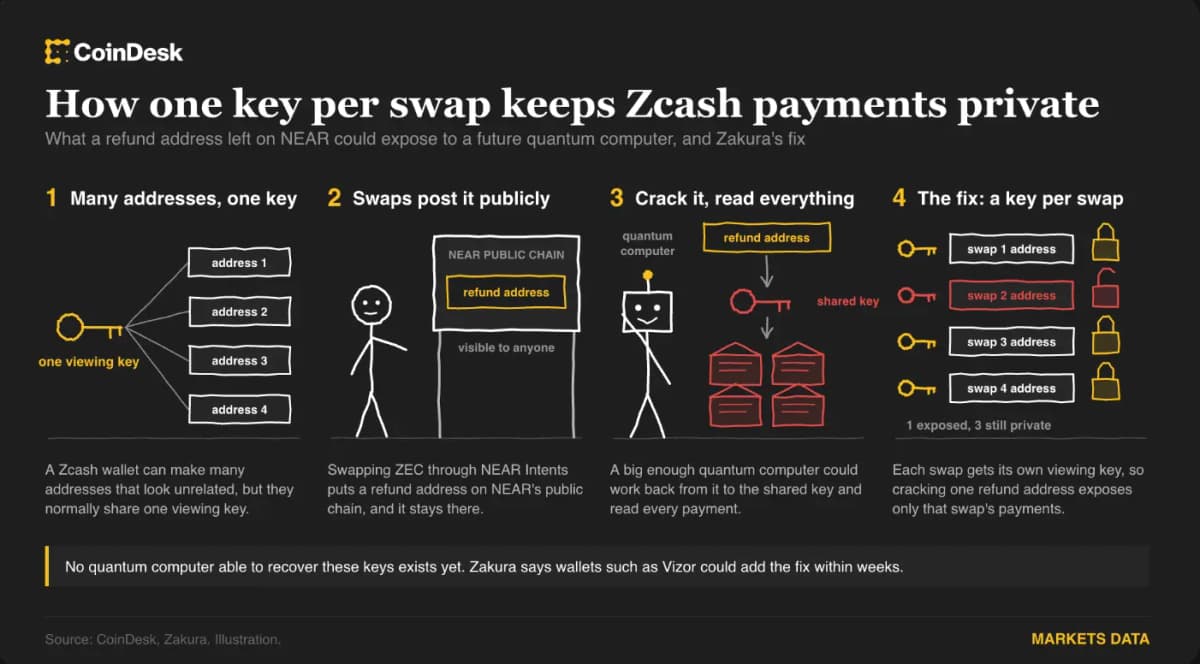

The team behind Zakura, a newer version of the software that runs the Zcash network, wants to give every ZEC swap made through NEAR Intents its own private viewing key. The change closes a gap a future quantum computer could exploit: today, the service posts one of a user's Zcash addresses on NEAR's public chain as a refund destination, and that address stays there permanently even when no refund is ever needed.
A large enough quantum machine running Shor's algorithm, the 1994 method for reversing exactly this kind of elliptic-curve math, could work backward from such a published address to the underlying viewing key. Because Zcash wallets normally share one viewing key across many unlinkable-looking addresses, a single crack would expose every payment an account ever received, including amounts and memos. Spending keys are separate, so funds themselves would stay safe under the current design.
Why it matters
Zakura's fix caps the blast radius. Each swap gets its own viewing key while the spending key stays with the user's main account, so an attacker who someday cracks a refund address on NEAR would see only the payments tied to that one swap. The design also solves a practical snag: restoring a wallet with hundreds of keys would normally mean scanning the entire Zcash chain with each one, so wallets would instead query a database using private information retrieval, a technique that answers the question without learning which addresses were asked about.
Market impact
The timing is pointed. Last week Google said its Willow quantum chip had produced near-perfect versions of a component such an attack would burn through, and the same threat model hangs over Satoshi-era bitcoin, whose public keys already sit onchain. Zakura says compatible software wallets, including Vizor, could adopt the open-source feature within weeks, ahead of the January target Zcash developers set for quantum-resistant payments earlier this month. Hardware wallets would follow once firmware supports it, giving Zcash a credible early lead in the industry-wide race to get quantum-resistant privacy shipped before the hardware catches up.
Frequently asked questions
-
How could a quantum computer expose Zcash swap history?
A large quantum machine running Shor's algorithm could reverse the elliptic-curve math behind a Zcash address to recover its viewing key. Because Zcash wallets normally share one viewing key across many addresses, cracking one published refund address could link every payment the account received.
-
What is Zakura's proposed fix for the ZEC refund address leak?
Zakura wants to assign a separate viewing key to every ZEC swap made through NEAR Intents. Spending keys stay with the user's main account, so an attacker who cracks a refund address would see only the payments tied to that single swap.
-
Why do Zcash refund addresses end up on NEAR's public chain?
NEAR Intents posts one of the user's Zcash addresses on NEAR's public chain as a refund destination when a swap deposit lands. The address stays visible permanently even if the swap completes and no refund is ever needed.
-
How do wallets manage hundreds of per-swap keys without scanning the whole chain?
Zakura proposes a database queried with private information retrieval. The wallet asks where its refunds landed and the database answers without learning which addresses the wallet asked about, avoiding a full Zcash chain scan with every key.
-
When could quantum-resistant Zcash payments reach users?
Zakura says software wallets built on its open-source libraries, including Vizor, could adopt the feature within weeks, ahead of the January target Zcash developers set for quantum-resistant payments. Hardware wallets would follow once their firmware supports it.
 CryptoSlate
 CoinTelegraph
 WuBlockchain