








 CoinDesk

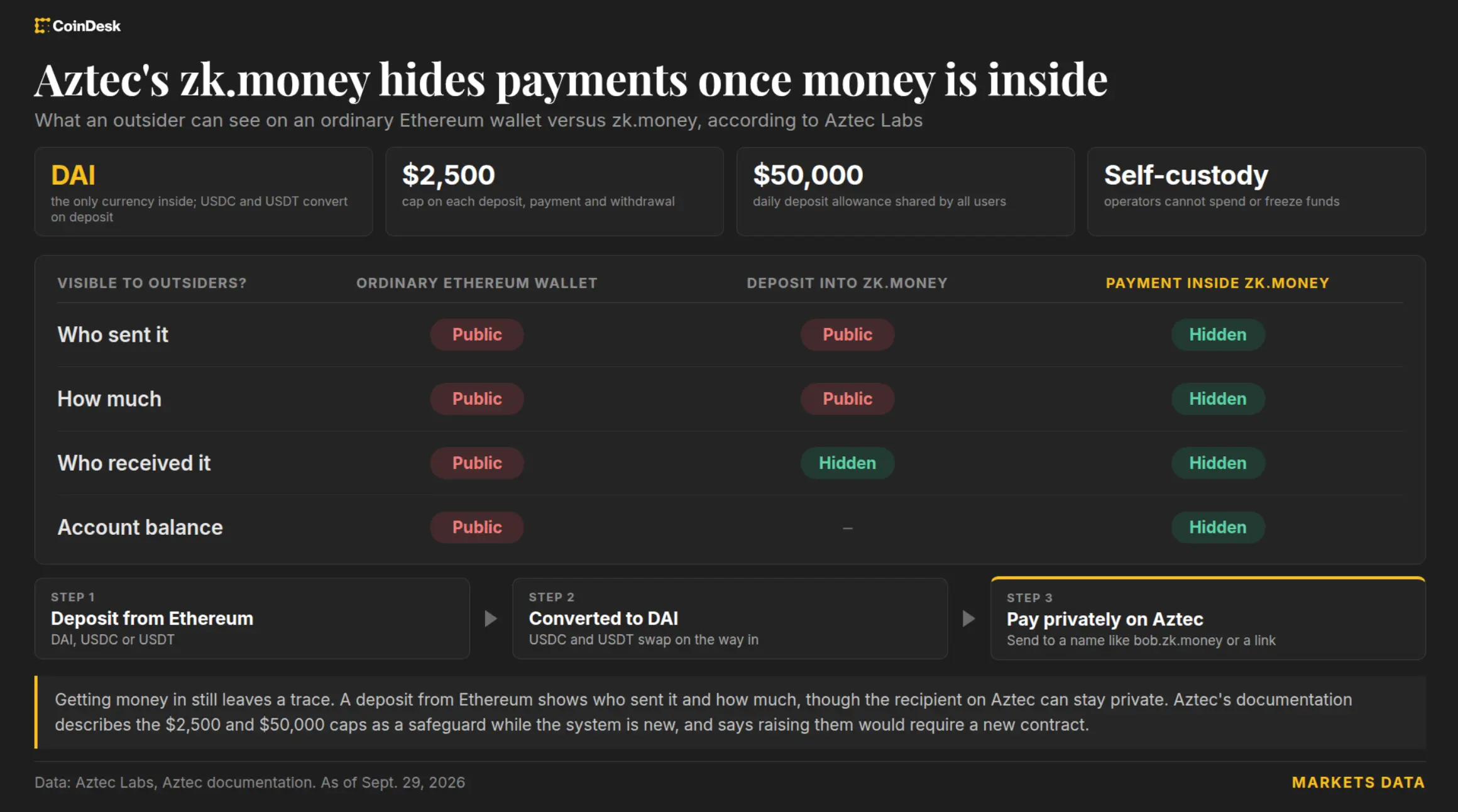


Aztec Labs is relaunching zk.money, a self-custodial wallet that moves payments onto the Aztec Network and hides transaction amounts, balances and recipients. Users can deposit DAI, USDC or USDT from Ethereum, but USDC and USDT are converted to DAI inside the wallet. Each deposit, payment and withdrawal is capped below $2,500, and the software has not been fully audited.
Why it matters
Ethereum transactions are public, allowing anyone with a wallet address to inspect balances and trace transfers. zk.money offers a way to keep subsequent activity private while still using Ethereum-originating stablecoins. Users can send funds to readable names or payment links instead of sharing a long wallet address. The wallet is self-custodial, meaning Aztec Labs says it cannot spend or freeze users’ funds.
Privacy has limits at the entry point: an Ethereum deposit reveals the sender and amount, even if the recipient on Aztec remains private. The wallet also screens deposit and withdrawal addresses under a sanctions policy. A sealed server co-signs operations but, according to the documentation, cannot spend funds on its own.
Market impact
The early Alpha release sets a shared daily deposit allowance of $50,000, which replenishes over time. Deposits cost 35 cents plus Ethereum fees, withdrawals cost 20 cents, and users receive 100 sponsored transactions per day. Payments may be delayed if the contract covering network fees runs short or cannot meet prevailing fees.
Aztec says the original zk.money served more than 75,000 wallets and processed over $100 million before closing in 2024. The relaunched wallet arrives while the network remains in Alpha and critical bugs are possible. Aztec Labs says a separate system called Oxide will check payments for software errors; users can move to an updated network once a planned fix to the V5 proof-system flaw is ready. The balance to watch is whether privacy utility can expand without users taking on unacceptable security risk.




Frequently asked questions
-
What information does zk.money hide?
Payments on the Aztec Network hide amounts, balances and recipients. An Ethereum deposit still reveals the sender and amount.
-
Which stablecoins can users deposit into zk.money?
Users can deposit DAI, USDC or USDT from Ethereum. USDC and USDT are converted to DAI inside the wallet.
-
What are the transaction limits in the Alpha release?
Each deposit, payment and withdrawal must be below $2,500. All users share a $50,000 daily deposit allowance that replenishes over time.
-
What fees and sponsored transactions does zk.money offer?
A deposit costs 35 cents plus Ethereum fees, and a withdrawal costs 20 cents. Users receive 100 sponsored transactions per day, though payments can be delayed if fee funds are insufficient.
-
What security risks should users consider?
The network is in Alpha and the wallet software has not been fully audited, so critical bugs are possible. Aztec says Oxide will check payments for errors and users can move to an updated network once a planned fix is ready.
 TheBlock
 Crypto News
 WatcherGuru
 CoinTelegraph
 CryptoSlate
 WuBlockchain