








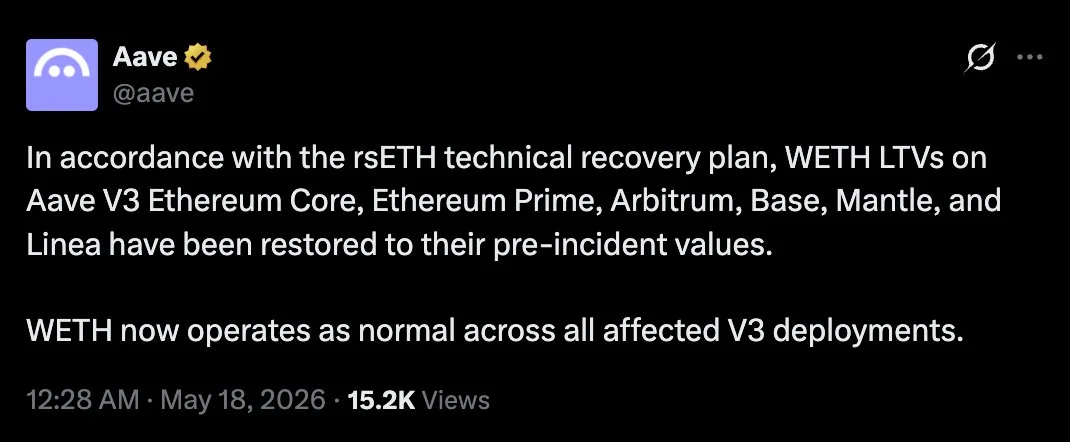

Aave has restored WETH loan-to-value ratios across its affected V3 deployments, reopening borrowing against WETH via standard supply paths and the collateral-and-debt swap functions. Founder Stani Kulechov framed the change as the next phase of the rsETH technical recovery plan, signaling that the swap-path work still in progress is the remaining open item rather than the LTV parameters themselves.
Why it matters
The LTV restoration is a routine parameter governance action on Aave, but the context is the rsETH incident on Kelp DAO's restaking layer that disrupted Aave's rsETH market and forced conservative LTV cuts across multiple chains. Walking LTVs back to pre-incident levels is a signal that the underlying risk parameters for WETH collateral are no longer compensating for residual rsETH exposure — the protocol's risk team has either ring-fenced the rsETH impact or decided it no longer contaminates the WETH book.
Market impact
The change applies to Aave V3 on Ethereum Core, Ethereum Prime, Arbitrum, Base, Mantle, and Linea — seven deployments where WETH borrowing capacity had been throttled. Restoring it returns the largest single-collateral pool on the protocol to its normal operating envelope, which matters for basis traders and ETH-wrapped-loop strategies that route through Aave WETH pairs.

Frequently asked questions
-
What did Aave change about WETH borrowing?
Aave restored WETH loan-to-value ratios across affected V3 deployments to pre-incident levels, allowing users to borrow against WETH again via standard supply and collateral-and-debt swap functions.
-
Which Aave V3 deployments did the WETH LTV update cover?
The update applies to Aave V3 on Ethereum Core, Ethereum Prime, Arbitrum, Base, Mantle, and Linea — seven deployments where WETH borrowing capacity had been throttled.
-
What is the rsETH incident Aave is recovering from?
The rsETH incident originated on Kelp DAO's restaking layer and disrupted Aave's rsETH market, forcing conservative LTV cuts across multiple chains while the protocol's risk team worked through a technical recovery plan.
-
What part of the rsETH recovery plan is still open?
Aave founder Stani Kulechov said the swap-path work is the remaining open item in the recovery plan; the LTV parameter restoration is the step the protocol just completed.
-
Why does restoring WETH LTVs matter for DeFi users?
WETH is the largest single-collateral pool on Aave. Returning it to its normal operating envelope matters for basis traders and ETH-wrapped-loop strategies that route through Aave WETH pairs, restoring borrowing capacity that had been throttled.

 CoinDesk
 CryptoSlate
 CoinTelegraph
 Crypto Rank News
 TheBlock