








 Crypto News
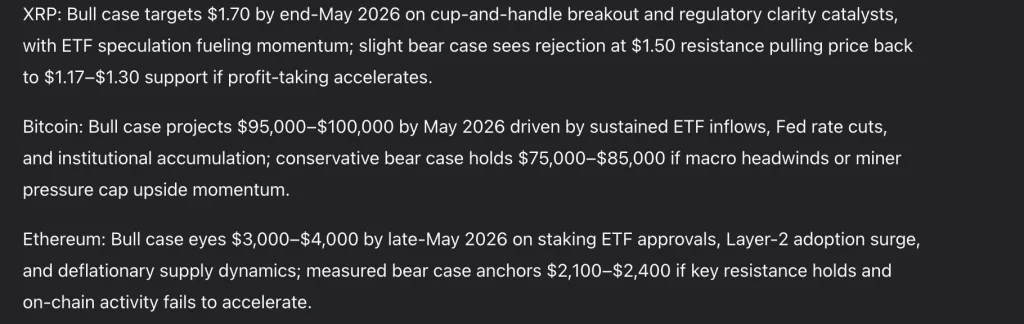
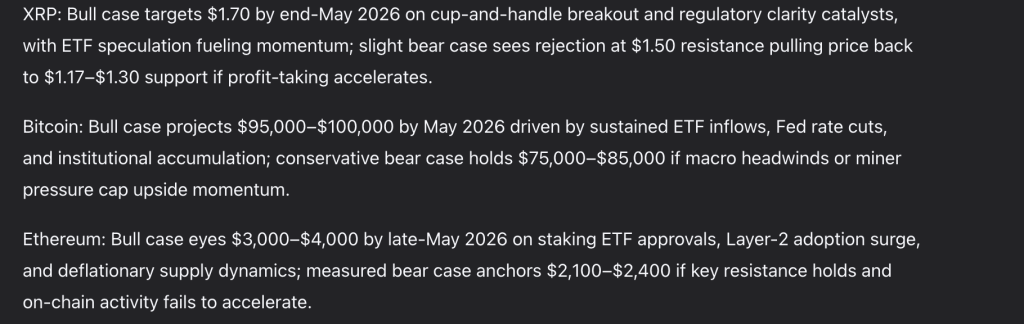

Alibaba's Qwen AI has laid out end-of-May 2026 price targets for Bitcoin, Ethereum, and XRP, projecting BTC at $95,000–$100,000, ETH at $3,000–$4,000, and XRP at $1.70. The model ties each target to a specific catalyst: BTC to sustained ETF inflows, potential Fed rate cuts, and continued institutional accumulation; ETH to staking ETF approval, Layer-2 expansion, and deflationary supply; XRP to a cup-and-handle breakout and regulatory clarity.
Why it matters
The interesting read is less the headline numbers and more the structural framing. Qwen is explicitly tying each move to a trigger rather than projecting blind upside, which gives traders a falsifiable set of conditions. BTC's case rests on the $75K pivot holding; ETH's on reclaiming $2,400–$2,600; XRP's on breaking and holding above $1.50. Lose any of those, and the target line moves out or down.
At the time of the call, BTC was trading around $78,996 and holding above the $75K pivot, ETH was sitting near $2,339 just below its reclaim zone, and XRP was around $1.39 — all three still below the inflection points their respective bull cases depend on. That gap between narrative and price is the core tension: structure intact, breakout not yet confirmed.
Market impact
Near-term, the call keeps a constructive lens on the three majors without overpromising. A slip below $75K on BTC would likely compress the range to $75K–$85K and delay the upside scenario. ETH losing $2,300 puts $2,100–$2,200 back on the table. XRP rejection at $1.50 reopens the $1.17–$1.30 support zone and shifts tone back to consolidation rather than expansion. For the market, the operative read is that price still needs to confirm what the narrative already implies — the trigger windows are narrow, and the next push, not the current levels, decides whether Qwen's targets become a roadmap or a counter.



Frequently asked questions
-
What are Qwen AI's price targets for Bitcoin, Ethereum, and XRP by end of May 2026?
Qwen projected BTC at $95,000–$100,000, ETH at $3,000–$4,000, and XRP at $1.70, tying each to specific catalysts including ETF inflows, staking ETF narratives, and a cup-and-handle breakout structure for XRP.
-
What price levels does Qwen say must hold for each asset's bull case to stay intact?
Bitcoin relies on the $75K pivot holding, Ethereum needs to reclaim and hold $2,400–$2,600, and XRP must break and sustain above $1.50. Loss of any of those levels weakens or delays the respective upside scenarios.
-
Where were BTC, ETH, and XRP trading when the Qwen forecast was published?
At the time of the call, Bitcoin was around $78,996 and holding above the $75K pivot, Ethereum sat near $2,339 just below its reclaim zone, and XRP was around $1.39 — all three still below the inflection points their bull cases required.
-
What downside scenarios does Qwen outline if the trigger levels fail?
A BTC slip below $75K would compress the range to $75K–$85K and delay the breakout. ETH losing $2,300 brings $2,100–$2,200 back into focus. XRP rejection at $1.50 reopens the $1.17–$1.30 support zone and shifts the tone back toward consolidation.
-
Why is the Qwen call framed around triggers rather than just price targets?
Each target is tied to a specific, falsifiable catalyst — ETF inflows and macro easing for BTC, staking ETF approval and Layer-2 expansion for ETH, regulatory clarity and technical breakout for XRP — which gives traders a clear set of conditions to monitor rather than a blind upside projection.
 CoinTelegraph
 Altcoin Daily
 WatcherGuru
 Lookonchain
 Glassnode
 WuBlockchain