


 CryptoSlate
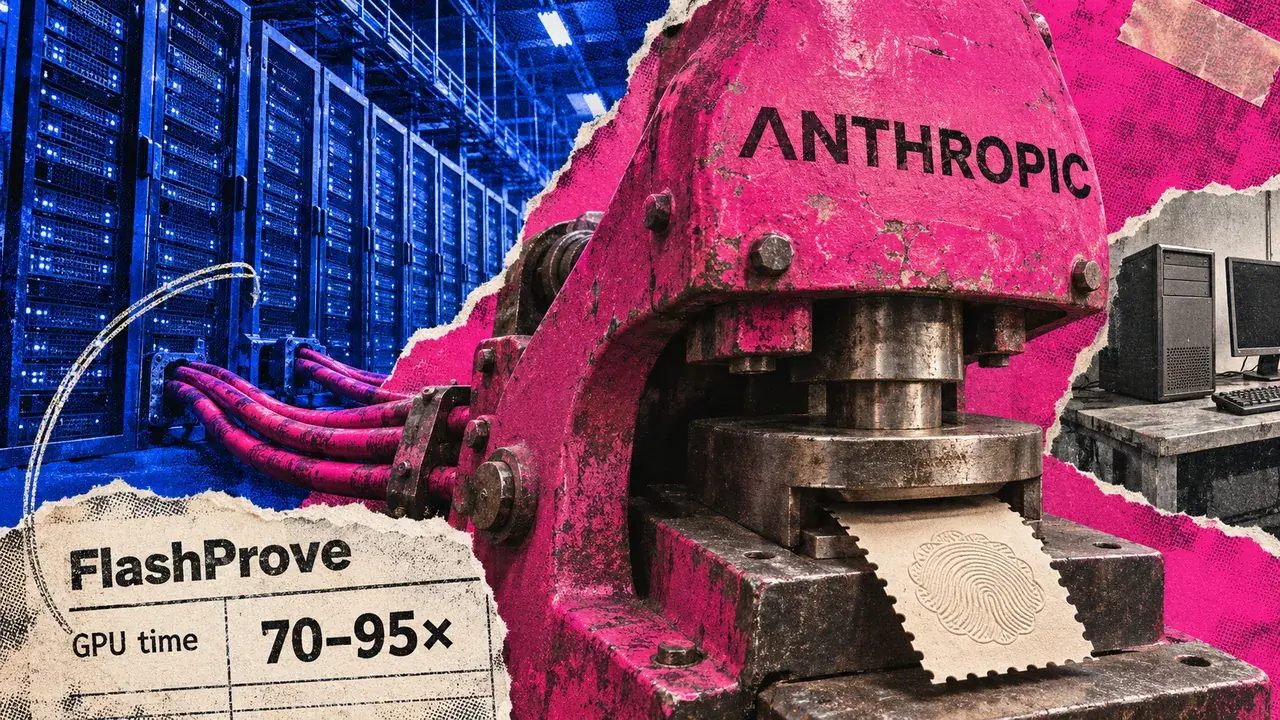


Anthropic has released FlashProve, a research prototype that checks selected AI outputs against committed model weights without revealing those weights. Its benchmark using Meta's Llama 4 Maverick requires roughly 70 to 95 times the GPU time of a specified FP8 vLLM inference comparison. The demonstration is not a verification feature being switched on for Claude customers.
Why it matters
A provider first publishes a cryptographic commitment to its model weights, then produces a proof that the committed model generated the checked output from a specified input. A user can verify the proof without downloading the weights or rerunning the model.
The commitment must come from a trusted party to establish that it identifies the advertised model. A valid proof also does not establish that an answer is true or safe: it checks the computation, not the quality of the response.
Market impact
The prototype offers a potential safeguard for buyers of third-party AI services, but its computing cost is a major obstacle to routine use. The demonstration generates proofs on one H100 GPU; checking a roughly 19 MB proof takes 17 seconds on 24 CPU threads or 21 seconds on one thread.
FlashProve proves outputs after a transcript is complete, so an altered response could reach a user before tampering is detected. Its current context limit is 1,024 tokens, and it proves an exact integer model's highest-ranked next-token choices rather than ordinary sampled responses. Anthropic also says the fast executable code is not proved equivalent to the formal protocol, and zero knowledge has not been formally proved for batched requests.
Frequently asked questions
-
How does FlashProve check an AI model's output?
A provider commits to model weights and produces a proof that the committed model generated the checked output from a specified input. A user can verify the proof without downloading the weights or rerunning the model.
-
Why must a model commitment come from a trusted party?
A trusted commitment helps establish that the weights being checked belong to the advertised model. A proof against an arbitrary commitment would not establish that identity.
-
How much computing does proof verification require?
In the demonstration, checking a roughly 19 MB proof takes 17 seconds on 24 CPU threads or 21 seconds on one thread. Generating the proof requires substantially more computing.
-
Does a successful FlashProve proof mean an AI answer is true?
No. The proof checks model computation, not whether an answer is factually correct or safe.
-
Can FlashProve prevent an altered response from reaching a user?
Not in its current form. It proves outputs after a transcript is complete, so an altered response could reach a user before tampering is detected.
 WuBlockchain
 Crypto News
 CoinDesk
 CoinTelegraph
 WatcherGuru
 CZ Binance
 TheBlock