








 CoinDesk

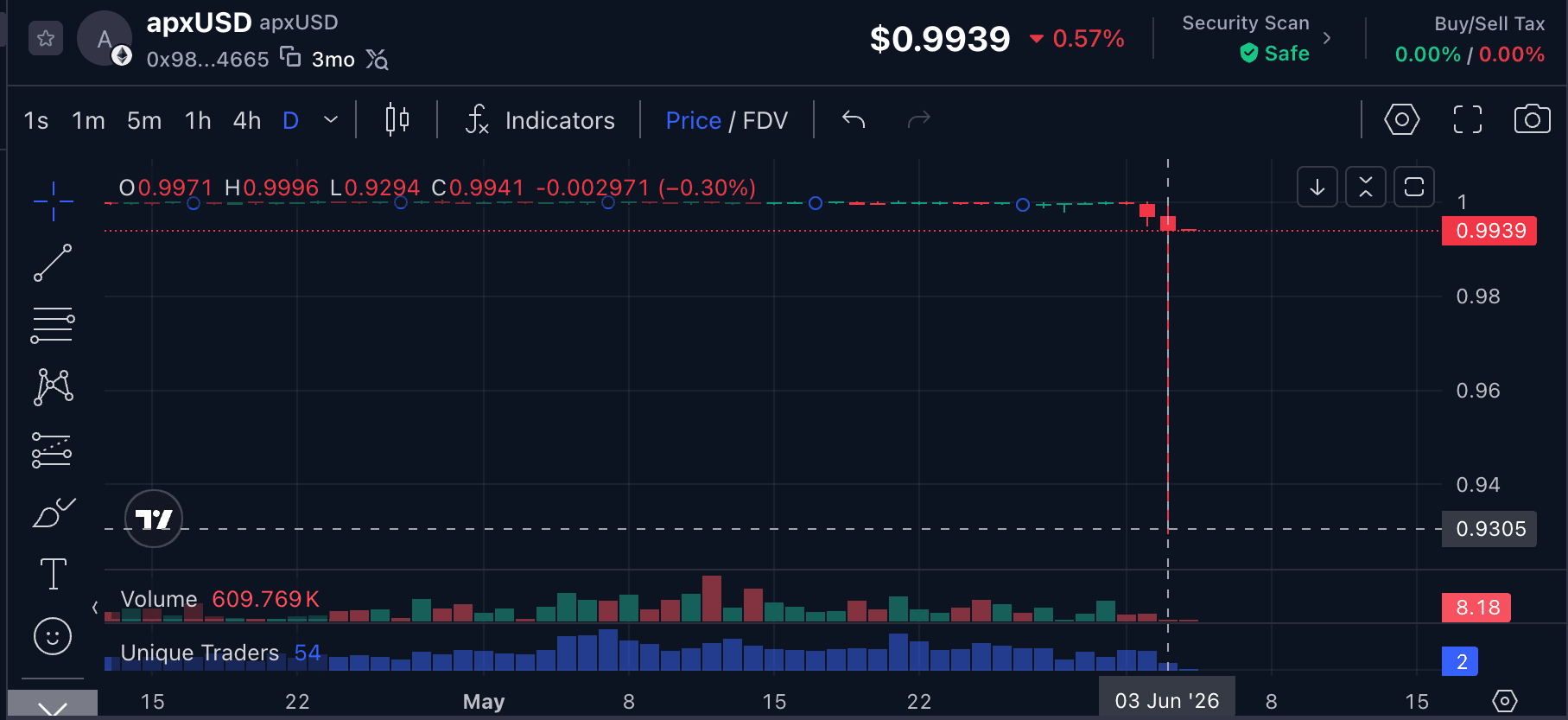


Apyx's apxUSD stablecoin briefly slipped to 93 cents on Wednesday as bitcoin dropped below $63,000, dragging the value of the protocol's preferred-equity reserves. The token is the base layer of Apyx's two-token system, designed to trade at $1; holders who deposit apxUSD receive apyUSD, a yield-bearing savings token that accrues returns through dividends from the underlying shares.
The reserves are dominated by Strategy's STRC preferred shares, which carry a $100 par value, alongside short-term U.S. Treasuries and cash equivalents. When STRC trades below par, the market value of those reserves declines, exposing apxUSD to secondary-market volatility.
Why it matters
Apyx framed the move as expected behavior for a stablecoin backed by preferred equity rather than cash, not a structural break. The protocol pointed to STRC's history: the share has traded below par four times since August, and each episode ended with prices returning to $100. Strategy has historically used its ability to raise the STRC dividend rate to draw demand and lift the share back toward par — a lever Apyx argued underpins the stablecoin's resilience.
The protocol also stressed that its main apyUSD/apxUSD Morpho lending market is driven by dividend accrual rather than STRC's spot price, meaning the volatility does not feed the oracle and trigger cascading liquidations.
Market impact
The episode lands against a broader risk-off backdrop: U.S. spot bitcoin ETFs have now logged 13 straight days of outflows, shedding $4.37 billion since mid-May as total assets fell to $82.83 billion from $104.29 billion. Ether, solana and XRP products have joined the redemption wave, leaving Hyperliquid-linked HYPE funds as the only major crypto ETF category still pulling net new money.
For apxUSD specifically, the near-term read is whether STRC mean-reverts again — and whether the overcollateralization buffer Apyx highlights holds through another sub-par stretch. The protocol published a real-time collateral-versus-supply dashboard so holders can monitor the cushion directly.




Frequently asked questions
-
Why did apxUSD drop to 93 cents?
Bitcoin fell below $63,000 on Wednesday, dragging the value of Apyx's reserves. The reserves are dominated by Strategy's STRC preferred shares, and when STRC trades below its $100 par value, the market value of those reserves declines, exposing apxUSD to secondary-market volatility.
-
How does Apyx explain the depeg?
Apyx said the move is expected behavior for a stablecoin backed by preferred equity rather than cash deposits, not a structural break. The protocol noted that STRC has traded below par four times since August and mean-reverted to $100 each time, with Strategy historically raising the dividend rate to draw demand.
-
Does the depeg trigger liquidations on Morpho?
Apyx said the main apyUSD/apxUSD Morpho market is driven by dividend accrual, not STRC's spot price, meaning the volatility does not feed the oracle and does not trigger cascading liquidations in that market.
-
What backs apxUSD?
The reserves are dominated by Strategy's STRC preferred shares, which carry a $100 par value, alongside short-term U.S. Treasuries and cash equivalents. Apyx also maintains collateral in excess of circulating supply as a buffer against mark-to-market drawdowns.
-
What is the broader market context around the depeg?
U.S. spot bitcoin ETFs have logged 13 straight days of outflows, shedding $4.37 billion since mid-May as total assets fell to $82.83 billion from $104.29 billion. Ether, solana and XRP products have joined the redemption wave, leaving Hyperliquid-linked HYPE funds as the only major crypto ETF category still pulling…
 TheBlock
 CryptoSlate
 WuBlockchain
 CoinTelegraph
 WatcherGuru
 Lookonchain