


 CryptoSlate



Binance says users can verify at least 1:1 backing for Bitcoin and nine other named tokens in its reserve snapshot taken at 00:00 UTC on Oct. 31. The exchange also said it reallocated only excess futures insurance reserves during recovery from its security incident, with remaining funds above required coverage. Neither disclosure establishes a reserve shortfall or a measurable increase in ADL probability.
Why it matters
Proof of reserves and futures risk answer different questions. The snapshot addresses whether customer Bitcoin was backed at a specific time; Binance’s own Futures Insurance Funds support the handling of bankrupt positions and sit outside the user-verifiable proof-of-reserves view. Binance says it monitors those funds against stress scenarios and adds company funds when required.
A futures hedge can still be cut if a fund cannot take on a bankrupt position. Binance’s guidance says ADL may be triggered when a fund reaches its Maximum Takeover Capacity, or when unrealized losses on positions it has assumed exceed the relevant available balance. The exchange says that capacity is capped at a multiple of the fund’s balance, with the multiplier confidential. Fund allocations can vary across contract categories, so an exchange-wide reserve figure does not establish headroom for a specific Bitcoin contract.
Market impact
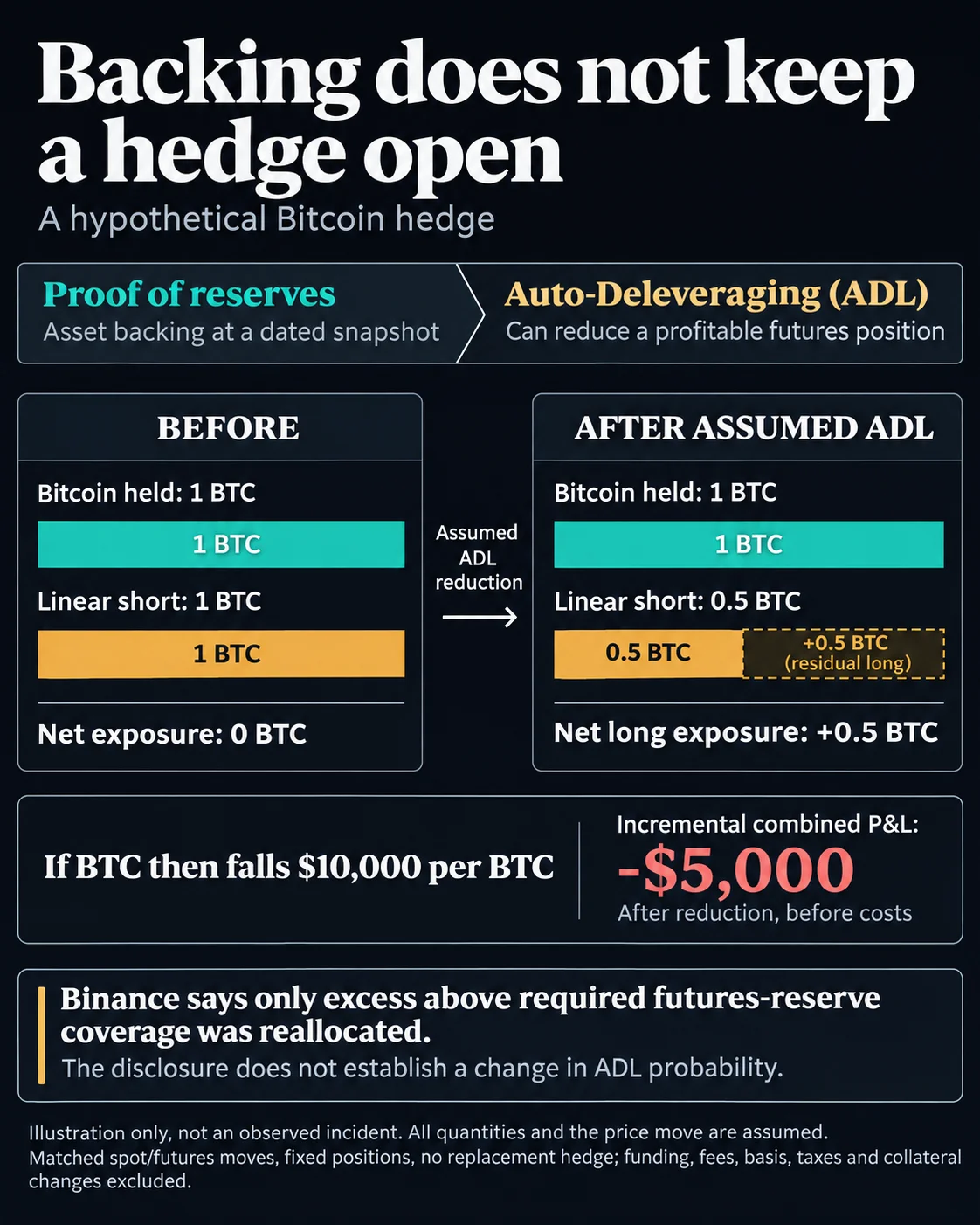
ADL can reduce a profitable opposing position, with profitability and leverage affecting its queue priority. In a hypothetical example, a trader holding 1 BTC and short 1 BTC in linear futures would have 0.5 BTC of net long exposure if ADL cut the short to 0.5 BTC. A further assumed $10,000-per-BTC decline would then mean a $5,000 incremental loss, before fees, funding, basis differences, taxes or collateral changes.
Eligible Delta Neutral accounts receive lower ADL priority within the same profit/loss category, not immunity. Initial qualification requires Portfolio Margin or Portfolio Margin Pro, VIP4 or above, enabled Delta Mode and a calculated long-short exposure gap below 5% of the larger side. Spot Account assets and options positions are excluded from that calculation.

Frequently asked questions
-
What does Binance’s Oct. 31 proof-of-reserves snapshot confirm?
Binance says users can verify at least 1:1 backing for Bitcoin and nine other named tokens in the snapshot taken at 00:00 UTC on Oct. 31.
-
Does the reserve reallocation show that Binance has a futures insurance shortfall?
No. Binance said it reallocated only excess reserves and that remaining funds exceeded required coverage. The disclosure does not establish a reserve shortfall or a measurable increase in ADL probability.
-
When can Binance trigger Auto-Deleveraging?
Binance’s guidance says ADL can be engaged when a fund reaches its Maximum Takeover Capacity or when unrealized losses on positions it has assumed exceed the relevant available balance.
-
How could ADL change a trader’s exposure in the example?
If a trader holds 1 BTC and a 1 BTC futures short is reduced to 0.5 BTC, the trader has 0.5 BTC of net long exposure. A further assumed $10,000-per-BTC decline would mean a $5,000 incremental loss.
-
Do Delta Neutral accounts avoid ADL?
No. Qualifying accounts receive lower ADL priority within the same profit/loss category, but are not exempt. Initial qualification includes Portfolio Margin or Portfolio Margin Pro, VIP4 or above, enabled Delta Mode and an exposure gap below 5% of the larger side.
 Altcoin Daily
 WatcherGuru
 Whale Alert
 Lookonchain
 CoinTelegraph
 CoinDesk