








 CryptoSlate


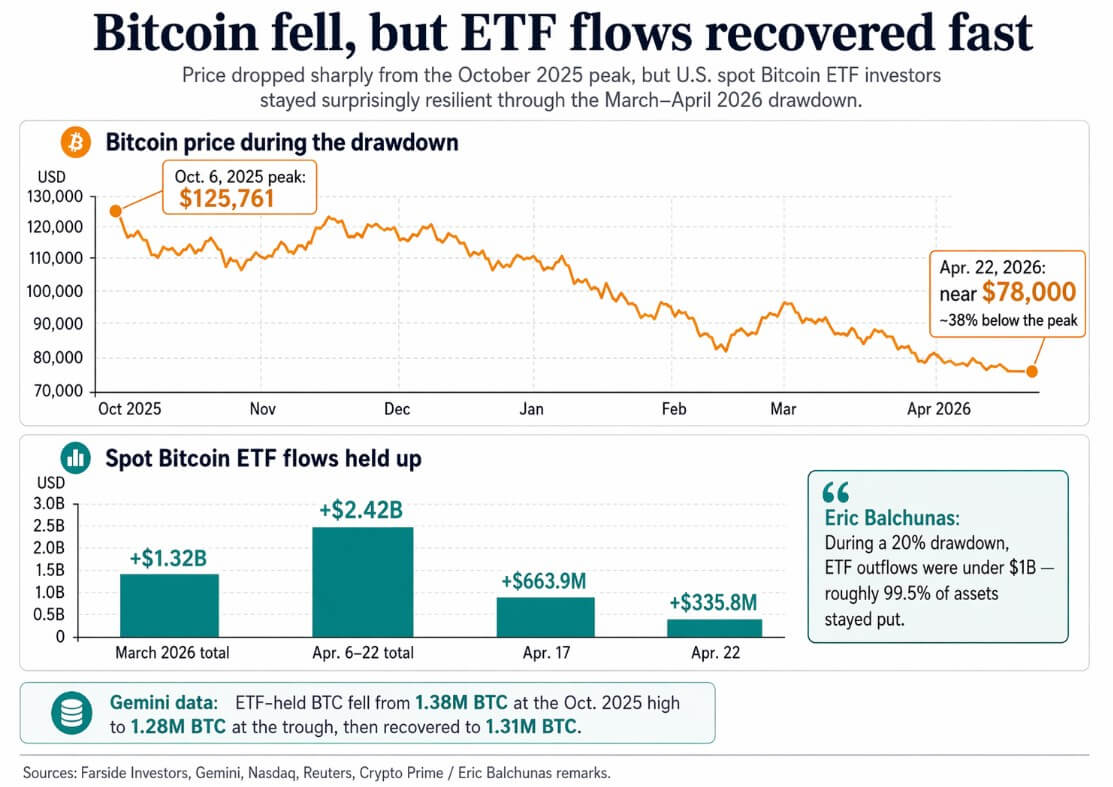
Bitcoin trades near $78,000 — roughly 38% below the $125,761 peak set on Oct. 6, 2025 — and US spot Bitcoin ETFs absorbed that drawdown without producing the exit wave skeptics had been waiting for. March alone pulled in $1.32 billion in net inflows, reversing a four-month outflow streak, and ETFs added another $2.42 billion between Apr. 6 and Apr. 22. The strongest single sessions were Apr. 17 at $663.9 million and Apr. 22 at $335.8 million, while Gemini's coin-level data shows ETF-held Bitcoin fell only from 1.38 million BTC at the October 2025 high to 1.28 million at the trough, then recovered to 1.31 million. Bloomberg senior ETF analyst Eric Balchunas noted that during a 20% drawdown inside a hostile macro window, ETFs logged outflows of under $1 billion — roughly 99.5% of their assets, held.
Why it matters
The flow behavior reflects a buyer profile that is structurally different from the 2022 cycle. ETF purchases route through model portfolios, advisor guardrails, committee-approved position limits, and rebalancing schedules — constraints that turn a drawdown from a discretionary decision into a rule-based one. The Bitwise–VettaFi 2026 advisor survey shows 32% of financial advisors now allocate to crypto in client accounts (up from 22% a year earlier), 42% are cleared to buy crypto, and 77% name an ETF as their preferred vehicle. EY-Parthenon and Coinbase's 2026 institutional survey adds that 73% of institutions plan to increase digital asset allocations this year, 66% already access spot crypto through ETFs or ETPs, and 81% prefer registered vehicles over direct custody. The selling pressure in March and April, in other words, came from the cohorts with the fewest guardrails — leveraged traders, miners, legacy crypto-native holders, and corporate treasuries — not from the wrapper-bound buyers.
Market impact
The distribution infrastructure is widening the gap. Bank of America opened crypto ETP recommendations to advisors across Merrill, Merrill Edge, and its Private Bank on Jan. 5, 2026. Morgan Stanley launched MSBT on Apr. 8 after filing in January, and Charles Schwab announced spot crypto trading access. BlackRock's late-2024 guidance — up to a 2% starting Bitcoin allocation in diversified portfolios — means a 38% drawdown translates into a tolerable drag rather than a forced exit. Citi's 12-month scenarios frame the spread: a $165,000 bull case anchored in sustained institutional demand, and a $58,000 bear case tied to stalled US regulatory progress draining the ETF-demand catalyst.

Frequently asked questions
-
How much did US spot Bitcoin ETFs absorb during the 38% drawdown?
US spot Bitcoin ETFs pulled in $1.32 billion in net inflows during March 2026, reversing a four-month outflow streak, and added another $2.42 billion between Apr. 6 and Apr. 22. The strongest single day was Apr. 17 at $663.9 million.
-
Why did Bitcoin ETF holders not sell during the drawdown?
ETF purchases route through model portfolios, advisor guardrails, committee-approved position limits, and rebalancing schedules, so drawdown behavior is rule-based rather than discretionary. BlackRock's late-2024 guidance of up to a 2% starting allocation also means a 38% drop is a tolerable drag on a diversified…
-
Who was actually selling Bitcoin during the March–April 2026 drop?
Per Bloomberg's Eric Balchunas, the selling pressure came from longer-tenured crypto holders — leveraged traders on perps and margin venues, miners selling into weakness for liquidity, legacy crypto-native holders with few formal guardrails, and corporate treasuries responding to firm-level constraints.
-
What is Citi's 12-month price target for Bitcoin?
Citi's 12-month bull case targets $165,000, anchored in sustained institutional demand and a constructive US regulatory backdrop. The bear case sits at $58,000, tied to stalled US regulatory progress draining a primary ETF-demand catalyst.
-
What would test whether ETF resilience is structural or just benign macro?
A repeat of April's quick flow recovery in the next 20%–30% drawdown would move Balchunas's interpretation from thesis toward documented fact. A wholesale ETF exit under sufficient macro stress would confirm the holder composition held only as long as conditions allowed.
 TheBlock
 Glassnode
 CoinDesk
 Lookonchain
 WuBlockchain
 CoinTelegraph
 Crypto News