








 CoinDesk
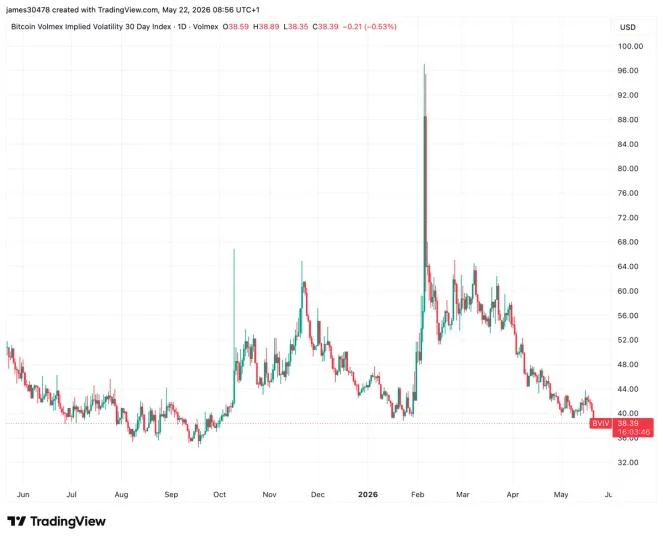



Bitcoin's 30-day annualized implied volatility index, BVIV, fell to 38% this week — its lowest reading since October 2025 — even as financial headlines continue to flag elevated macro and geopolitical risk, according to data provider Volmex.
BTC traded near $77,000 while WTI crude held below $100 a barrel, the conventional proxy for geopolitical tension. Despite that risk backdrop, options markets are pricing the calmest stretch in seven months.
Why it matters
"Bitcoin volatility has collapsed, and you can see it clearly in the BVIV levels, which we track closely to monitor market complacency," said Shiliang Tang, Managing Partner at Monarq Asset Management. Tang pinned the drop on three forces: the Iran conflict moving into later stages, the structural bid from Strategy (MSTR) and its perpetual preferred STRC complex, and systematic call overwriters aggressively selling upside to collect yield.
Strategy has accumulated 171,238 BTC in 2026, dwarfing the roughly 63,450 BTC mined over the same period — a 2.7:1 demand-to-issuance imbalance that is steadily shrinking float available to the market.
Market impact
Lower implied volatility tends to compress options premiums, a tailwind for institutional holders running covered-call strategies but a headwind for directional option buyers. Tang warned that the same systematic overwriting that is suppressing vol is also "keeping a heavy lid on the entire volatility complex" because BTC has underperformed other risk assets on the upside, pushing funds to monetize premium rather than chase directional exposure.
The read-through is two-sided: a calmer vol regime signals Bitcoin's maturation as an asset owned across ETFs, asset managers, corporates and treasuries, but it also flattens the convexity that long-vol allocators rely on for tail protection.
Tokens
Primary: BTC. Related: STRC (Strategy perpetual preferred).

Frequently asked questions
-
What is the Bitcoin implied volatility index (BVIV) and why does it matter?
BVIV is the annualized 30-day implied volatility index for BTC, tracked by Volmex. It fell to 38% this week — its lowest reading since October 2025 — signaling traders expect fewer large price swings over the next month despite ongoing macro risk headlines.
-
Why has Bitcoin implied volatility dropped to a 7-month low?
Monarq Asset Management's Shiliang Tang attributes the drop to three forces: the Iran conflict moving into later stages, the structural bid from Strategy (MSTR) and its perpetual preferred STRC complex acting as a downside floor, and systematic call overwriters aggressively selling upside options to collect yield.
-
How much Bitcoin has Strategy purchased in 2026 and why does that matter for volatility?
Strategy has accumulated 171,238 BTC in 2026, compared with roughly 63,450 BTC mined over the same period — a 2.7:1 demand-to-issuance imbalance. Persistent institutional buying reduces float available on the market and dampens downside volatility by acting as a structural floor.
-
What are systematic call overwriters and how do they suppress Bitcoin volatility?
Systematic call overwriters are typically institutional funds running yield-enhancement strategies that continuously sell out-of-the-money call options on their BTC holdings to collect premium. The steady supply of sold options suppresses implied volatility and caps expectations for large upside moves.
-
Does lower implied volatility mean Bitcoin is becoming a more mature asset?
Yes. Declining implied volatility reflects Bitcoin's growing maturity as an institutional asset, with deeper liquidity, broader ownership across ETFs, asset managers, corporates, and treasury allocators. Tang cautioned, however, that the same overwriting suppressing vol also flattens the convexity long-vol allocators…
 CoinTelegraph
 WatcherGuru
 CryptoSlate
 WuBlockchain