








 CoinDesk
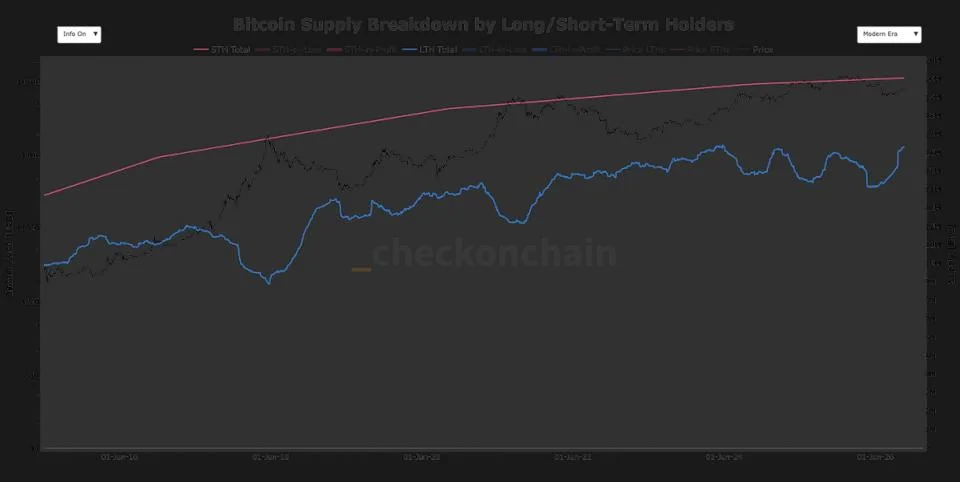

Bitcoin's long-term holder cohort now controls roughly 16.3 million BTC, up more than 2 million coins since the asset's record high above $126,000 in October, with about 200,000 BTC added in the past month alone. The cohort — defined as wallets that have held BTC for at least 155 days — is now within striking distance of the 16.4 million BTC peak recorded in January 2024, just before U.S. spot bitcoin ETFs began trading.
Why it matters
Long-term holders are the cohort the market treats as "smart money" — they tend to buy weakness and sell strength, the inverse of the panic-driven flow that dominates headlines. The fact that LTH supply is rising into a depressed price tape means the patient bid is back, not the speculative bid. Historically, the only other times LTH supply expanded at this pace were the 2015 and 2019 bear markets, both of which preceded multi-year bull runs.
The structural shift since the January 2024 ETF launch is also worth flagging: for two and a half years, LTH supply oscillated in a 14M–16M BTC range as the cohort distributed into ETF demand. That downtrend now looks broken — ETFs soaked up the coins LTHs were willing to sell, and the original holders are accumulating again at lower prices.
Market impact
The 2 million BTC absorbed during the current drawdown is a meaningful supply sink at a time when post-halving issuance is running at roughly 328,500 BTC per year. If ETF inflows continue to drain exchange float while LTHs stop distributing, the marginal buyer profile tightens — and any return of risk-on flow meets a thinner available supply. The setup mirrors the conditions that preceded the Q1 2024 vertical move, though the catalyst this time has yet to arrive.

Frequently asked questions
-
What is Bitcoin's long-term holder supply and why does it matter?
Long-term holder (LTH) supply measures BTC held by wallets that have not moved coins in at least 155 days. It matters because this cohort is treated as "smart money" — they historically buy weakness and sell strength, so rising LTH supply into a drawdown signals patient accumulation rather than panic selling.
-
How much BTC have long-term holders accumulated during the current bear market?
LTH supply has risen by more than 2 million BTC since Bitcoin's record high above $126,000 in October, reaching roughly 16.3 million BTC. About 200,000 BTC was added in the past month alone.
-
When was the only previous time LTH supply was higher?
LTH supply hit 16.4 million BTC in January 2024, just before U.S. spot bitcoin ETFs began trading. In the months that followed, the cohort distributed nearly 2 million coins as Bitcoin rallied.
-
What does the LTH downtrend breaking mean for BTC price?
Since the January 2024 ETF launch, LTH supply oscillated between 14M and 16M BTC as the cohort sold into ETF demand. A break above that 2.5-year range suggests LTHs are accumulating again at lower prices rather than distributing — a setup that historically preceded multi-year bull runs in 2015 and 2019.
-
How does LTH accumulation interact with Bitcoin ETF flows?
ETFs have absorbed much of the BTC LTHs were willing to distribute between 2024 and 2025, draining exchange float. If LTHs stop selling into ETF demand while inflows continue, available supply tightens against post-halving issuance of roughly 328,500 BTC per year.
 Whale Alert
 WuBlockchain
 Crypto News
 Crypto Rank News
 CryptoSlate