


 CryptoSlate
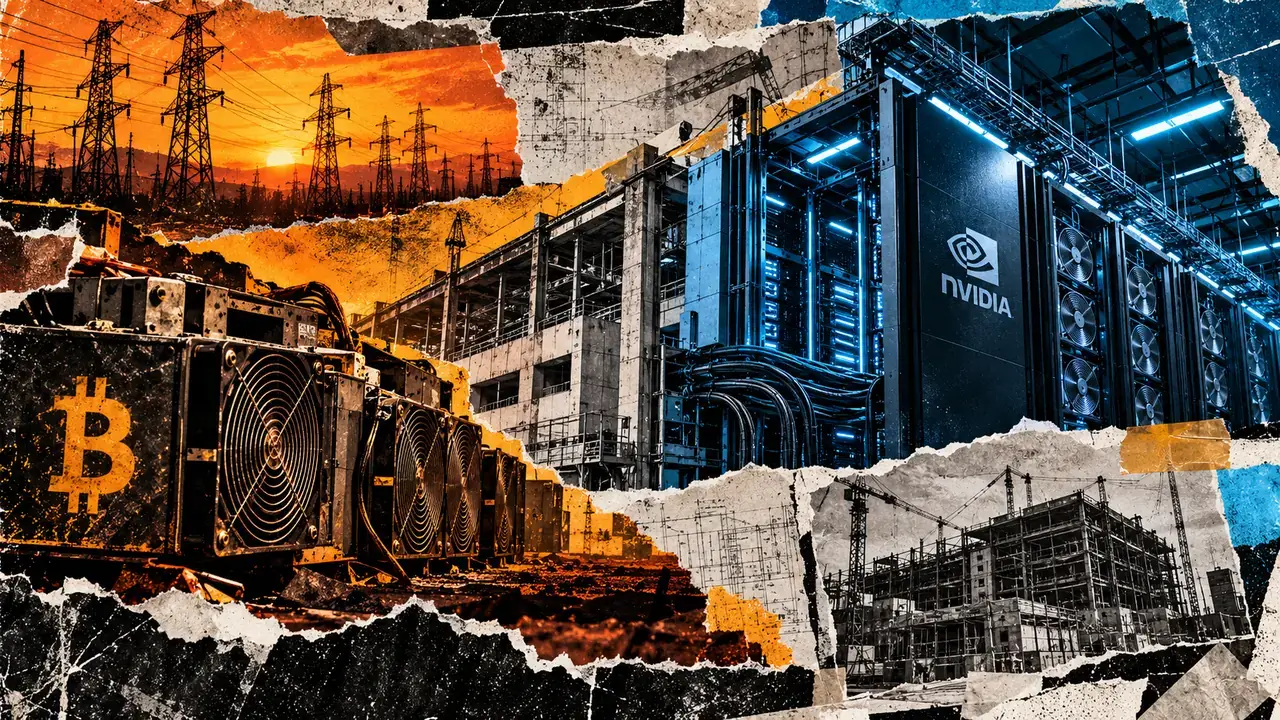



Bitcoin miners have announced more than $100 billion in AI contracts, yet only about 550 MW of more than 4 GW under contract was billing customers in September. Converting a mine into an AI data center requires costly upgrades, and Core Scientific's agreements show how construction funding, rent credits and debt shape who ultimately captures the revenue.
Why it matters
Bitcoin miners' most valuable AI asset may be access to power, not their mining machines. ASICs cannot train AI models, and turning a mining facility into an AI-grade data center requires denser cooling, high-speed networking and more robust power systems. CoinShares estimated that conversion costs roughly $8 million to $15 million per MW, compared with $700,000 to $1 million per MW for conventional mining infrastructure.
Even power figures need context: a 100 MW grid connection does not mean 100 MW of computing capacity. At a power usage effectiveness ratio of 1.25, about 80 MW would reach computing equipment, with the rest supporting the facility. Announced capacity can also include connections that are approved or queued, rather than ready to serve customers.
Core Scientific's second-quarter results illustrate the economics once facilities are operating. It reported $136.7 million in colocation revenue, with 437 MW billing by mid-July. Of that revenue, $35.1 million came from power charges passed through to customers, which added matching costs rather than gross profit.
Market impact
Under disclosed CoreWeave agreements, base license fees start at $100 per kilowatt per month and rise 3.5% annually. For certain landlord-owned equipment, construction credits can reduce rent by up to $1.5 million per MW. At an initial $100 rate, a full credit could halve a one-megawatt site's $100,000 monthly base fee to $50,000 until the allowance is used.
Core Scientific also faces the cost and execution risk of building. It recorded $954.2 million in capital expenditure in the first half of 2026, including $180.9 million funded by CoreWeave. A financing subsidiary issued $3.3 billion of secured notes at 7.75% in May, equivalent to about $255.8 million in annual coupon costs on the original principal before repayments.
These terms do not erase the value of miners' power access, but they show why headline contract totals are not the same as shareholder returns. The outcome depends on which sites become operational, how much construction costs, and how rent credits and financing claims divide the cash flows.

Frequently asked questions
-
How much of the announced AI capacity was generating revenue?
About 550 MW was billing customers in September, out of more than 4 GW under contract.
-
Why can't Bitcoin mining sites immediately operate as AI data centers?
AI facilities need denser cooling, high-speed networking and more robust power systems. CoinShares estimated conversion costs at roughly $8 million to $15 million per MW.
-
How do CoreWeave construction credits affect Core Scientific's rent?
Credits for certain landlord-owned equipment can be worth up to $1.5 million per MW and reduce future base fees. At the initial rate, a full credit could halve monthly rent until it is exhausted.
-
What portion of Core Scientific's colocation revenue came from power pass-throughs?
The company reported $35.1 million in power charges within $136.7 million of second-quarter colocation revenue. The charges had matching expenses, so they did not create gross profit.
-
What financing costs did Core Scientific take on for its data-center projects?
A financing subsidiary issued $3.3 billion of secured notes at 7.75%. On the original principal, that rate represents about $255.8 million in annual coupon costs before repayments.
 Benjamin Cowen
 Crypto Rank News
 CoinDesk
 Lookonchain
 WuBlockchain
 WatcherGuru
 TheBlock
 Crypto News