








 CoinDesk
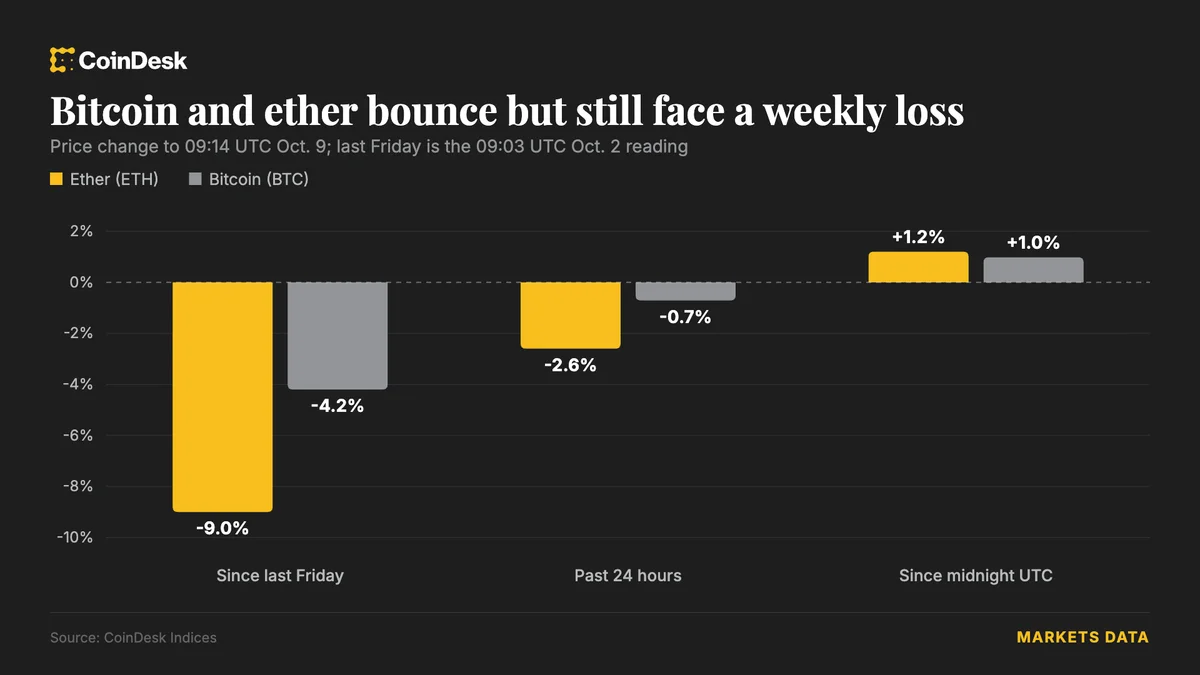



Bitcoin recovered to around $82,500 on Friday after President Donald Trump said the U.S. would not attack Iran before the Nov. 3 midterm elections, easing a geopolitical risk premium that had pushed the price to a low near $80,300 on Thursday. The rebound has not undone the damage, however: bitcoin is still down about 4% on the week and ether has slid roughly 9% to around $2,500, with the CoinDesk 100 index remaining 2.2% lower over 24 hours. The derivatives footprint suggests the bounce came without fresh leverage, with futures open interest slipping 1.9% to $27.1 billion even as price recovered and longs taking $931 million of the $1.09 billion in 24-hour liquidations before Friday's session.
Why it matters
The bounce is best read as a relief rally rather than a structural reversal. Smaller tokens led the recovery, with the CoinDesk 80 up 2.2% since midnight UTC, more than twice the gain in the CoinDesk 5, but DeFi tokens were still down nearly 4% over 24 hours. U.S.-listed bitcoin, ether and zcash ETFs all posted outflows on Thursday, leaving XRP funds as the only crypto products to take in money. Brent crude slipped about 1% to around $103 a barrel and Nasdaq 100 futures rose 0.83% as equity markets caught the same relief bid, evidence the move was macro-driven rather than crypto-specific.
Market impact
Starknet's STRK jumped 33% over 24 hours after the network said it is actively considering leaving Ethereum to become a standalone layer-1 blockchain targeting full quantum resistance by 2027. The broader quantum debate was kicked off by Ethereum Foundation researcher Justin Drake's call for a "bunker mode" push toward post-quantum cryptography, which Coinbase cryptographer Yehuda Lindell dismissed as "FUD." Layer-1 strength was broad elsewhere: Kaia rose 40% on an Upbit listing, APT gained 12%, and ATOM and DOT added roughly 10%. AI tokens lagged after CNBC confirmed OpenAI told investors it had $50 billion in annualized revenue at the end of September, below the $68 billion figure widely reported last month; KITE and VVV each lost about 9% over 24 hours.





Frequently asked questions
-
Why did Bitcoin bounce back to $82,500 on Friday?
Bitcoin recovered after President Trump said the U.S. would not attack Iran before the Nov. 3 midterm elections, easing a geopolitical risk premium that had pushed BTC to a low near $80,300 on Thursday.
-
How much did Bitcoin and ether fall over the past week?
Bitcoin is down about 4% on the week even after recovering to around $82,500, while ether has slid roughly 9% to around $2,500.
-
How much did long positions get liquidated during Thursday's flush?
Longs took $931 million of the $1.09 billion in 24-hour liquidations, with ether leading at $345 million and the largest single order a $20 million ETH-USD position on Hyperliquid.
-
Why did Starknet's STRK jump 33% on Friday?
STRK rallied after the network said it is actively considering leaving Ethereum to become a standalone layer-1 blockchain targeting full quantum resistance by 2027, though the plan has not yet been approved.
-
Did U.S. spot bitcoin and ether ETFs see outflows on Thursday?
Yes. U.S.-listed bitcoin, ether and zcash ETFs all posted outflows on Thursday, leaving XRP funds as the only crypto products to take in money.
 WatcherGuru
 WuBlockchain
 Crypto News
 CoinTelegraph