








 CryptoSlate



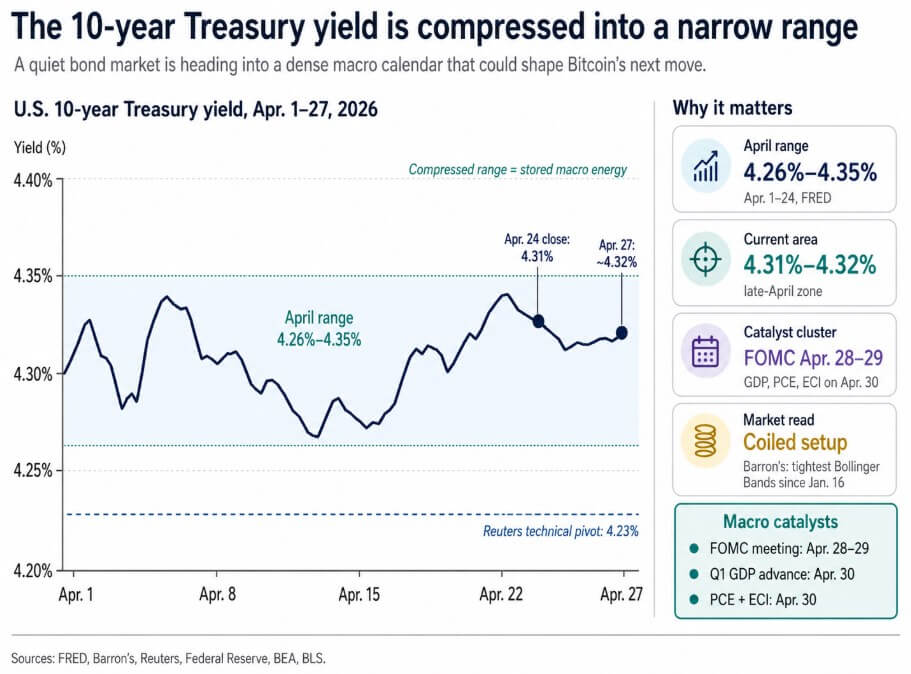
Bitcoin's $80,000 test this week will be decided less by crypto-native catalysts than by where the US 10-year Treasury yield resolves out of its tightest compression since January, as a dense three-event macro cluster lands inside 48 hours. Bitcoin drew $933 million of last week's $1.2 billion in crypto investment product inflows and is pressing into the short-term holder cost basis at $80,100 with $4.4 million per hour in realized profit already showing on-chain, per Glassnode's April 22 report.
Why it matters
The 10-year spent April 1 through April 24 inside a 4.26%-4.35% band, closing at 4.31% on April 24 per FRED data, with Barron's noting Bollinger Band compression to its tightest reading since January 16 and Reuters framing the setup as a symmetrical triangle. A coiled yield range is a market storing energy before a directional decision, and that decision arrives Wednesday through Thursday: the FOMC meets April 28-29, the BEA publishes advance Q1 GDP alongside March Personal Income and Outlays and the PCE deflator on April 30, with the Employment Cost Index landing the same morning. Three macro prints in two days are enough to move Treasuries materially in either direction and to reset the financial-conditions backdrop that Bitcoin's current rally is implicitly relying on.
Market impact
CoinShares recorded $1.2 billion in weekly crypto inflows — the fourth consecutive positive week, third straight above $1 billion, with $192 million going to Ethereum and total AUM climbing to $155 billion. Farside data show US spot Bitcoin ETFs strung together nine straight positive sessions from April 14 to April 24, totaling over $2 billion in cumulative inflows. The bull case is yields closing below the April floor near 4.26% and breaking Reuters' 4.23% technical pivot, which would give Bitcoin the cleanest macro backdrop of the rally and a credible shot at clearing and holding $80,100. The bear case is a break above 4.35% toward the 4.6% upside resolution area, where financial conditions tighten just as more than 54% of recent buyers sit on unrealized profit, profit-taking accelerates past Glassnode's $4.4 million-per-hour print, and $78,100 — the True Market Mean — gives way to the $75,000 downside-acceleration zone. The March precedent is concrete: even $1 billion-plus weekly demand could not stop $405 million in post-FOMC outflows once the Fed's read turned hawkish. The same mechanism is available again this week, and the bond market gets the first vote.


Frequently asked questions
-
What level does Bitcoin need to clear for the $80,000 test to resolve bullishly?
Bitcoin must clear and hold above the short-term holder cost basis at $80,100, per Glassnode's April 22 report. Sustained demand through that level would confirm the institutional bid has enough depth to absorb the $4.4 million per hour in realized profit already showing on-chain.
-
Why is the bond market more important than the Fed for Bitcoin this week?
The 10-year Treasury yield has spent April compressed in a 4.26%-4.35% band — its tightest Bollinger Band compression since January 16 — and a coiled yield range typically resolves with a sharp directional move before the Fed's policy guidance is even priced in. That resolution runs through the FOMC, Q1 GDP, and PCE…
-
How much institutional money has flowed into Bitcoin recently?
CoinShares recorded $1.2 billion in crypto investment product inflows last week — the fourth consecutive positive week and third straight above $1 billion — with $933 million going to Bitcoin and $192 million to Ethereum. Farside data show US spot Bitcoin ETFs posted nine straight positive sessions from April 14 to…
-
What happens to Bitcoin if 10-year yields break higher?
A break above 4.35% toward Reuters' 4.6% upside resolution area would tighten financial conditions as Bitcoin presses into a zone where more than 54% of recent buyers sit on profit. Profit-taking accelerates past Glassnode's $4.4 million-per-hour print, the True Market Mean at $78,100 gives way, and Glassnode's…
-
What is the March precedent that informs this week's risk?
In the week following the March FOMC, even $1 billion-plus weekly crypto demand could not prevent $405 million in post-FOMC outflows once markets read the meeting as a hawkish pause. The mechanism — macro repricing overriding genuine crypto demand — is available again this week if the bond market turns hawkish before…
 Altcoin Daily
 Crypto News
 WatcherGuru
 Lookonchain
 Benjamin Cowen
 CoinDesk
 Crypto Capital Venture