








 CoinDesk

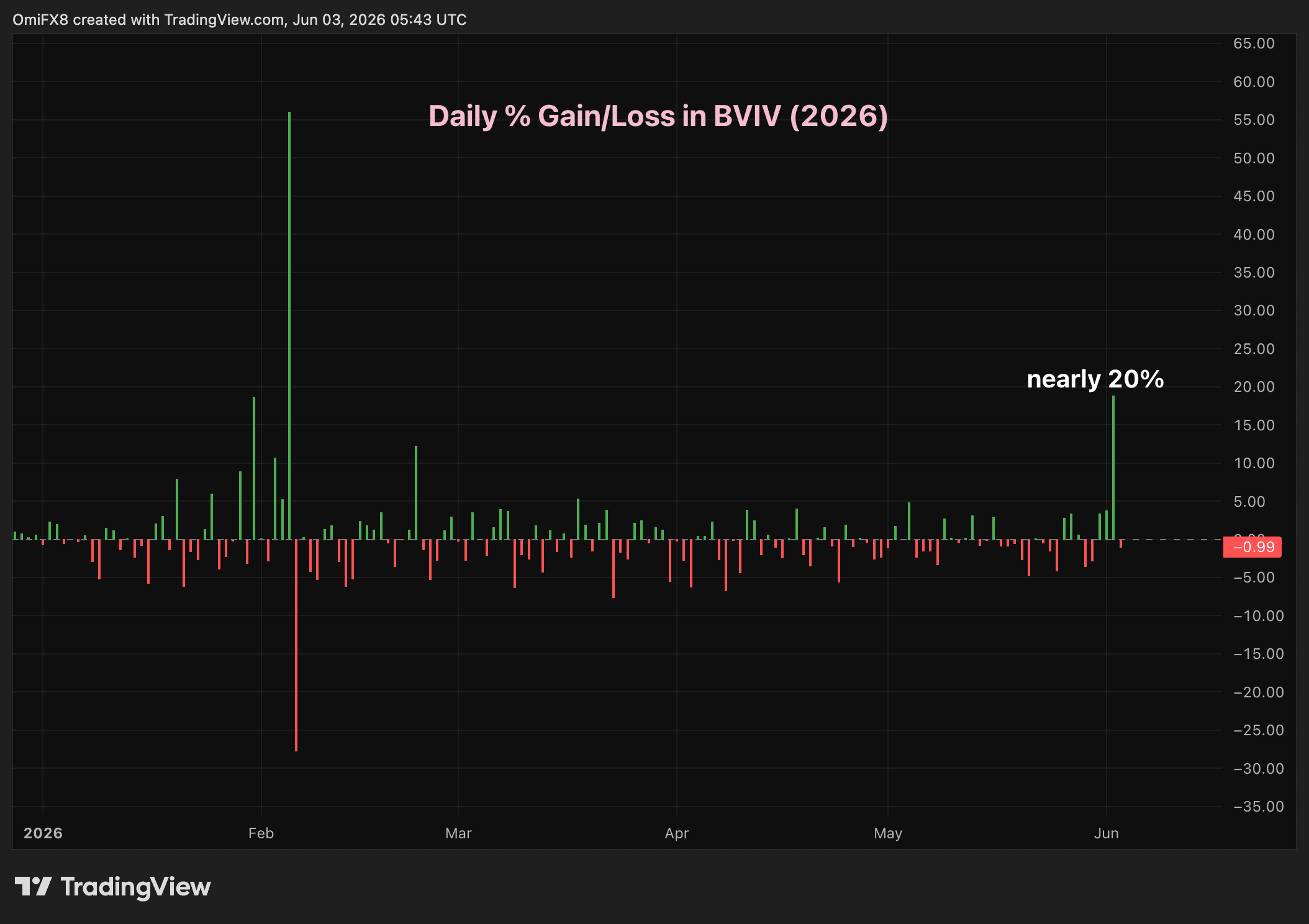
Bitcoin's 30-day implied-volatility index, BVIV, jumped nearly 20% on Tuesday to 46.45% — the steepest single-day spike since the Feb. 5 crash — as BTC fell over 6% on the day to roughly $66,000, per TradingView data. The move broke a roughly two-month stretch in which the index sat near its year-to-date low of 40% even through an orderly drop from BTC's early-May high near $82,000 down to $75,000 last week.
Why it matters
BVIV is effectively bitcoin's analog to Wall Street's VIX, and the way it traded through May suggests the market had stopped pricing in tail risk. That changed Tuesday: with the index ripping higher on a 6% spot drop, traders are once again paying up for downside protection through options. The Feb. 5 comparison sharpens the read — that day, BVIV surged more than 50% to above 90% as BTC slid toward $60,000. Tuesday's spike is far smaller in absolute terms, but the direction is the one to watch.
A relatively new dynamic is also at work. Since U.S. spot bitcoin ETFs launched, BVIV has moved inversely to spot price with increasing consistency — the textbook VIX pattern that institutions imported onto a crypto-native index. Two months of calm followed by a 20% volatility spike is the kind of regime shift that options desks flag, not a one-day noise print.
Market impact
The setup matters for anyone short gamma or running carry trades against realized vol: a regime shift from suppressed BVIV into a rising-fear regime tends to compress dealer positioning, lift skew toward puts, and amplify spot moves on the way down. Whether Tuesday prints as a one-day blip or the start of a sustained volatility expansion will hinge on BTC's ability to hold above the $65K area — a clean break lower would likely drag BVIV toward the 55-60% band and force another round of protection buying.

Frequently asked questions
-
What is bitcoin's BVIV index?
BVIV measures bitcoin's 30-day implied volatility — the expected price swing priced into options. It functions as bitcoin's analog to Wall Street's VIX fear gauge.
-
How big was Tuesday's BVIV spike?
BVIV jumped nearly 20% to 46.45% in a single session, the largest one-day increase since the Feb. 5 crash, according to TradingView data.
-
Why did BVIV spike if BTC's drop was orderly?
The index sat near its 40% year-to-date low for roughly two months, even through an orderly drop from $82K to $75K. Tuesday's 6% slide to $66K broke that calm and triggered fresh downside-protection buying.
-
How does this compare to the Feb. 5 crash?
On Feb. 5, BVIV surged more than 50% to above 90% as BTC slid toward $60K. Tuesday's spike is smaller in absolute terms but marks a sharp directional break after two months of suppressed volatility.
-
What would signal this is a regime shift, not a one-day blip?
A clean break below the $65K area would likely pull BVIV into the 55-60% band and force another round of protection buying. Holding $65K would suggest the spike fades as fast as it appeared.
 Glassnode
 Crypto Rank News
 Crypto News
 Altcoin Daily
 CoinTelegraph
 WatcherGuru
 CryptoSlate