








 CoinDesk
Bitcoin's drawdown since October has been driven by a rotating cast of headwinds largely unrelated to the asset's own fundamentals, and FalconX senior crypto strategist Martin Gaspar argues the classic bottom signals are now lining up. With sentiment around Strategy (MSTR) settling from hysteria to calm, he tells CoinDesk's Crypto Long & Short newsletter that attention can return to traditional signals, and several are flashing green.
Spot BTC ETFs shed $5.4 billion year-to-date through June 30, but the breakdown matters more than the headline. $8.2 billion of that has exited since May 12, a window Gaspar ties to MSTR concerns and capital rotation ahead of the SpaceX IPO. With both largely in the rearview, sustained inflow would signal that market confidence is stabilizing. The Coinbase premium, which tracks US investor appetite, has already improved meaningfully since quarter-end, supporting that read.
Why it matters
Sustained net outflows from spot ETFs over six weeks would, on their own, look like a structural derisking event. The composition tells a different story: outflows concentrated in a brief MSTR-driven scare and an IPO-related capital shuffle are not the same as allocators walking away from the asset. If inflows resume as those two forces fade, the bid underneath BTC looks far more resilient than the YTD print suggests.
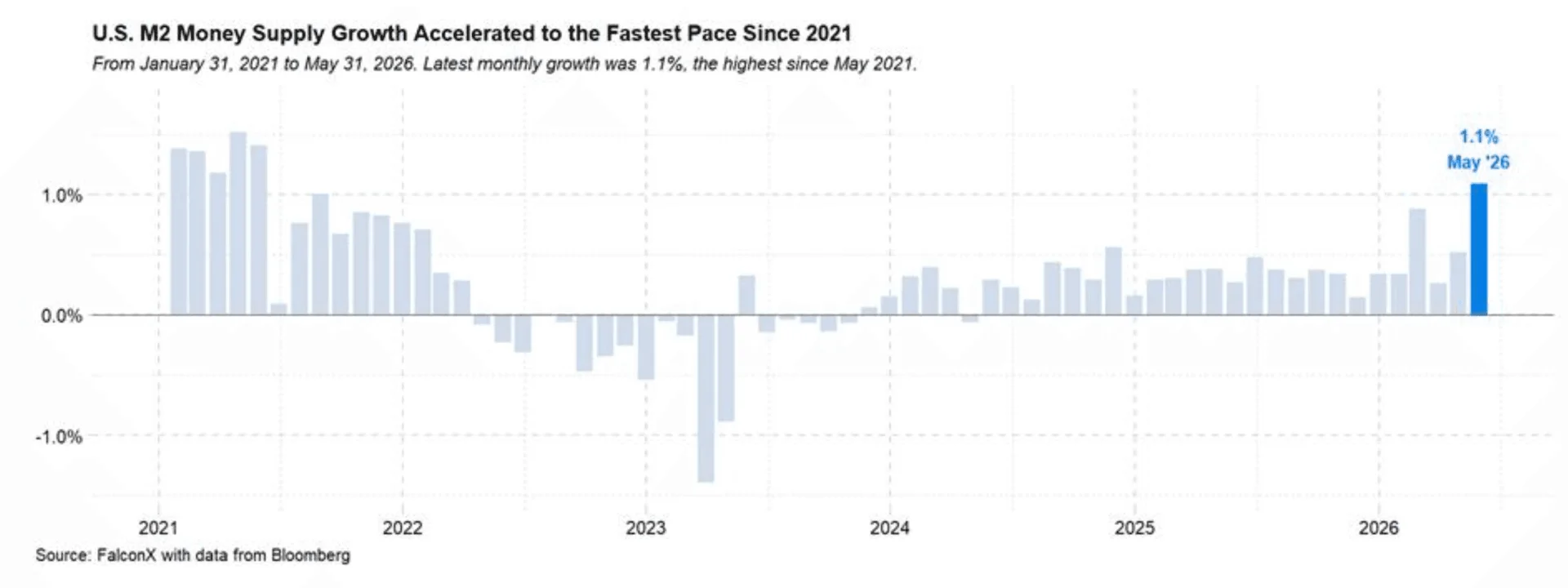
Underneath that, the macro backdrop is shifting. US money supply crossed $23 trillion for the first time in May, with month-over-month growth above 1%, the highest pace since 2021 and a marked acceleration from prior months. Bitcoin's fixed 21 million supply cap and the asset's easy portability and divisibility are properties gold cannot match, and the case for BTC as a hedge against monetary expansion is the same one allocators have leaned on for years. The argument does not require a crisis, only an environment in which the money supply is again expanding meaningfully.
Market impact
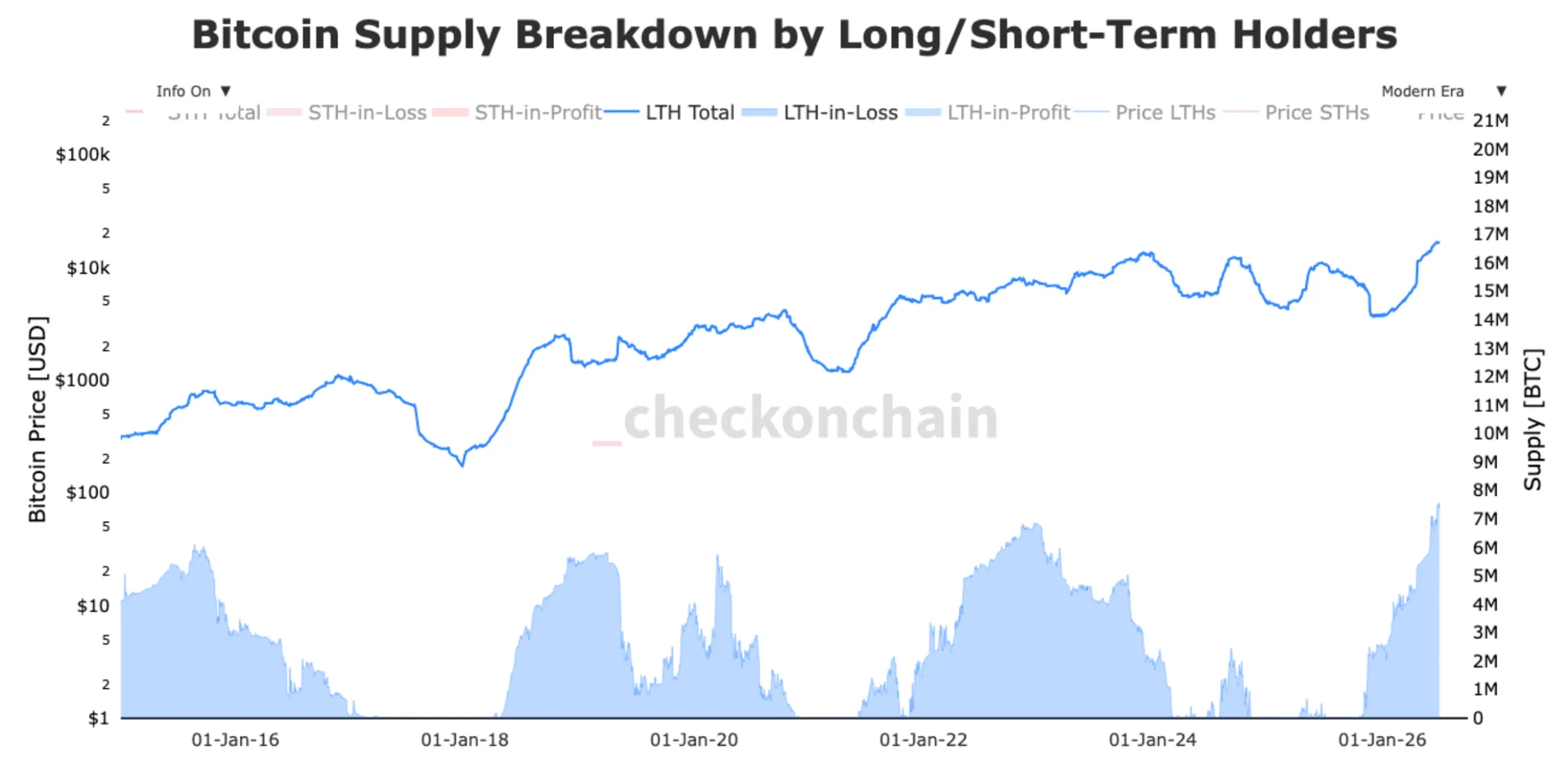
The on-chain footprint supports the bottom-call framing. Roughly 45% of long-term holder supply is sitting at a loss per Checkonchain, a level Gaspar flags as consistent with prior BTC cycle floors, and long-term holder BTC supply has climbed to a record high in recent weeks. Movements of longer-held coins have also abated from last year's pace, easing one of the heavier supply overhangs that weighed on price through 2025.
The forward question is what happens when the headwinds of the last nine months rotate into tailwinds.

Frequently asked questions
-
What is FalconX saying about the BTC market bottom?
FalconX senior strategist Martin Gaspar argues BTC's drawdown since October has been driven by external headwinds, not weakening fundamentals, and that classic bottom signals, including under-water long-term holder supply and easing ETF outflows, are now lining up.
-
How much have spot BTC ETFs lost year-to-date?
Spot BTC ETFs recorded about $5.4 billion in net outflows YTD through June 30, according to FalconX. Gaspar flags that $8.2 billion of that total exited since May 12, a window he ties to MSTR concerns and capital rotation around the SpaceX IPO.
-
Why is the Coinbase premium important here?
The Coinbase premium tracks the gap between BTC's price on Coinbase and on offshore venues, and is read as a proxy for US dollar buying pressure. FalconX notes it has improved meaningfully since quarter-end, suggesting US investor appetite is returning even as headline ETF flows remain negative.
-
How much of BTC's long-term holder supply is underwater?
Roughly 45% of long-term holder BTC supply is currently sitting at a loss, per data from Checkonchain cited by FalconX. The firm flags that level as consistent with prior BTC cycle floors.
-
Why does US money supply growth matter for BTC?
US money supply crossed $23 trillion for the first time in May, with month-over-month growth above 1%, the fastest pace since 2021. FalconX frames BTC's fixed 21 million supply cap, portability, and divisibility as properties that make it a cleaner hedge against monetary expansion than gold.
 Whale Alert
 WuBlockchain
 Crypto News
 Lookonchain
 Altcoin Daily
 CryptoSlate