








 CoinDesk
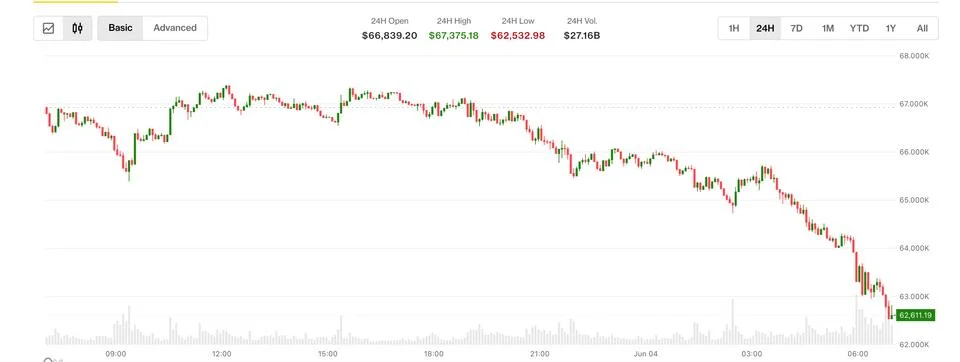



Bitcoin fell to roughly $63,000 on Wednesday, its lowest level since February, extending a weekly slide of more than 14% and a four-week drawdown of about 21%. The drop dragged the 30-day implied volatility index BVIV to 53.17, the highest reading since early April, as traders piled into protective options and pushed the fear gauge sharply higher.
The price action is now confirmed by flows: investors pulled another $50 million from US-listed spot Bitcoin ETFs on Wednesday, marking the 13th consecutive trading day of outflows from the vehicles that launched in January 2024 and have served as the cleanest read on institutional demand. The streak, the longest since the products went live, has stripped several billion dollars from the complex and is the structural counterpart to the tape.
Why it matters
The combination of a price floor breaking and persistent ETF redemptions changes the character of the move — this is no longer a leveraged long flush, it's an institutional de-risking cycle. Paul Howard, senior director at liquidity provider Wincent, framed the dynamic in an emailed note: "A broad sell-off in crypto, which started with Strategy's transfer triggering ETF outflows and is now fueled by speculative news about Mt. Gox liquidations, signals a potential continued sell-off. BTC at $50k is a level some are starting to talk about as a bottom this year." He added that the absence of fresh catalysts and a rotation of liquidity into AI-themed tech is removing the marginal buyer from the BTC tape.
Market impact
The technical levels traders are watching now sit below the current price rather than above. Analysts at Material Indicators pointed to the low-$60,000 region as the first major decision zone: the February local low of $59,900 and the 200-week moving average are clustering in the same area, and a break below would open the door to the $50,000 conversation Howard flagged. The February crash nearly tested that band on some exchanges before the sell-off ran out of steam, which is why traders treat it as the last meaningful bid zone before a deeper reset.

Frequently asked questions
-
Why did Bitcoin fall below $63,000?
Bitcoin slid to roughly $63,000 on Wednesday, its lowest level since February, extending a weekly drop of more than 14% and a four-week decline of about 21%, with the move confirmed by 13 consecutive days of outflows from US-listed spot Bitcoin ETFs.
-
How long have spot Bitcoin ETFs been seeing outflows?
Investors pulled another $50 million from US-listed spot Bitcoin ETFs on Wednesday, marking the 13th consecutive trading day of outflows — the longest streak since the products launched in January 2024.
-
What is BVIV and what did it signal during the selloff?
BVIV is the 30-day implied volatility index for Bitcoin, and it climbed to 53.17 on Wednesday — its highest reading since early April — as traders rushed into protective options amid the drawdown.
-
What levels are traders watching as potential support?
Analysts at Material Indicators flagged the low-$60,000 region as the first major decision zone, where the February local low near $59,900 and the 200-week moving average are clustering. A break below would open the door to a $50,000 floor conversation.
-
What is the Mt. Gox overhang and why does it matter now?
Creditors of the defunct Mt. Gox exchange are still owed large Bitcoin distributions, and the market has been weighing speculative news of imminent liquidations. Wincent's Paul Howard cited those concerns, alongside Strategy's recent transfer and AI-sector liquidity rotation, as the key drags on price.
 CryptoSlate
 Crypto News
 WatcherGuru
 Lookonchain
 Crypto Rank News
 Benjamin Cowen
 CoinTelegraph
 TheBlock